Serengeti Calving Season: Why January to March Is East Africa’s Best Kept Secret
Ask most safari travelers when to visit the Serengeti, and the majority will say July or August—the Mara River crossing season, the height of the Great Migration spectacle. What most of them do not know is that January through March delivers a wildlife experience that many experienced East Africa hands consider superior, more intimate, and more emotionally resonant than the famous crossings. The wildebeest calving season in the southern Serengeti and Ndutu area is East Africa’s most underrated major wildlife event, and the travelers who discover it rarely return to the Serengeti in any other month.
What the Calving Season Actually Involves
The Numbers and the Intensity
Half a Million Calves in Three Weeks
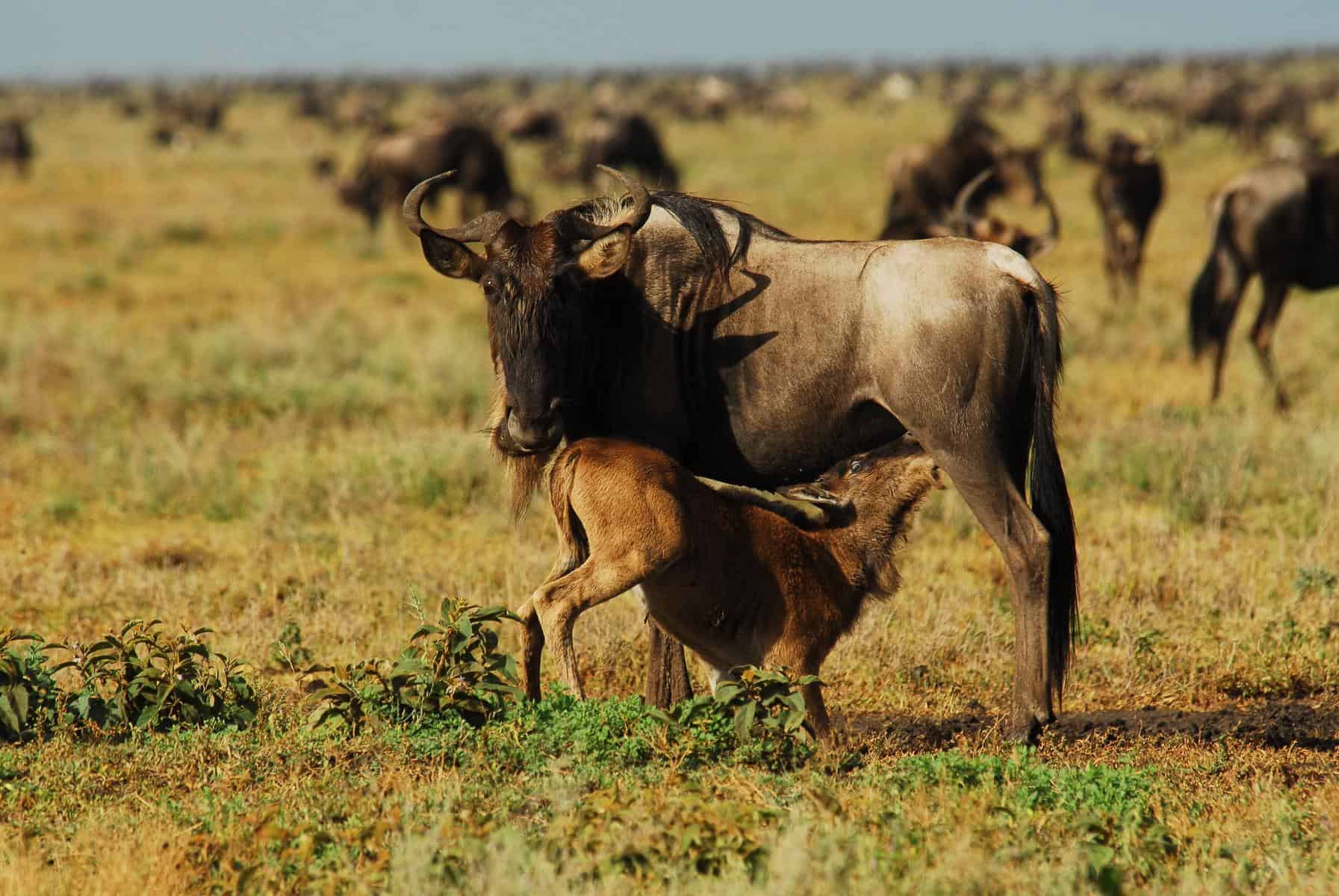
The wildebeest calving season concentrates between 400,000 and 500,000 births into a three-to-four-week window between mid-January and mid-February, with the synchronized breeding cycles of the 1.5 million wildebeest in the Great Migration herd driving this timing. The synchronization is evolutionary adaptation rather than coincidence—by concentrating births into the same window, wildebeest calves overwhelm the ecosystem’s predator capacity, ensuring enough calves survive the first critical hours to sustain the population. A cheetah can kill three calves per day at maximum. When 10,000 calves arrive on a single morning across the Ndutu Plains, predator saturation means that many calves survive simply because predators cannot eat fast enough.
The result of this concentration is a density of newborn wildebeest calves, nursing mothers, predators in a feeding frenzy, and territorial displays across the southern Serengeti’s short grass plains that creates a continuous wildlife narrative from dawn until dark. Every direction from the vehicle holds a story in progress—a cheetah stalking a calf fifty meters to the left, a hyena clan trotting purposefully toward a wildebeest group on the horizon, and a golden jackal pair working the edge of a newborn cluster. The calving season’s intensity comes not from single explosive moments—the river crossing’s drama—but from the relentless accumulation of individual life-and-death moments playing out simultaneously across miles of open plain.
Predator Diversity and Hunting Success Rates
The calving season delivers the highest predator hunting success rates observable anywhere in the Serengeti ecosystem at any time of year. Cheetahs, whose hunting success on adult impala or Thomson’s gazelle averages approximately 50 percent, achieve success rates above 90 percent hunting calves during the peak calving window. This means that almost every cheetah hunt you observe on the Ndutu Plains in late January or February results in a kill—a transformative shift from game drive dynamics in other seasons, where an unsuccessful hunt is considerably more common than witnessing a kill. Multiple cheetah hunts per morning during peak calving season is realistic, and experienced guides position the vehicle to observe both the stalk and the chase without disturbing either animal.
Wild dogs, if a pack is denning in the Ndutu area during the calving season, run dawn hunts that cover the calving ground at full pack speed. The pack’s coordinated pursuit of a small wildebeest group—driving them toward a pinch point while flanking members cut off escape—is one of Africa’s most impressive predator strategies executed visibly on open ground. Wild dog den activity during the calving season requires the right pack territory at the right time, but when it aligns, a morning den visit followed by a pack hunt across the calving grounds is the Serengeti calving season’s most sought-after experience. African Wild Trekkers’ guiding team tracks wild dog den locations in the Ndutu area each season and incorporates them into itineraries when the pack’s position permits.
The Calving Season vs the Mara River Crossings
Comparing East Africa’s Two Great Migration Spectacles
Why Experienced Safari Travellers Prefer the Calving Season
The Mara River crossings that draw the largest percentage of Serengeti visitors in July and August are unquestionably dramatic. Thousands of wildebeest plunge into crocodile-infested water in a panic-driven stampede, with the sound of hooves and the foam of the river and crocodiles exploding from the surface—this is one of Africa’s most cinematically powerful wildlife moments. First-time safari travelers who witness a Mara River crossing describe it as unlike anything they have experienced in any natural environment. The crossing’s immediate visual impact is extraordinary, and the shared experience among spectators creates an emotional environment that is itself part of the spectacle.
The calving season lacks the crossing’s explosive singularity. There is no single moment when everything happens at once. Instead, the calving season delivers a sustained, layered experience that rewards attention, patience, and the ability to read the landscape’s multiple simultaneous narratives. A guide who can read the behavior of a cheetah at 500 meters, identify the wildebeest group most likely to calve within the next hour from the posture of the females, and position the vehicle to observe a jackal’s territorial boundary without affecting either the jackal or the nearby cheetah family is delivering the calving season’s real value. This interpretive depth is what experienced safari travelers return for repeatedly and what differentiates the calving season from the crossings as a recurring destination.
Visitor Numbers in January-March Versus July-August
The calving season carries significantly fewer vehicles per sighting than the Mara River crossing season. July and August bring Tanzania’s peak visitor numbers and park vehicle concentrations that rival Kenya’s Masai Mara—popular lion prides in the central Seronera area can attract eight to fifteen vehicles simultaneously, and the Mara River crossing points draw dozens of vehicles from both sides of the river during active crossing events. The January-March calving season sees a fraction of this visitor volume. The Ndutu Plains during peak calving host perhaps fifteen to twenty percent of the visitor numbers that the same area’s equivalent location receives in the peak dry season, and game drives frequently result in sole-vehicle sightings of cheetah hunts that in July would attract a parade of safari vehicles converging by radio.
This lower visitor density is itself a major reason experienced African safari travelers prefer the calving season. A cheetah kill witnessed by a single vehicle—guide and client watching in silence from ten meters—is fundamentally different experience from the same kill watched by eight vehicles with passengers photographing and whispering. African Wild Trekkers positions its calving season vehicles away from the radio channels that create vehicle convoys, using local knowledge to find sightings independently and enjoy them without the concentrated attention that draws more vehicles.
Practical Planning for the Calving Season
When, Where, and What to Book
Ndutu vs Seronera for Calving Season Safari
The calving season takes place primarily on the Ndutu Plains at the southern border of the Serengeti and Ngorongoro Conservation Area rather than in the central Seronera area where year-round resident predators concentrate. Ndutu-based camps offer direct access to the calving grounds without the hour-long drive from Seronera, and the short-grass terrain around Lakes Ndutu and Masek positions clients within the heart of the calving concentration rather than accessing it from a distance. The Ndutu area camps are smaller than the Serengeti’s main camps, typically housing eight to sixteen guests, which means the game drive vehicles from any single camp cover the plains without significant overlap.
A combined itinerary that places three nights in Ndutu followed by two nights in the central Serengeti near Seronera delivers the best of both calving season and year-round predator watching in a single five-night Serengeti circuit. Ndutu delivers the calving intensity; Seronera delivers the resident lion prides, the kopje leopards, and the cheetah families that hold territory between the two areas year-round. Adding a Ngorongoro Crater descent as a sixth night creates the most complete Southern Serengeti circuit available in the January-March window. African Wild Trekkers runs this five-to-six night combined circuit regularly during the calving season and adjusts the Ndutu versus Seronera time allocation based on where the calving concentration is densest during the specific visit dates.
Accommodation Options and Booking Lead Times
The Ndutu area’s limited accommodation — fewer than a dozen camps and lodges in total — means that calving season bookings fill earlier than the Serengeti’s larger inventory. Travellers planning a January-February Ndutu visit should book at least six months in advance for mid-range camps and twelve months in advance for the most sought-after properties that hold only eight to twelve beds. The calving season’s growing reputation among experienced safari travelers has increased demand significantly over the past five years, and last-minute availability in January and February is increasingly rare at desirable properties. African Wild Trekkers holds preferred booking relationships with Ndutu area camps and can access allocations that general booking channels do not reach.
The calving season also coincides with Tanzania’s shoulder pricing at most camps—the January-March window falls between the high seasons of July-October and June, and many properties offer rates ten to twenty percent below their peak season pricing during the calving months. This pricing coincidence means that the calving season delivers simultaneously the best wildlife of the year and lower accommodation costs than the famous high season. Extraordinary wildlife, lower prices, fewer vehicles, and no requirement to compete for vehicles at river crossings—this is genuinely East Africa’s best-kept secret in the literal sense. African Wild Trekkers advises all first-time Tanzania visitors who have flexibility on dates to seriously consider the calving season as the primary safari window.
Plan Your Safari
The Serengeti calving season from January through March is the wildlife event that African Wild Trekkers most enthusiastically recommends to travelers who ask about the best time to visit Tanzania. The team plans calving season itineraries annually, tracking the calving zone’s location in each specific season and positioning clients where the calving concentration is highest during their visit dates. The Ndutu area camp selection, the Seronera extension, and the Ngorongoro Crater addition are all calibrated to the calving season’s natural rhythms.
Every calving season booking includes Ndutu area camp accommodation with all activities and full board, Ngorongoro Conservation Area permits, a guide and vehicle familiar with the calving ground’s seasonal patterns, and coordination of the calving zone positioning based on the current season’s herd location. The team confirms all reservations with written confirmation numbers before any deposit is requested.
Contact African Wild Trekkers at africanwildtrekkers.com/contact with your January-March Tanzania travel dates, and we will build a personalized calving season itinerary with a full cost breakdown within 24 hours.