Ndutu Plains Tanzania: Calving Season Safari in the Southern Serengeti
The Ndutu area in the southern Serengeti-Ngorongoro Conservation Area boundary zone hosts one of Africa’s most extraordinary and least-understood wildlife events: the wildebeest calving season. Between January and March, up to half a million wildebeest calves arrive within a few weeks across the Ndutu Plains, creating a concentration of newborn animals that attracts every predator in the ecosystem. This delivers wildlife viewing of an intensity that rivals and in many ways surpasses the famous Mara River crossings of the high season. This guide explains what the calving season involves, when to visit, and how to plan a Ndutu safari that experiences the phenomenon at its peak.
The Wildebeest Calving Season at Ndutu
What Happens and Why Ndutu
The Biology of Synchronised Calving
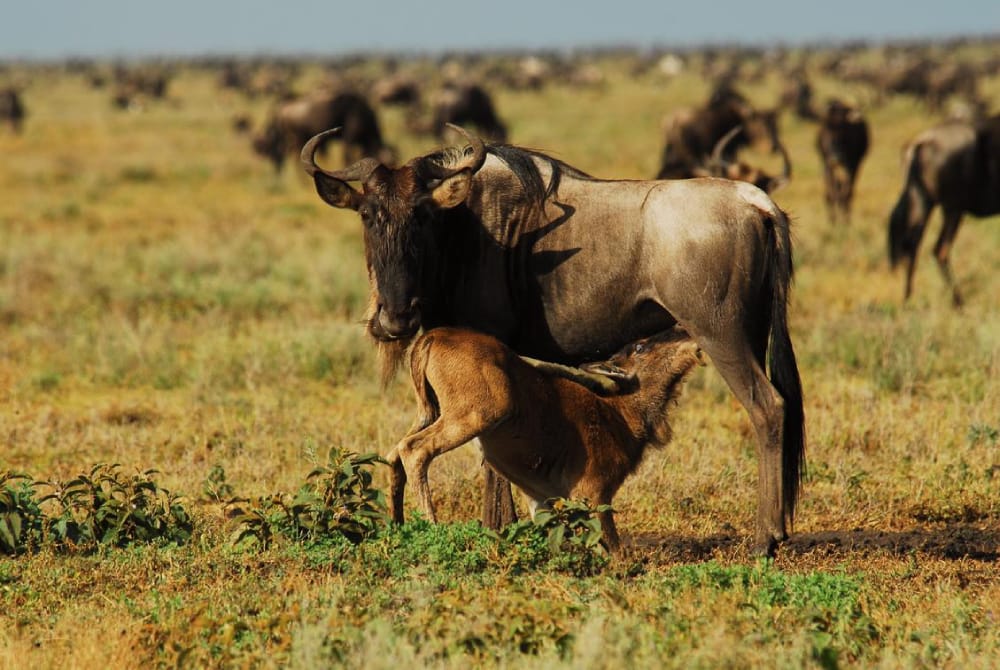
The wildebeest calving season is one of nature’s most precisely timed evolutionary adaptations. The vast majority of wildebeest births — up to 80 percent of the herd’s annual reproduction — occur within a three-to-four week window from late January through February, with hormonal cycles synchronising across millions of individuals to drive this concentrated timing. This concentrated calving overwhelms the ecosystem’s predators, ensuring that enough calves survive the first critical hours to sustain the herd’s population. A single cheetah, lion, or hyena can only catch and consume so many calves per day regardless of how many are available, so the synchronisation creates a survival window through sheer abundance that staggered births would not provide.
Ndutu’s short grass plains are the preferred calving location because the open terrain allows wildebeest mothers to see predators approaching from a distance and to monitor their calves’ vulnerability. The southern Serengeti’s short grass also grows on volcanic soils unusually rich in nutrients, creating a grazing environment that supports lactation more effectively than the longer grasses of the northern Serengeti. The calving grounds shift slightly year to year based on rainfall patterns and grass availability, but the Ndutu area — centred on Lake Ndutu, Lake Masek, and the surrounding short grass plains — consistently hosts the largest concentration of birthing wildebeest between mid-January and mid-March.
Predator Viewing During Calving Season
The density of young, vulnerable wildebeest calves on the Ndutu Plains during January and February creates a feeding bonanza for every predator species in the ecosystem. Cheetahs thrive during the calving season with success rates that far exceed their dry-season averages, as the open terrain and high prey density give them ideal hunting conditions. Multiple cheetah coalitions and mothers with cubs work the plains simultaneously, and on a single morning game drive at Ndutu during peak calving season it is realistic to see three or four separate cheetah hunts. The open landscape makes the entire chase visible from the vehicle — from the stalk through tall grass to the explosive sprint, the knockdown, and the kill. Few other environments deliver a complete predator-prey sequence with this clarity.
Lions and hyenas take calves with even less effort during calving season — a lioness lying in the short grass at Ndutu in February can make a kill without moving more than fifty metres. The hyena clans that follow the wildebeest migration north from Ndutu maintain enormous clan territories on the southern plains during calving season, and dawn drives reveal hyenas returning to their dens with the evidence of successful night hunts. Jackal pairs coordinate to separate calves from their mothers at the herd edge, with one jackal distracting the mother while the other makes the approach. Wild dogs, if a pack’s territory overlaps the calving grounds, run dawn hunts covering kilometres of open plain and return with full bellies to the den where pups wait. The Ndutu calving season concentrates the Serengeti’s predator diversity and hunting frequency into a period that many experienced Africa safari travellers identify as the single most compelling wildlife spectacle they have witnessed.
Planning a Ndutu Calving Season Safari
Timing and Camps in the Ndutu Area
When to Visit Ndutu for the Calving Season
The peak calving period at Ndutu runs from mid-January through mid-February in most years, with the exact timing varying by three to four weeks depending on the previous year’s rainfall patterns and when the wildebeest herd completed its October-November southward migration. Late January and the first two weeks of February typically deliver the highest calf density and the most intense predator activity. The calving tails off through March as the surviving calves grow stronger and the herd begins its gradual movement northward toward the central Serengeti. March visits still deliver excellent calving season remnants — young calves on the run, large predator groups in the transition zone — but the peak concentration of newborns is past.
The Ndutu calving season overlaps with Tanzania’s short rains, which typically end in December. The southern Serengeti in January and February is the greenest and most lush it will be all year — the plains glow with fresh growth after the rains, and the photographic light differs dramatically from the dry season’s brown and dusty palette. The green landscape contrasts with the tawny predators and makes the calving season a visually spectacular photographic period even before considering the wildlife intensity. African Wild Trekkers runs dedicated calving season Ndutu itineraries timed to the peak period, adjusting the exact dates each year based on the wildlife team’s on-the-ground assessment of where the calving concentration is highest.
Camps in the Ndutu Area
The Ndutu area falls within the Ngorongoro Conservation Area rather than the Serengeti National Park proper, and the conservation area’s permit structure allows a small number of permanent camps in the Ndutu region that operate under different regulations from the Serengeti’s camps. The Ndutu Safari Lodge is the most established property in the area, positioned on the shore of Lake Ndutu within walking distance of the lake’s hippo pool and offering veranda game viewing that makes wildlife sightings possible from the dining room table. Several seasonal and semi-permanent camps also operate in the Ndutu area during the calving season, ranging from permanent canvas structures to mobile camps that relocate between seasons to follow the best wildlife.
The Ndutu camps are positioned specifically to maximise access to the short grass calving plains, and most offer game drives that begin within minutes of the camp boundary. The camp circuit for a Ndutu calving season safari differs from a standard Serengeti circuit because the focus is on covering the calving ground methodically rather than making long drives between distant sighting areas. Short drives and long stops at productive calving concentrations — watching a pride of lions work through a cluster of birthing wildebeest, or a cheetah mother demonstrating the hunt to cubs she is teaching to stalk — deliver more of what the calving season offers than the long transit drives that characterise a dry-season Serengeti circuit.
How Ndutu Compares to the Mara River Crossings
Two Completely Different Spectacles
Calving Season vs River Crossings: Which Is Better?
The Mara River crossings between July and September and the Ndutu calving season between January and March are the two peaks of the Great Migration’s annual cycle, and comparing them is genuinely difficult because they deliver completely different experiences. The river crossings are sudden, explosive, and communal — thousands of wildebeest plunging into a crocodile-filled river in a shared panic that generates noise, spray, and a visceral drama that no other wildlife context replicates. The calving season is steady, complex, and intimate — the constant low-level drama of births, predator hunts, calf deaths, and calf survival unfolding across miles of open plain over days rather than minutes, building cumulative emotional intensity that the crossings’ brief explosions cannot provide in the same way.
Travellers who have experienced both consistently say that the calving season is the more sophisticated spectacle — it rewards patience and attention to detail in ways that the crossing’s immediate drama does not require. A crossing is unmistakably dramatic the moment it begins. The calving season delivers its best moments to people who sit quietly with a guide for forty-five minutes watching a cheetah stalk, who understand why the hyena’s angle of approach shifts three times before the run, and who notice the wildebeest mother’s behaviour change the moment she realises her calf cannot keep pace with the herd. African Wild Trekkers guides the Ndutu calving season with exactly this level of interpretive attention, making the experience as intellectually satisfying as it is visually extraordinary.
Plan Your Safari
The Ndutu calving season is East Africa’s most underrated major wildlife event and one that African Wild Trekkers recommends specifically to travellers who have already seen the Mara River crossings or who travel in the January-March window when the northern circuit’s dry season advantages are months away. The team builds dedicated calving season itineraries that position clients in the Ndutu area during the peak two-to-three week window, combining calving plain game drives with Ngorongoro Crater access and optional Serengeti extension nights.
Every Ndutu calving season booking includes the Ndutu camp accommodation with all activities and full board, the Ngorongoro Conservation Area permit, and the guide and vehicle for all game drives. The team adjusts the exact camp dates each year based on the herd’s calving position in the specific season, and advises clients in advance if the peak timing appears to shift from the typical January-February window. The team confirms all reservations in writing before any deposit is requested.
Contact African Wild Trekkers at africanwildtrekkers.com/contact with your January-March travel dates and we will build a personalised Ndutu calving season itinerary with full cost breakdown within 24 hours.