Coke’s Hartebeest Facts: The Long-Faced Antelope of East Africa’s Plains
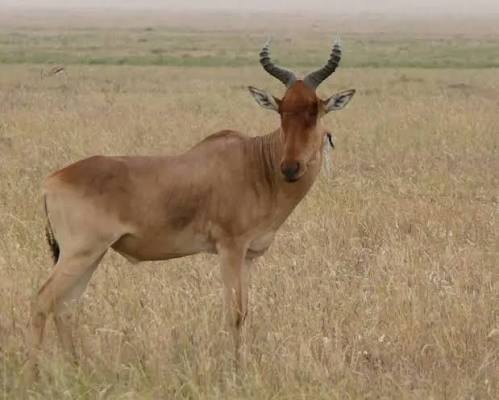
The hartebeest’s appearance generates strong opinions. Its face is absurdly elongated. hindquarters slope steeply downward from a high shoulder. Its bracket-shaped horns grow upward from a common pedicle and curve outward and backward in a shape that no other antelope replicates. Many visitors call it awkward. Biologists call it efficient. The hartebeest is among the most endurance-capable of East Africa’s plains antelopes its cardiovascular system and limb proportions allow sustained running at speed for distances that exhaust most predators. The odd shape is the result of optimisation, not accident.
What Is Coke’s Hartebeest?
Coke’s hartebeest, Alcelaphus buselaphus cokii, is the East African subspecies of the red hartebeest complex. Adults weigh between 116 and 218 kilograms. Shoulder height reaches 1.1 to 1.3 metres the shoulder is distinctly higher than the hindquarters, creating the characteristic sloping back profile. Both sexes carry horns the distinctive bracket-shaped horns grow from a common pedicle at the top of the elongated face, curving upward, outward, and then backward. Horn length reaches 45 to 70 centimetres. The coat is pale tawny-brown with a white rump patch and black face, leg, and shoulder markings.
The elongated muzzle and the bracket-horn configuration together give the hartebeest a frontal profile unlike any other antelope. The pedicle the bony base shared by both horns rises from the top of the skull as a distinct projection before the horns branch from it. This structure gives the hartebeest skull a characteristic H-shape when viewed from the front.
Sentinel Behaviour and Open Country Living
Hartebeests are open-country specialists. They favour open short-grass plains and lightly wooded savanna where visibility is high and sustained running is possible. Like the topi, hartebeest males use termite mounds, raised ground, and fallen tree trunks as elevated observation platforms standing high to survey the surrounding plains for predators. The elevated position adds metres to the effective detection range of incoming predators across flat terrain.
Hartebeest herds respond to predator detection with a specific sequence. The alerted individual stares at the threat and stamps a forefoot. Others in the herd orient to the alerted individual’s gaze direction. The herd then moves away from the threat at a trot, increasing to a full run if the predator approaches. Hartebeests are highly social alarm-communicated animals the single alerted individual’s response triggers the herd’s response without any vocal call.
Diet and Grazing Specialisation
Hartebeests are grazers. Medium to tall grass makes up the bulk of the diet, with preference for the mid-section of grass stems rather than the tips or the base. This feeding position within the grass sward reduces competition with shorter-muzzled grazers that take the top of the grass and with ground-feeding species that take the base. The elongated muzzle is an adaptation for selective grazing at the mid-stem position allowing the hartebeest to reach into dense grass and select specific growth stages.
Range in East Africa
Coke’s hartebeest ranges across the open savanna of Kenya and northern Tanzania. The Maasai Mara, Amboseli, Tsavo, and the Rift Valley grasslands all hold populations. Tanzania’s Serengeti and the Ngorongoro Conservation Area carry hartebeests on the open plains. Uganda’s Kidepo Valley National Park in the far northeast holds a small population in its open savanna ecosystem.
Plan Your Safari
Kenya’s Maasai Mara and Amboseli produce the most reliable Coke’s hartebeest encounters in East Africa. Open-plain game drives in the early morning, when hartebeests are actively grazing and males are on their termite mound sentinel posts, deliver the best observations. Tanzania’s Ngorongoro Crater floor holds a resident hartebeest population alongside wildebeest, zebra, and other plains grazers the closed crater environment allows sustained observation of territorial behaviour throughout the day.
African Wild Trekkers designs Kenya and Tanzania safari itineraries through open-plain habitats where hartebeest, topi, wildebeest, and the full plains antelope community coexist. Contact us to plan a safari exploring the grassland ecosystem in depth.