Topi Facts Africa: The Vigilant Antelope of East Africa’s Open Plains
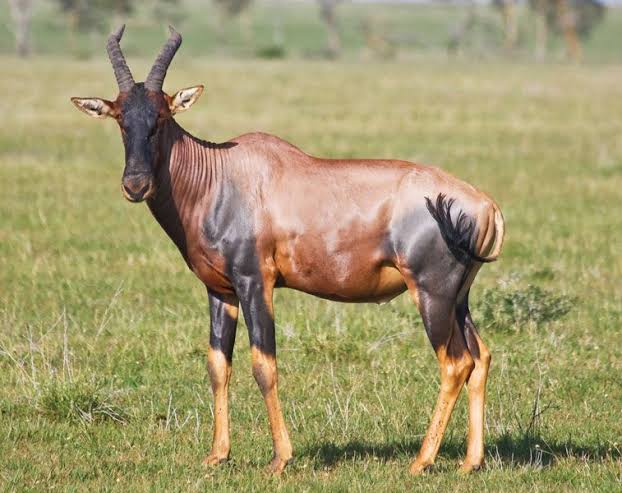
The topi is one of the most vigilant antelopes in East Africa. A territorial male stands alone on a termite mound or raised patch of ground, surveying the surrounding plains in all directions while his herd feeds below. This elevated sentinel position sometimes maintained for hours gives the topi’s territory early warning of predator approach that any purely ground-level grazer cannot match. The termite mound display platform is so characteristic that a single elevated, dark-shouldered antelope silhouetted against a Maasai Mara horizon is almost always a topi male at his territorial station.
What Is a Topi?
The topi, Damaliscus lunatus jimela, is a subspecies of the same Damaliscus genus that includes the tsessebe, the blesbok, and the bontebok. Adults weigh between 96 and 160 kilograms. Shoulder height reaches 100 to 130 centimetres. Both sexes carry lyre-curved horns with strongly ridged surfaces, reaching 37 to 70 centimetres. The coat is reddish-brown with dark, metallic blue-black patches on the shoulders, upper forelegs, and thighs a distinctive two-tone colouration that makes the topi easy to distinguish from other savanna antelopes at distance. The face is elongated with a distinct downward slope from shoulder to hindquarters.
Territorial Behaviour and the Termite Mound
Male topi hold territories during the breeding season. The termite mound functions as the territory’s focal display point. A territorial male stands on the mound during the day, maintaining a posture of alertness that communicates occupancy to neighbouring males and to females moving through the territory. The elevation gives him a 360-degree predator detection advantage. Any predator approaching across flat grassland appears in his sightline while still at safe distance the mound turns the male’s sentinel vigilance into a resource that benefits the entire herd grazing nearby.
When two territorial males meet at a boundary, they perform a parallel walk display standing side by side, walking slowly in the same direction, assessing each other through posture and horn angle. Most boundary disputes resolve through display rather than physical combat. Horn-locking fights do occur and can be intense topi fights leave combatants exhausted after bouts lasting 10 to 15 minutes.
Breeding System: Lek and Non-Lek Populations
Topi breeding systems vary by habitat and population density. In areas of high density like parts of the Maasai Mara males establish lek arenas where tight clusters of small territories attract females for mating, paralleling the Uganda kob’s lek system. In lower-density areas, males hold larger dispersed territories.
Range in East Africa
Topi range across the open grasslands of Kenya, Tanzania, Uganda, and Rwanda. The Maasai Mara holds one of the largest East Africa topi populations thousands of animals mix with the wildebeest migration herds on the open plains. Tanzania’s Serengeti northern and western zones hold significant populations. Uganda’s Queen Elizabeth open grasslands support topi alongside Uganda kob. Rwanda’s Akagera savanna carries a resident topi population on the open grassland sectors.
Plan Your Safari
The Maasai Mara is the most productive East Africa topi destination. Mara North and Naboisho conservancies hold large topi populations with visible termite mound territorial displays year-round. During the rutting season, lek areas concentrate dozens of competing males in a small area — one of East Africa’s most dramatic antelope behaviour spectacles. Tanzania’s Serengeti northern zone produces topi encounters on the same plains as wildebeest, zebra, and Thomson’s gazelle.
African Wild Trekkers designs Maasai Mara and Serengeti safari itineraries that include dedicated antelope behaviour observation alongside the major wildlife spectacles. Contact us to plan a Kenya or Tanzania safari that reveals the plains antelope community in depth.