African Penguin Facts: The Only Penguin to Breed in Africa
Penguins in Africa
Most travelers arrive in Africa expecting lions, leopards, elephants, giraffes, and rhinos. They are genuinely surprised to discover that one of the continent’s most charismatic and accessible wildlife experiences involves penguins waddling across a beach thirty minutes from Cape Town. The African penguin — also called the jackass penguin for its braying call that sounds startlingly like a donkey — is the only penguin species that breeds on the African continent. Its colonies on the Western Cape coast and on islands along South Africa’s coastline offer some of the most accessible large-animal wildlife encounters in all of Africa. The experience of sitting on a beach at Boulders in Simon’s Town while African penguins walk within meters of your feet is one of those wildlife moments that lands with unexpected force regardless of what else a traveler has seen.
The IUCN classifies the African penguin as Endangered. The global population has collapsed from approximately 1.5 million breeding pairs in the early 1900s to roughly 25,000 breeding pairs today. A decline of more than 98 percent in just over a century. Egg collection, guano harvesting that destroyed nesting habitats, and oil spills. And competition with commercial fishing for anchovy and sardine prey has all driven this catastrophic decline. Climate change has also shifted fish distributions away from traditional penguin foraging ranges. The species may be one of the most rapidly declining seabirds in the world. Without significant intervention, the population trajectory raises serious concern about long-term viability. Every traveler who visits an African penguin colony and pays the conservation levy embedded in their entry fee contributes to the protection programs keeping the species alive.
African Penguin Biology
Adaptation to the African Coast
Physical Adaptations and Thermoregulation
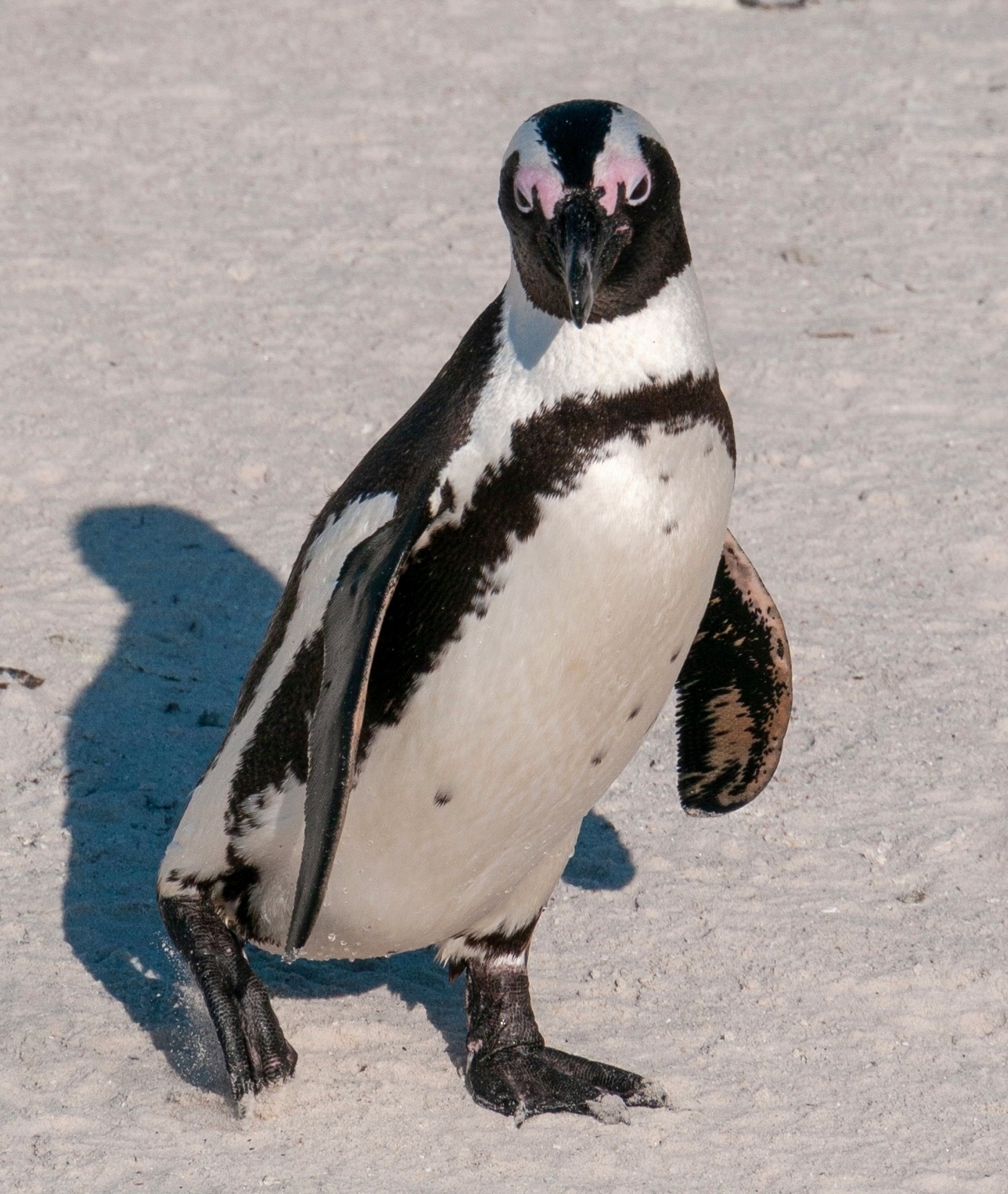
The African penguin is a medium-sized penguin—approximately 60 to 70 centimeters tall and weighing 2.2 to 3.5 kilograms. It has the classic black-and-white countershading that characterizes most penguin species. The black back and white front provide camouflage from predators both above and below. From the surface, the dark back blends with the dark ocean. From below, the white belly is less visible against the bright sky. The African penguin’s distinguishing features include a black band across the chest and pink glandular patches above the eyes that flush darker when the bird is hot. These patches provide a visible thermoregulation signal. A speckled pattern of individual spots on the white chest is unique to each individual. Like a fingerprint. Allowing researchers to identify specific birds from photographs.
Thermoregulation in a warm-climate penguin presents different challenges than in Antarctic species. African penguins evolved in the cold Benguela Current upwelling zone along South Africa’s west coast. This current brings cold, nutrient-rich water from depth to the surface, supporting the enormous anchovy and sardine populations that African penguins historically depended on. The birds are well insulated against cold water for foraging. But on land — particularly during the warmest months of November through February — they can overheat. The pink supraorbital glands behind the eyes function partly as heat radiators, flushing more blood to the skin surface when the bird is warm. Colonies typically have access to shaded rock overhangs, dense bushes, and burrowed nesting sites. These allow birds to retreat from direct sun during the hottest hours of the day.
Breeding, Nesting, and Chick Development
African penguins breed year-round, with peak breeding varying by colony location. At Boulders Beach and Betty’s Bay. The largest and most accessible Cape colonies. Most breeding occurs between March and May and October and November. But active nests with eggs or chicks are present throughout the year. Pairs are monogamous and breed in the same burrow site repeatedly across years. Both parents share incubation and chick-feeding responsibilities. The nesting burrow—ideally excavated in guano-compacted earth that provides insulation and protection from sun and predators—neighbors defend vigorously. This produces the constant squabbling and vocalizing that makes an active penguin colony such an entertaining place to spend an hour.
Chick growth from hatching to independence takes approximately 70 days. During this period, both parents make regular foraging trips to sea and return to feed the chick regurgitated fish. When the chick reaches independence, it enters the sea in its juvenile plumage. Entirely blue-grey above and white below, with no black markings. It typically disperses several hundred kilometers from the birth colony before returning to molt into adult plumage. Juveniles return to their birth colony to breed for the first time at three to four years of age. This shows the high site fidelity that makes established colonies like Boulders persistent over many decades. The disruption of traditional breeding sites. Through development, predation, or the removal of the guano substrate that burrows require, it is particularly damaging. Displaced pairs rarely establish equivalent breeding success at alternative locations.
Best Places to See African Penguins
Cape Peninsula and West Coast Colonies
Boulders Beach, Simon’s Town
Boulders Beach in Simon’s Town, 40 kilometers from Cape Town along the False Bay coast, is the most visited and most accessible African penguin colony in the world. The colony established itself at Boulders in the early 1980s and has grown to approximately 2,000 birds. It is managed by South African National Parks and accessible via a boardwalk system that allows close-range viewing without disturbing breeding birds. Visitors can walk on a designated beach section where penguins move freely around human visitors. This produces the intimate encounter that makes Boulders one of South Africa’s most reliable family-friendly wildlife experiences. The colony is active year-round. The presence of chicks from October through February adds a dimension of parental behavior. Feeding, thermoregulating. And protecting from predators. That enriches the observation considerably.
Simon’s Town is easily reached by train from Cape Town along the False Bay coast. One of the world’s great scenic rail journeys. This makes the Boulders penguin colony accessible even without a hired car. The combination of a Cape Town city visit and the Cape Peninsula drive (Cape Point, Chapman’s Peak, Hout Bay). And a Boulder’s penguin encounter fits comfortably into a single day from the city. It consistently ranks as one of the most satisfying South African day trips available to travelers based in Cape Town. Travelers on multi-day Cape Peninsula itineraries can combine Boulders with a visit to Betty’s Bay on the opposite side of False Bay. The Stony Point colony near Betty’s Bay is the second largest mainland African penguin colony. It offers a slightly more natural and less crowded viewing experience than Boulders.
Island Colonies and the Conservation Context
The majority of the African penguin breeding population nests on offshore islands rather than mainland colonies. Dassen Island is off the West Coast north of Cape Town, and Robben Island is in Table Bay. And the islands of Algoa Bay near Port Elizabeth all host the largest breeding aggregations. St. Croix Island in Algoa Bay holds the largest colony in the world. These islands are accessible only through limited permit systems or conservation research contexts. The Algoa Bay islands in particular are not accessible to standard tourist visits. This means that the mainland colonies are at Boulders, Betty’s Bay. And several smaller sites along the Cape coast are the primary viewing opportunities for most travelers. This limitation makes the mainland colonies more precious as accessible points of contact between the public and a species in urgent conservation need.
The Southern African Foundation for the Conservation of Coastal Birds (SANCCOB) runs a seabird rehabilitation center in Cape Town. It treats oiled, injured, and orphaned African penguins—including the survivors of the Treasure oil spill of 2000. In that event, SANCCOB coordinated the rescue and rehabilitation of over 40,000 birds in the largest seabird rescue in history. Visitor tours of the SANCCOB facility provide context for the conservation challenges the species faces. They also allow travelers to observe rehabilitation work directly. The center is one of the most effective ways for visitors to understand the mechanisms of African penguin conservation beyond what a simple colony visit communicates. Many travelers find that the rehabilitation context adds significant meaning to the subsequent encounter with the birds on the beach at Boulders.
Plan Your Safari
A Boulders Beach penguin visit fits seamlessly into any Cape Town or Cape Peninsula itinerary. It adds an entirely unexpected wildlife encounter to a South Africa safari that has been otherwise focused on the Kruger, the Garden Route, or the Winelands. Most Cape Town visitors are surprised by how much the penguin encounter resonates relative to its accessibility and its modest scale.
African Wild Trekkers builds Cape Peninsula excursions. Including Boulders Beach, Cape Point. And Cape of Good Hope. Into South Africa itineraries as a standard complement to Kruger and Garden Route game viewing. This ensures travelers experience the full range of South Africa’s exceptional wildlife rather than only the savanna component.
Contact African Wild Trekkers at africanwildtrekkers.com/contact with your South Africa travel dates, and we will design an itinerary that includes the Cape Peninsula’s African penguin colonies alongside Kruger and the country’s broader safari experiences within 24 hours.