African Fish Eagle Facts: The National Bird Behind the Sound of Africa
The Sound of Africa
The call of the African fish eagle is one of the most evocative sounds in nature. A far-carrying, yelping cry that carries across lake and river surfaces and defines the atmosphere of Africa’s waterways as completely as any visual image. Most travelers who hear the call for the first time on a boat safari or a lakeside morning stop entirely. And many describe it as the single sound that most powerfully connects them to the continent. The African fish eagle is the national bird of four African countries. Zimbabwe, Zambia, and South Sudan. And Namibia. Serves as the national emblem of several more and appears on more African currency and national insignia than any other bird. Its visual authority — the white head, rust-brown body, and black wings of an adult bird perched on a dead tree over an African lake — rivals the bald eagle as an avian national symbol anywhere in the world, and its call surpasses it in emotional impact.
The African fish eagle is a large raptor. Adults span 175 centimeters in wingspan and weigh up to 3.6 kilograms. That inhabits large lakes, rivers, and estuaries. And large reservoirs throughout sub-Saharan Africa wherever sufficient fish biomass supports a breeding pair’s territory. It is one of Africa’s most reliably seen birds on any safari or boat trip near water. And the combination of its visual distinctiveness and its iconic call. And its spectacular aerial fish-strike hunting behavior makes it one of the first birds that any first-time Africa visitor learns to recognize and one that never loses its power to impress on subsequent visits.
African Fish Eagle Biology
Hunting, Diet, and Territory
The Fishing Strike
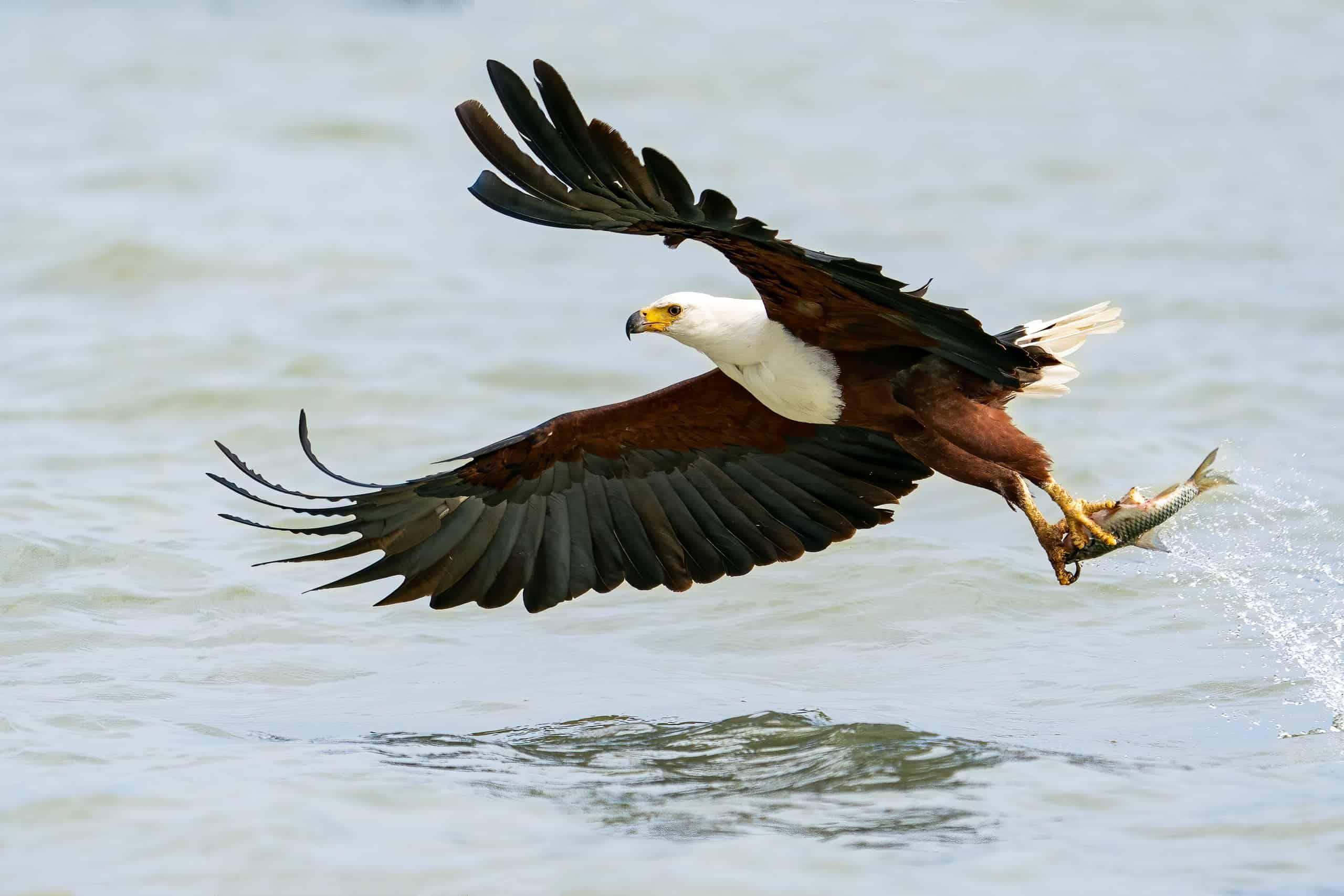
The African fish eagle hunts almost exclusively by swooping from a perch to seize fish from within the top 30 centimeters of the water surface. The hunting sequence is one of the most spectacular in African birdlife: the eagle drops from its perch in a steep dive and extends its talons forward at the last moment. And closes the powerful curved claws around a fish visible near the surface. If the fish is small enough, the eagle carries it directly back to the perch or to a feeding tree. If the fish is large. Fish eagle prey can weigh up to 3 kilograms, occasionally close to the eagle’s own body mass. The bird may drag it below the surface briefly before releasing the fish and swimming to shore using its wings as paddles, a behavior documented in several large eagle species that hunt oversized prey.
The fish eagle’s toes have specialized textured pads. Called spicules. On the underside that provides grip on wet, slippery fish in the same way that the osprey’s textured pads function. This adaptation allows the fish eagle to maintain a grip on live fish that struggle powerfully against the pressure of the talons, a requirement that most raptors with smooth-soled feet cannot reliably meet with fish prey. The outer toe rotates backward to give the foot two toes facing forward and two facing backward around a fish, significantly increasing grip strength. All members of the osprey family share this reversible outer toe. An evolutionary response to the specific physical demands of fish predation.
Pair Bonding and Nesting
African fish eagles are monogamous and long-lived, with pairs often remaining together for many years and returning to the same nest site. A large stick structure in a prominent tree or on a cliff face across breeding seasons. Both parents contribute to nest construction and maintenance, adding new material each season until old nests reach two meters in diameter and several hundred kilograms in weight. Clutches typically consist of one to three eggs, with two being the most common clutch size. And both parents share incubation across the 42 to 45-day incubation period. In productive fishing territories where food is abundant, multiple chicks survive in a single season. In territories with lower prey availability, sibling competition frequently eliminates all but the dominant chick.
The territorial call—the iconic yelping cry delivered by both male and female with the head thrown back and the bill pointed skyward—is primarily a territorial advertisement directed at neighboring pairs and potential rivals rather than a courtship display, though pair members also call together in antiphonal duets that reinforce the pair bond. The sound carries over several kilometers of open water, establishing territorial boundaries acoustically in environments where visual range is limited by vegetation or topography. Territorial pairs calling from different ends of a large lake can respond to each other’s calls across distances that would make visual confirmation impossible for a bird perched at water level. The call is so reliable as a territorial signal that fish eagle pairs that move to new territories at the start of each breeding season begin calling immediately upon arrival to establish acoustic possession of the new area.
Best Places to See African Fish Eagles
The African fish eagle occurs across virtually all of sub-Saharan Africa wherever suitable large water bodies exist, making it one of the most widely accessible of Africa’s iconic birds. Uganda’s Kazinga Channel boat cruise delivers multiple fish eagle sightings at close range. The channel’s shores are lined with perched birds that swoop over the boat’s wake. And the combination of fish eagles, hippos, and crocodiles. And the channel’s extraordinary waterbird diversity makes the Kazinga one of the most concentrated wildlife boat experiences in East Africa. Lake Naivasha in Kenya’s Rift Valley, Lake Baringo, and the Masai Mara’s Mara River. And Lake Nakuru all support healthy fish eagle populations that produce regular and close sightings for visitors.
Zambia’s Lower Zambezi and South Luangwa rivers and Zimbabwe’s Mana Pools. And Botswana’s Okavango Delta are all excellent fish eagle destinations in Southern Africa. Lake Malawi—one of Africa’s Great Lakes—supports one of the continent’s largest fish eagle populations along its forested shoreline. And the fish eagle dominates as the large raptor at every lodge on the lake. Namibia’s Fish River Canyon, the Chobe River in Botswana, and Mozambique’s Zambezi Delta all deliver regular fish eagle encounters for travelers who incorporate water-based activities into their safari programs. The fish eagle accompanies every boat safari and lake-based lodge experience on the continent. Making it a constant companion of the most rewarding water-based wildlife experiences in Africa.
Plan Your Safari
African fish eagle sightings are an almost guaranteed component of any boat safari or waterside lodge stay across East and Southern Africa. Building boat safari activities—the Kazinga Channel, Lower Zambezi, Chobe River, and Okavango Delta—into your itinerary delivers fish eagle encounters alongside the hippos and crocodiles. And waterbirds that make Africa’s waterways such rich wildlife environments.
African Wild Trekkers incorporates boat safaris at the best water-based destinations across East and Southern Africa into all itineraries that pass through waterway ecosystems, ensuring the full sensory experience of Africa. Including the unforgettable sound of the fish eagle over an African lake. Forms part of every safari we design.
Contact African Wild Trekkers at africanwildtrekkers.com/contact with your travel dates, and we will design an itinerary that includes the continent’s best water-based safari experiences alongside the full range of Africa’s wildlife within 24 hours.