Zanzibar vs Diani Beach: The Head-to-Head Comparison
The Case for Each Destination
Zanzibar’s Advantages Over Diani
Zanzibar’s biggest advantage over Diani Beach is the cultural depth that Stone Town provides alongside the beach. No other Indian Ocean beach extension from an East Africa safari delivers a UNESCO World Heritage urban environment, a documented slave trade history, Arabic architectural heritage, and Swahili food culture within the same island framework as white sand beaches and coral reef snorkelling. A Zanzibar trip can be a pure beach experience for guests who never leave their northern coast hotel. It can also be a cultural immersion centred on Stone Town with beach days as a complement. This flexibility makes Zanzibar the more versatile choice for travellers whose interests extend beyond the beach.
Zanzibar’s beach diversity also exceeds Diani’s considerably. The northern beaches at Nungwi and Kendwa offer calm, deep-water swimming throughout the tidal cycle that tidal variation prevents on the eastern coast. The eastern beaches at Paje and Jambiani serve the kite-surfing market that the southeast monsoon creates from June through September. Mnemba Island’s coral reef attracts serious underwater enthusiasts who travel specifically for marine biodiversity rather than beach aesthetics. This range within a single destination suits groups with diverse interests more effectively than Diani’s more uniform beach format.
Diani’s Advantages Over Zanzibar
Diani Beach’s primary advantage over Zanzibar is logistical simplicity. Mombasa’s international airport sits under an hour away by road and connects to Nairobi with multiple daily domestic flights. A Kenya safari ending in Nairobi reaches the beach within two hours of leaving the safari ecosystem — no separate island transfer required. For Kenya-only itineraries, this directness makes Diani the natural beach extension without the visa considerations and airline connection complexity that a Tanzania island visit introduces.
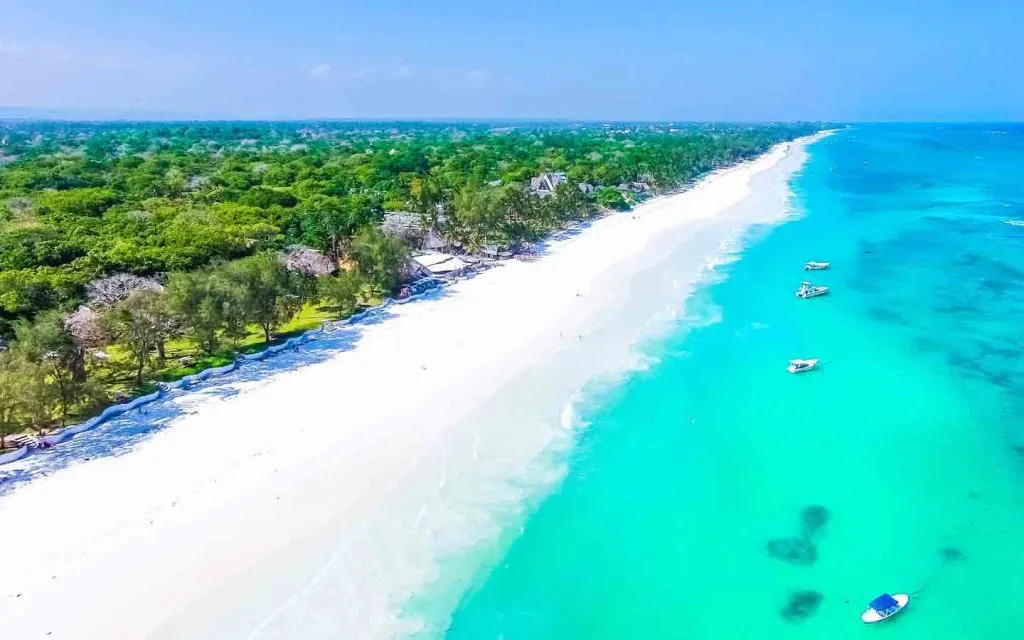
Diani’s beach aesthetic suits a specific preference — a long, wide, uninterrupted white sand beach facing the open Indian Ocean with consistent wave action and deep water throughout the tidal cycle. The stretch between Leopard Beach Resort and Southern Palms Beach Resort covers several uninterrupted kilometres of the finest beach real estate on the East African coast. Diani’s resident colobus monkey population in the coastal forest behind the hotels adds a wildlife dimension entirely absent from Zanzibar’s beach zone and provides a gentle wildlife encounter for guests transitioning from safari intensity to beach relaxation.
Practical Comparison: Costs, Activities and Accommodation
Cost Comparison Between Diani and Zanzibar
Mid-range beach accommodation costs broadly similar amounts in Diani and on Zanzibar’s northern coast — USD 150 to USD 350 per night covers a well-appointed hotel room with a swimming pool at comparable quality standards in both destinations. The key cost difference lies in the additional expenses that travel to Zanzibar imposes beyond accommodation. The internal flight from Nairobi to Zanzibar costs USD 150 to USD 250 per person return compared to USD 60 to USD 100 for Nairobi to Mombasa. The Tanzania component also requires a separate tourist visa — currently USD 50 — that a Kenya-only itinerary ending at Diani avoids entirely.
Marine activities in both destinations carry comparable costs, with Zanzibar’s Mnemba Atoll and Diani’s Kisite-Mpunguti Marine Park as the respective primary underwater destinations at similar per-dive rates. Zanzibar’s spice tour adds a USD 25 to USD 50 cultural activity with no direct Diani equivalent. Diani’s Colobus Conservation project and Shimba Hills National Reserve add wildlife dimensions that Stone Town’s cultural programme does not replicate. Overall, a Zanzibar extension costs USD 200 to USD 400 more per person than an equivalent Diani extension, primarily through higher flight costs and the Tanzanian visa.
Marine Activities and Underwater Environments
Mnemba Atoll and Kisite-Mpunguti Marine Park rank as the two strongest snorkelling and diving destinations on the East African coast. Mnemba’s enclosed atoll maintains calm, clear water conditions year-round with visibility regularly exceeding 20 metres. Coral diversity includes both hard and soft formations that shelter more than 500 fish species.
Dolphins enter the atoll in early morning hours and approach snorkellers of their own accord. Hawksbill and green sea turtles rest and feed among the seagrass beds, delivering the reliable turtle encounters that reef snorkellers most frequently cite as their highlight.
Kisite-Mpunguti Marine Park off Diani’s southern coast offers whale shark sightings between October and March — aligning with Diani’s best visiting window. The park’s shallow reef sections suit beginner snorkellers while its deeper coral walls serve experienced divers. Excursion dhows land at Mpunguti ya Juu and Mpunguti ya Chini islands, adding Swahili coastal culture to the underwater focus. For visitors specifically targeting whale sharks, Diani’s October to March season makes it the stronger choice over Zanzibar regardless of other comparison factors.
Making the Decision
Which Destination Suits Your Priorities
The Decision Framework
Choose Zanzibar if your East Africa trip includes Tanzania, if you want cultural depth alongside the beach, if you travel as a couple or small group with diverse interests, or if the combination of a UNESCO heritage town and excellent coral reef diving matters more than logistical simplicity.
Choose Diani if your safari is Kenya-only and ends near Nairobi or Mombasa, if you prioritise the best uninterrupted white sand beach on the East African coast, if whale shark encounters from October to March are a priority, or if budget considerations favour the lower logistical cost of a Kenya mainland extension.
Diani’s beachfront hotels with large pools, consistent shallow swimming areas at high tide, and the nearby Shimba Hills wildlife reserve within day-trip distance suit families with children across a wide age range. For honeymoon couples who want the most atmospheric Indian Ocean beach setting in East Africa, Zanzibar’s boutique hotels at Matemwe or the exclusive Mnemba Island Lodge provide the romance quotient that Diani’s more resort-style hotel format struggles to match at equivalent price points.
Plan Your Safari
African Wild Trekkers offers both Zanzibar and Diani Beach extensions from all Kenya and Tanzania safari circuits and advises on which beach destination best matches your specific safari ending point, group composition, budget, and activity priorities. The comparison above provides the framework — your specific priorities determine the choice.
The beach extension package covers flights from your safari endpoint to the beach destination, accommodation selection matching your budget and priorities, water sports and reef excursion arrangements, and return flights to your international departure airport. Both extensions connect seamlessly to the safari rather than requiring separate logistics management.
Contact African Wild Trekkers at africanwildtrekkers.com/contact with your safari ending location and beach priorities and we will recommend the best East Africa beach extension for your trip within 24 hours.