Zanzibar vs Seychelles: The Complete Comparison
Understanding What Each Destination Offers
Zanzibar’s Proposition: Culture, Safari Access and Value
Zanzibar’s most distinctive quality in a comparison with the Seychelles is its position as a complete destination in its own right rather than a pure beach retreat.
The UNESCO heritage of Stone Town, the living Swahili-Arab cultural traditions of the island’s interior communities, the spice farm landscape of the agricultural hinterland, and the direct flight connections to Tanzania and Kenya’s safari ecosystems create a depth of experience that pure granite-island beach destinations cannot replicate.
For travellers who complete a Kenya or Tanzania safari and want a beach extension that continues the cultural immersion, Zanzibar extends the East Africa experience rather than replacing it with something geographically and culturally unrelated.
Zanzibar’s cost advantage over the Seychelles is substantial and relevant to most travelers making this comparison.
A mid-range beach hotel on Zanzibar’s northern coast costs USD 150 to USD 350 per night.
Equivalent quality on the Seychelles’ Mahe, Praslin, or La Digue islands costs USD 400 to USD 800 per night.
Luxury private island resorts in the Seychelles run to USD 1,500 to USD 3,000 per night.
The Seychelles’ isolation, the cost of importing virtually all food and materials, and a deliberate government policy of restricting tourism numbers to maintain exclusivity all drive these prices higher than Zanzibar’s larger, agriculturally self-sufficient island environment.
The Seychelles Advantage: Beaches, Exclusivity and Marine Life
Seychelles’ most compelling argument is the quality of its most famous beaches.
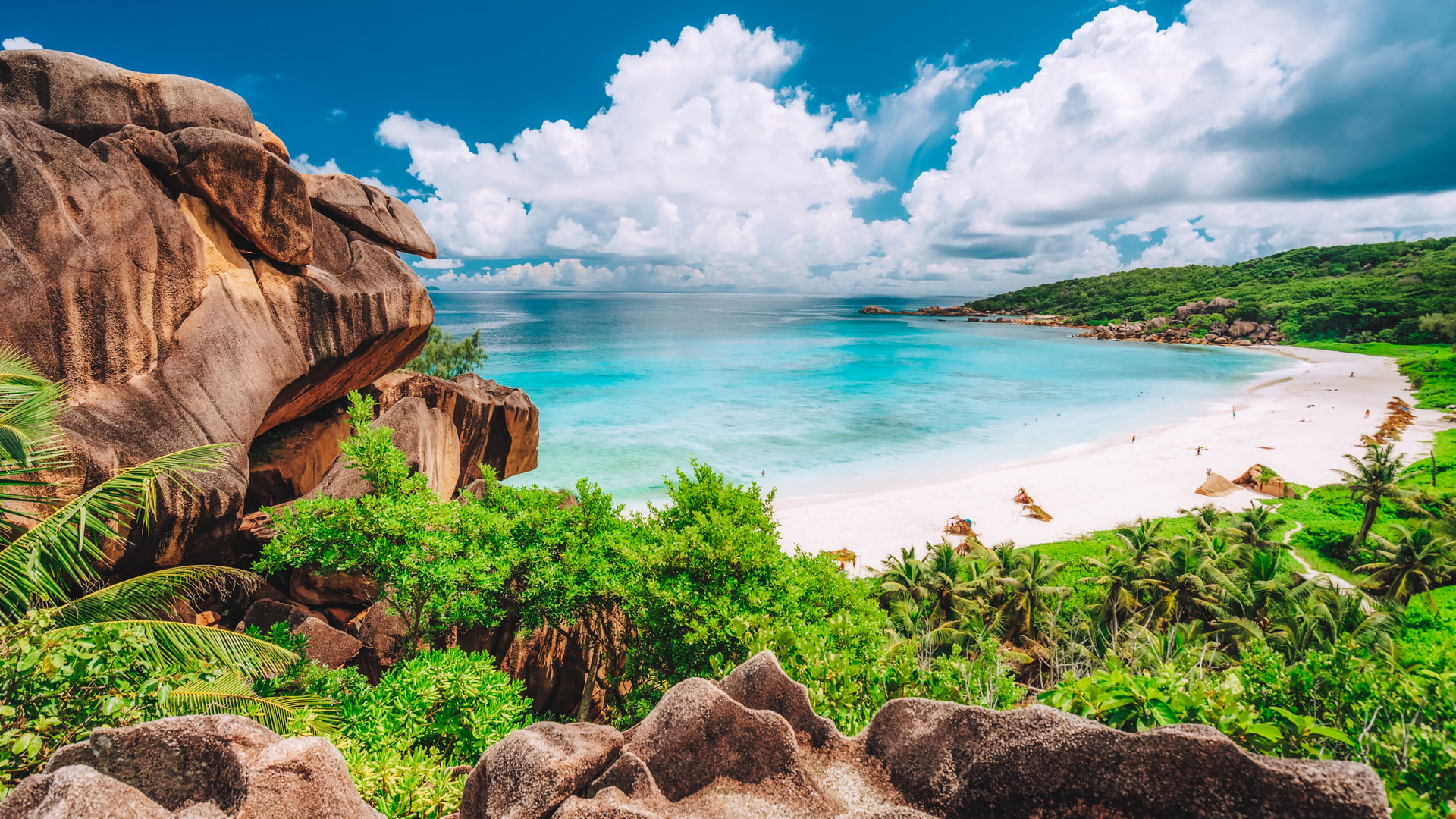
Anse Source d’Argent on La Digue and Anse Lazio on Praslin rank regularly among the world’s most beautiful beaches, with pink-tinged granite boulders, turquoise water, and powdery white sand that produces the travel magazine cover images most travelers picture when they imagine a perfect Indian Ocean beach.
No beach on Zanzibar matches the specific visual impact of these granite boulder beaches, whose geological uniqueness—mid-ocean granite outcrops are geologically improbable remnants of the ancient supercontinent Gondwana—creates a landscape unlike any other tropical beach destination on earth.
The Seychelles’ marine environment rivals the Indian Ocean’s best reef systems, with whale shark aggregations off western Mahe and the Aldabra Atoll’s dugong population providing charismatic megafauna encounters at a level Zanzibar’s offshore reefs cannot consistently match.
The Seychelles also delivers extraordinary terrestrial wildlife on protected islands—the world’s largest land tortoise population on Aldabra, endemic bird species on the inner islands, and the endemic coco-de-mer palm.
This wildlife dimension adds interest for the naturalist whose attention a pristine beach alone cannot hold for a full week.
Practical Comparison: Logistics, Costs and Timing
Getting There and Total Trip Costs
Zanzibar International Airport receives direct flights from Nairobi in under 45 minutes and from Dar es Salaam in 20 minutes — connections that make Zanzibar the most straightforward Indian Ocean extension from an East Africa safari.
The Seychelles receives direct flights from several European hubs but no direct connection from Nairobi, requiring a transit through Dubai, Abu Dhabi, or Doha that adds four to eight hours to the journey from an East Africa safari endpoint.
This connectivity difference genuinely extends the trip’s total travel time in a way that Zanzibar’s direct connection avoids entirely.
Total cost comparison for a seven-night beach extension after a ten-day East Africa safari shows the Seychelles costing USD 2,000 to USD 5,000 more per person than Zanzibar for mid-range to upper-mid-range accommodation.
Higher hotel rates and additional flights from East Africa drive most of this difference.
For travelers who prioritize the Seychelles’ specific beach quality and exclusivity, this premium is readily justified.
For travellers who want excellent Indian Ocean beach quality alongside cultural depth and the ability to allocate more of their total travel budget to the safari itself, Zanzibar delivers compelling value without compromising beach quality below the absolute premium tier.
Timing and Seasonal Conditions
Both Zanzibar and the Seychelles operate on Indian Ocean monsoon timing that broadly aligns—the southeast monsoon from May through September brings rougher conditions to both destinations’ eastern coasts, while the northwest monsoon of December through March delivers the calmest sea conditions across the broader region.
The Seychelles’ inner granite islands maintain more consistently calm conditions year-round than Zanzibar’s outer island beaches because the granite formations’ depth shelters them from ocean swell that Zanzibar’s flat coral island topography cannot deflect.
This advantage makes peak season conditions at Mahe and Praslin more reliable than Zanzibar’s eastern coast in the same months, though Zanzibar’s northern coast at Nungwi and Kendwa matches the Seychelles’ calm water for the same weather system reasons.
The combined safari-plus-beach timing consideration works identically for both destinations.
June through October produces the driest and most reliable weather for both Indian Ocean beach destinations and represents the overlap between Kenya’s and Tanzania’s best safari season and the most predictable beach conditions.
The Verdict
Making the Right Choice for Your Trip
Who Should Choose Zanzibar and Who Should Choose Seychelles
Choose Zanzibar if your East Africa trip is Kenya- or Tanzania-based and you want to minimize additional flight complexity; if your budget allocates more to safari quality than beach exclusivity; if you want cultural depth—Stone Town, spice tours, Swahili cuisine—alongside beach relaxation; or if you are traveling with first-time East Africa visitors for whom the complete cultural experience matters more than the absolute premium beach product.
For most East Africa safari travellers comparing these two destinations, Zanzibar delivers 90 percent of the beach quality at 60 percent of the cost while adding the cultural dimension that makes the Indian Ocean extension feel like a continuation of Africa.
Choose Seychelles if your trip begins in Europe with a direct Seychelles flight as the opening leg before connecting to East Africa for the safari; if your beach priorities specifically require the granite boulder beaches at Anse Source d’Argent or Anse Lazio; if your budget allows the premium without trade-offs elsewhere in the trip; or if you have already visited Zanzibar and want a different Indian Ocean experience for a repeat East Africa visit.
The Seychelles rewards a trip specifically designed around it rather than one added as an afterthought from a safari ending in Nairobi or Dar es Salaam.
Plan Your Safari
African Wild Trekkers recommends and books both Zanzibar and Seychelles extensions from East Africa safari circuits and advises on the routing, timing, and accommodation selection that make either option work as a complete post-safari experience.
The comparison above provides the framework — your specific priorities determine the choice.
The beach extension package covers flights from your safari endpoint, accommodation at the beach destination, water sports arrangements, cultural activities at Zanzibar, or island wildlife excursions at the Seychelles, and return international connections.
Both options are arranged as single packages without requiring independent logistics management from the traveler.
Contact African Wild Trekkers at africanwildtrekkers.com/contact with your safari details and beach extension preferences, and we will recommend the best Indian Ocean option for your trip within 24 hours.