Crowned Eagle Facts: Africa’s Most Powerful Forest Predator
The crowned eagle is Africa’s most powerful eagle relative to its body size. It can kill prey several times heavier than itself, including bushbuck, small antelopes, and monkeys.
Unlike the martial eagle, which hunts above open landscapes, the crowned eagle prefers forests and woodland edges. It uses stealth, speed, and powerful strikes to capture prey in dense vegetation.
Its strength, intelligence, and hunting ability make it one of Africa’s most impressive predators. It remains a major threat to medium-sized mammals, especially forest primates.
Research on crowned eagle nests has revealed remains of vervet monkeys and young baboons. These findings show the eagle’s ability to hunt and kill primates. Some researchers have also suggested that early forest-dwelling hominids may have faced threats from crowned eagles.
Identification
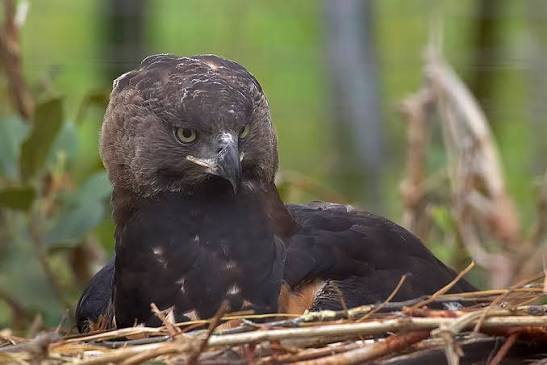
The crowned eagle measures between 80 and 99 centimetres in length. It has a large crest of long, pointed feathers on its head. The raised crest creates a striking crown-like appearance.
The crest usually lies flat when the bird rests. When the eagle becomes alert or displays, the feathers rise and spread around the head.
The upperparts show dark grey-brown feathers. The underparts appear white with heavy rufous-brown bars. The tail displays bold black and white bands.
During flight, the crowned eagle shows broad rounded wings and a long barred tail. These features help distinguish it from other large African eagles.
Hunting Behaviour
The crowned eagle hunts through forests and along woodland edges. It flies low and quietly through vegetation before attacking from close range.
The eagle relies on surprise rather than high-altitude dives. It uses trees and vegetation as cover before launching a rapid attack.
Its powerful talons deliver a crushing strike to the prey’s body. The impact can kill or disable the animal immediately. The eagle then uses its beak to finish the kill.
Large prey may remain at the hunting site for several days. The eagle feeds repeatedly and returns to the carcass when needed. When prey becomes too heavy to carry, it removes smaller pieces and transports them separately.
Nesting and Territory
Crowned eagles build large nests high in forest trees. They add new materials to the nest each breeding season. Over many years, a nest can reach two metres deep and 1.5 metres wide.
Some nests remain active for more than 20 years. These long-term nesting sites show the strong territorial behaviour of the species.
The crowned eagle has a slow breeding cycle. A pair produces one chick every two years. The chick spends 90 to 110 days in the nest before flying.
After leaving the nest, the young eagle depends on its parents for up to 11 months. This slow reproduction makes adult survival important for the species.
Where to See Crowned Eagles in East Africa
Crowned eagles live in forest habitats across East Africa. They occur in Uganda’s national parks, Kenya’s highland forests, and Tanzania’s Eastern Arc Mountains.
Uganda provides some of the best opportunities to find this forest predator. Kibale Forest and Bwindi Impenetrable Forest support breeding pairs. Birdwatchers can search for them during forest walks and primate trekking activities.
Kibale Forest offers particularly good chances because of its rich bird diversity and established eagle territories. Visitors exploring chimpanzee habitats may hear their calls or spot them flying above the forest canopy.
Plan Your Birding Safari
Crowned eagle sightings require forest destinations with healthy breeding populations. Uganda’s Kibale Forest offers some of the best forest eagle viewing opportunities in East Africa.
The most impressive sightings occur during display flights. Adult pairs often soar above their nesting area while calling loudly. Early mornings during the breeding season provide the best chances to witness this behaviour.
A birding safari through East Africa’s forests offers a rare opportunity to encounter one of Africa’s most powerful and fascinating raptors.
African Wild Trekkers includes Uganda’s forest national parks in birding safari itineraries where crowned eagle territories are accessible. Contact us to plan a safari that targets East Africa’s most powerful forest raptor alongside the forest’s primate and bird community.