Serval Cat Facts: The Long-Legged Stealth Hunter of African Grasslands
Africa’s Most Elegant Small Cat
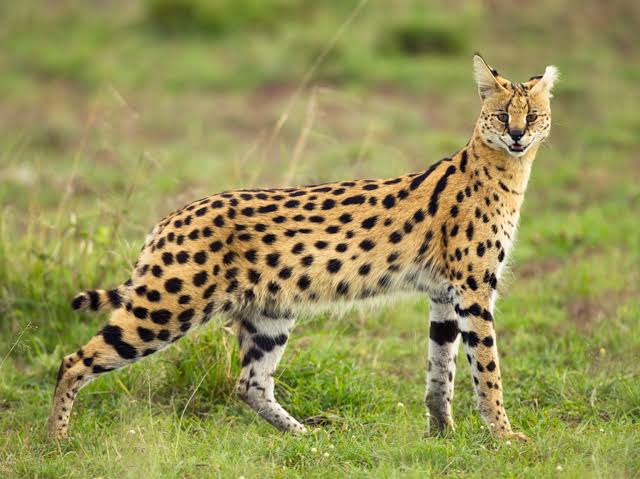
The serval is one of Africa’s most elegant and specialized predators. It is a medium-sized wild cat with proportionally the longest legs relative to body size of any cat species on Earth. Its enormous mobile ears are built for locating prey in long grass. Its hunting technique involves leaps of up to 2.4 meters vertically and 3.5 meters horizontally. This technique achieves the highest prey capture rate of any African cat species. Where lions succeed in roughly one in four hunting attempts and cheetahs in roughly half, the serval captures prey in approximately 50 to 60 percent of its attempts. This extraordinary success rate is achieved through a combination of exceptional hearing and a pouncing strike technique. The hearing can detect and pinpoint the movement of prey beneath the surface of dense grass. The pouncing strike delivers the killing blow with the front paws before the prey animal has time to react.
Servals live across sub-Saharan Africa — wherever tall grass, permanent water, and adequate rodent populations occur. But they are genuinely difficult to see on standard game drives because they are primarily crepuscular and nocturnal. They spend most of their active time in grass tall enough to conceal them completely. They are solitary and wary in their behavior. When a serval does appear on a game drive. Typically in the early morning when the animal is making its way back to a daytime resting site. It produces the kind of genuinely excited reaction that only unusual and photogenic sightings provoke. The low light catches the spotted coat against shorter vegetation. The serval is a specialist’s target, more anticipated by those who know the species than by first-time visitors. A genuinely rewarding find for any safari traveler who encounters one.
Serval Biology and Hunting Technique
Anatomy and Prey Capture
Ears, Legs, and the Pounce
The serval’s enormous ears—the largest, relative to skull size, of any cat species—are not primarily for visual impression but for acoustic hunting. The ears can rotate independently through a wide arc. They are lined with sensitive hair cells that amplify and localize the high-frequency sounds produced by small rodents moving beneath grass or underground. A hunting serval will stand motionless for extended periods, head tilted slightly and ears rotating. It processes acoustic information from the grass around it until it has pinpointed the precise location of a prey animal moving beneath the surface. This localization is accurate enough to allow the serval to strike at prey it cannot see. Targeting a rodent in a grass stem network purely from sound. No other cat species approaches this strike success rate in comparable prey conditions.
The long legs that give servals their distinctive silhouette elevate the serval’s head above the level of dense grass in its primary hunting habitat. This allows the ears to function without the acoustic interference of surrounding vegetation. The same long legs provide the leverage for the remarkable vertical and horizontal pounce that the serval uses to pin and kill prey. The pounce initiates from a standing position. The serval rises vertically with all four feet and lands squarely on the prey animal below. The impact of a rapid bite to the skull or neck kills the prey. Frogs, birds, lizards, insects, and small mammals all feature in the serval’s diet. Rodents — particularly vlei rats and multimammate mice — comprise the primary prey base in most habitats. Servals in Tanzania’s Ngorongoro Crater have been documented hunting flamingos at the crater lake. They adjust their prey selection to what is locally abundant rather than restricting themselves to a narrow prey profile.
Territory, Reproduction, and Social Behavior
Servals are solitary and territorial, with males holding larger ranges of 12 to 30 square kilometers that overlap with the smaller ranges of several females. Territory boundaries are maintained through scent marking. Spraying urine on grass stems and other vegetation. And regular patrolling rather than active defense through physical confrontation with rival servals. Males and females come together briefly for mating. The female raises the litter of one to three kittens entirely alone. The kittens are born in a sheltered den. Often a dense grass clump, a rocky crevice, or an appropriated aardvark burrow. They begin accompanying their mother on hunting trips at approximately six months of age. They learn the pounce technique through observation and play before gaining independence at around twelve to eighteen months.
The serval’s preference for tall, moist grassland habitat near permanent water creates a specific distribution pattern that is sensitive to habitat change. Drainage of wetlands, conversion of tall grass habitats to short pasture through heavy grazing. And the drying effects of climate change on African grassland ecosystems all reduce the habitat quality that servals require. Urban and peri-urban expansion in areas previously occupied by suitable serval habitat has produced increased human-serval contact in some parts of the range, particularly in South Africa. Servals are occasionally killed by domestic dogs or vehicles in peri-urban areas. In farmland areas, servals are sometimes persecuted for poultry predation. Livestock predation by servals is far less frequent than the persecution rate implies.
Best Places to See Servals
The Ngorongoro Crater in Tanzania is one of the best places in Africa for serval sightings. The crater floor’s mosaic of short grassland, swamp margins, and permanent water creates ideal serval habitats. The closed crater geography concentrates animals in predictable areas that experienced guides learn over years of daily drives. Servals in Ngorongoro appear regularly enough that they feature prominently in visitor accounts. Experienced guides seek them out specifically in the areas of the crater floor most likely to hold animals in the early morning. The Masai Mara, Serengeti, and Amboseli also deliver several sightings to travelers with experienced guides and a willingness to pay attention to the grassland edges rather than focusing exclusively on the large predator sightings that tend to dominate game drive attention.
South Africa’s Kruger National Park and surrounding private reserves have several populations in the moister eastern sections of the park. The private reserves’ night drive programs occasionally produce several sightings in the spotlight. Uganda’s Queen Elizabeth National Park, Kenya’s Laikipia Plateau conservancies, and Zambia’s South Luangwa riverine grasslands all support serval populations in appropriate habitat. The Drakensberg foothills in South Africa and the highland grasslands of Ethiopia and Kenya above 2,000 meters support mountain serval populations. These are effectively the same species but adapted to higher-altitude conditions. Servals in the Bale Mountains of Ethiopia are among the highest-altitude serval records on the continent.
Plan Your Safari
Serval sightings reward early morning game drives in areas with tall grass and permanent water. The Ngorongoro Crater delivers the most consistent serval encounters of any safari destination in Africa. Adding a Ngorongoro Crater drive to any Tanzania northern circuit itinerary. For several lions. And the extraordinary predator density the crater supports. It is one of the most rewarding scheduling decisions any Tanzanian safari makes.
African Wild Trekkers builds Ngorongoro Crater days into Tanzania’s northern circuit itineraries and designs drives timed for early morning small cat activity. This ensures the crater’s full predator diversity. Including the serval, a black-backed jackal. And the resident lion and leopard populations. Receives the attention it deserves alongside the crater’s famous buffalo and flamingo spectacle.
Contact African Wild Trekkers at africanwildtrekkers.com/contact with your Tanzania travel dates, and we will design an itinerary that includes the Ngorongoro Crater’s serval hunting grounds alongside the Serengeti migration circuit within 24 hours.