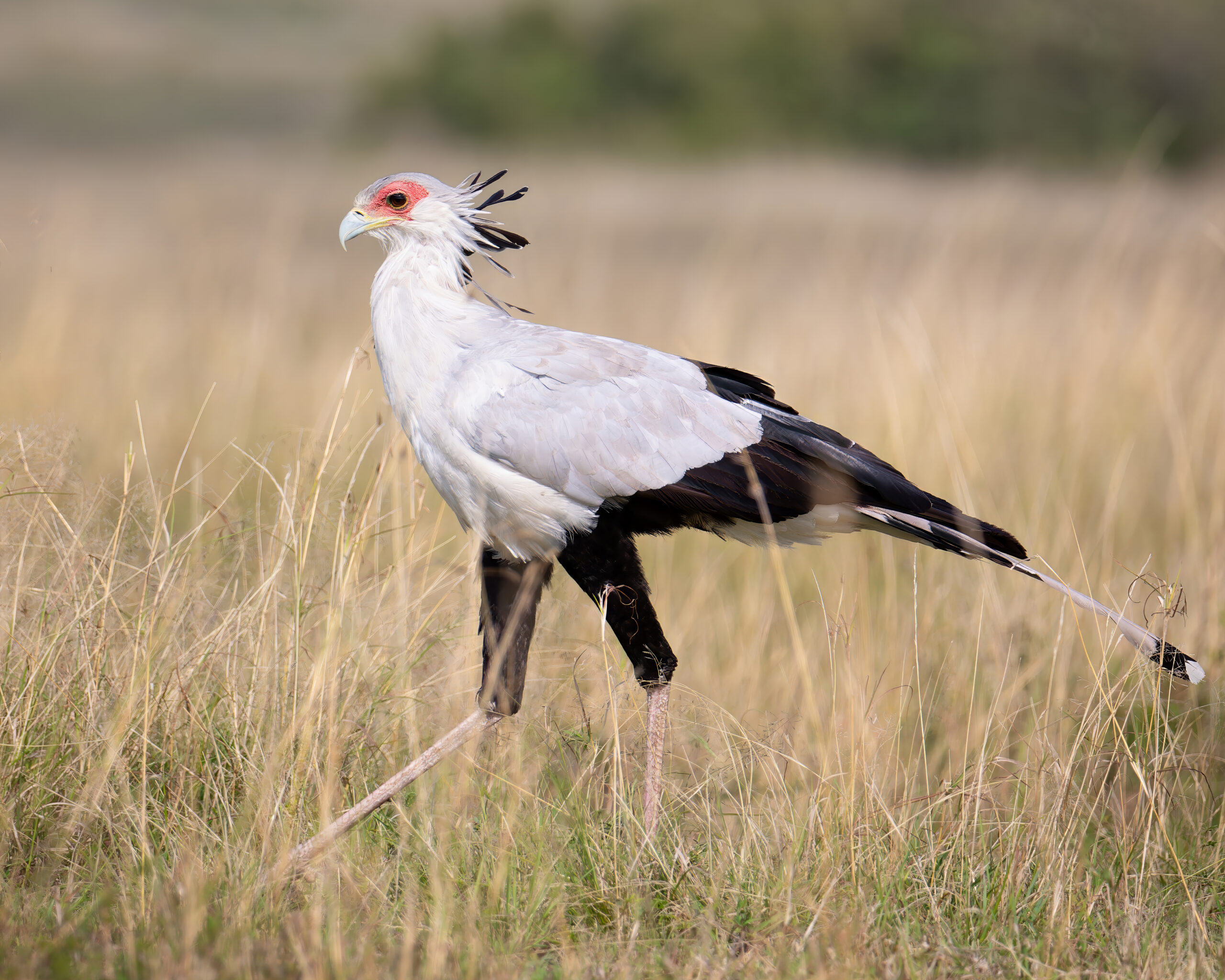
The Bird That Stomps Snakes
The secretary bird is one of the most distinctive and recognizable birds in Africa — a large, long-legged raptor that hunts entirely on foot across open grassland, stamping prey to death with powerful kicks rather than using talons or bill to subdue it. Standing 1.2 metres tall on legs so long that the bird looks like an eagle wearing stilts, with a crest of black feathers trailing behind the head and bright orange facial skin, the secretary bird is impossible to mistake for any other species. It walks through grassland at a brisk pace throughout the day — adults may cover ten kilometres of grassland on a single hunting day — flushing prey items from the grass and delivering rapid, powerful stomping strikes that can kill a snake with a force of five times the bird’s own body weight. This stomping technique is equally effective on lizards, rodents, and large insects, and the secretary bird hunts all of these in addition to the venomous snakes it is most famous for dispatching.
The secretary bird is the sole member of the family Sagittariidae — entirely unique, with no close relatives, and one of the most evolutionarily distinct birds in Africa. Its name’s origin is debated: one theory suggests the crest feathers resemble the quill pens that nineteenth-century secretaries tucked behind their ears; another proposes a French/Arabic linguistic derivation referring to the bird as a predatory bird. Whatever the etymology, the bird itself is utterly unlike any conventional image of a raptor, and a first sighting across African grassland — this improbable long-legged figure striding through the grass — produces the kind of double-take that only genuinely unusual animals provoke.
Secretary Bird Biology
Hunting, Anatomy, and Behavior
The Stomping Kill Technique
The secretary bird’s strike force has been measured in laboratory conditions using mounted specimens and force plates: individual strikes deliver approximately 195 newtons of force in under 15 milliseconds — roughly five times the bird’s body weight in force, applied faster than a human eye can resolve. This combination of force and speed is what makes the stomp effective against venomous snakes: the bird does not give the snake time to react and strike before the blow lands, and the force of a direct hit to the head or body is sufficient to stun or kill the snake outright. If the snake does not die from the initial stomp, repeated stomping finishes the job before the snake can reach a striking posture. The long legs that enable the stomping reach also keep the secretary bird’s body far enough from the snake’s head during the strike to reduce the risk of an effective counterattrike — a practical safety margin built into the hunting geometry.
When not stomping, secretary birds also use their wings as supplementary hunting tools — spreading them to startle hidden prey from cover and then stamping quickly. Large prey items — particularly large lizards and sizable snakes — are sometimes battered against the ground or carried aloft and dropped from height to kill by impact, a technique observed in several large raptors. Secretary birds also swallow small prey whole in the field, carrying larger items back to the nest where they are fed to the young in manageable pieces. The diversity of hunting techniques available to a single species that is superficially adapted for a single purpose (stomping) reflects the behavioral flexibility that makes secretary birds successful across a wide range of grassland conditions and prey availability situations.
Nesting and Breeding
Secretary birds nest in large, flat stick platforms constructed in the top of flat-topped acacia trees, typically 3 to 5 metres above the ground. The nest is used repeatedly across seasons, with new material added each year until old nests reach impressive dimensions of two metres in diameter and several metres in depth. Clutches of one to three eggs are incubated primarily by the female, with the male bringing food to the nest site. Chicks hatch asynchronously over several days, and the eldest chick typically has a competitive advantage in food access that reduces the survival probability of younger siblings in low-food years. Secretary bird chicks remain in the nest for approximately three months, developing their characteristic long legs and beginning to walk on the nest surface before their first flight.
Secretary birds are classified as Vulnerable by the IUCN, with the global population estimated at fewer than 10,000 breeding pairs and declining. The primary driver of decline is habitat loss — the conversion of open grassland to agriculture, the invasion of native grassland by bush encroachment (a process accelerating in many African savanna ecosystems due to changes in fire management and elephant browse pressure), and the degradation of grassland quality through overgrazing. Secretary birds require open, moderately short grass for effective walking-and-stomping hunting, and cannot hunt productively in tall dense grass or bush-encroached habitats. Their specialized habitat requirement makes them vulnerable to the grassland degradation trends that are affecting large proportions of their historical range across sub-Saharan Africa.
Best Places to See Secretary Birds
Secretary birds are most commonly seen in open, short-grass savanna environments across East and Southern Africa. The Masai Mara and Serengeti short-grass plains, Amboseli’s open grassland, the Ngorongoro Crater floor, and the Laikipia Plateau in Kenya all support secretary bird populations that are reliably encountered during morning game drives. The best sightings come when a pair is observed walking through the grass actively hunting — stamping through the vegetation, pausing, then delivering the rapid footstrike sequence — rather than simply seen perched in an acacia tree. The South African Highveld grasslands, including parts of Kruger’s open grassland sections and the surrounding private reserves, provide secretary bird habitat in Southern Africa, and sightings in the northern Kruger’s open mopane and grassland areas are not uncommon for observant game drive travelers.
Tanzania’s Tarangire National Park, with its open grassland around the Tarangire River, and Kenya’s Tsavo East, with its vast semi-arid plains, are additional good secretary bird locations. The Serengeti’s southern short-grass plains in the calving season area (January to March) are particularly productive for secretary bird sightings because the short grass favored by wildebeest calves is also ideal secretary bird hunting terrain, and the two spectacles — flamingos of the Rift Valley, wildebeest calving, and secretary birds hunting — can be combined in a single southern Serengeti itinerary during the calving season. For dedicated birders, the combination of secretary bird in the morning with flamingos at Lake Nakuru in the afternoon and fish eagles on the Kazinga Channel boat the following day represents a remarkably efficient African birding circuit achievable within a five-day Kenya-Uganda visit.
Plan Your Safari
Secretary bird sightings favor open grassland ecosystems and morning activity periods when the birds are most actively hunting. The Masai Mara and Ngorongoro Crater floor are the most reliable East Africa locations, while Kruger’s open sections and Laikipia deliver Southern Africa’s best encounters. Birds are most commonly seen walking, making early morning drives the most productive timing.
African Wild Trekkers designs safari itineraries that build in time for the birds and smaller mammals that most vehicle-focused safaris drive past, working with guides who appreciate the full range of African wildlife rather than focusing exclusively on the Big Five encounters that dominate most game drive agendas.
Contact African Wild Trekkers at africanwildtrekkers.com/contact with your travel dates and we will design a safari itinerary that includes the Masai Mara’s best secretary bird grasslands alongside the full range of East Africa’s wildlife within 24 hours.