The Wildcat That Changed Human History
The African wildcat holds one of the most remarkable positions in the natural history of any living animal: it is the sole ancestor of all domestic cats on the planet. Every tabby, every Persian, every Bengal cat, every feline companion sleeping on a human lap anywhere in the world descends from African wildcats domesticated approximately 10,000 years ago in the Fertile Crescent — and from the African wildcat subspecies, Felis lybica lybica, specifically. Genetic studies published from the 1990s onward have traced the domestic cat’s origin with remarkable precision, identifying the Near Eastern wild cat population that gave rise to the domestic lineage and even pinpointing the geographic and temporal window in which domestication occurred. The relationship between early agricultural human settlements and wild cats drawn to the rodents concentrated around grain stores is the most widely accepted domestication narrative, and it is one of the few domestication events in history that appears to have been initiated at least partly by the animal rather than entirely by humans.
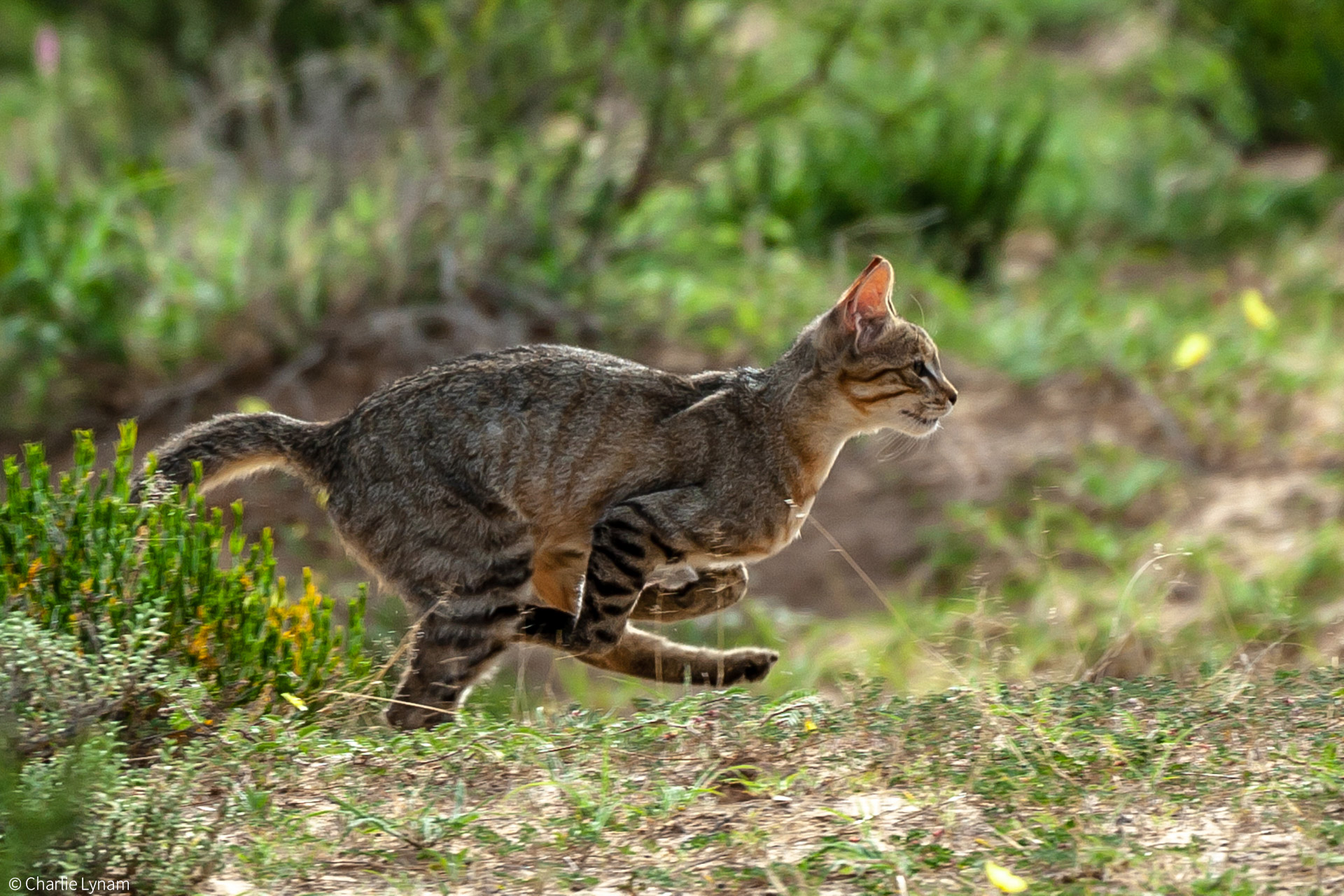
The African wildcat that safari travelers encounter on nighttime game drives in East and Southern Africa looks, at first glance, almost exactly like a large domestic tabby cat — grey-brown with faint tabby striping and a ringed tail. The resemblance is so close that African wildcats hybridize freely with domestic and feral cats wherever the two populations coexist, and maintaining genetically pure wildcat populations near human settlements is one of the most significant conservation challenges the species faces. Despite the domesticity of its appearance, the African wildcat in the wild is a complete, functioning predator leading an entirely independent life — hunting rodents, birds, lizards, and insects across African grassland and scrub habitats with the precision and efficiency that 10,000 years of subsequent domestic cat evolution has done remarkably little to reduce.
African Wild Cat Biology
Appearance, Behavior, and Distribution
Distinguishing Wild Cats from Domestic Cats
The African wildcat is slightly larger than the average domestic cat — adults weigh 3 to 6.5 kilograms — with longer legs relative to body size, a distinctly longer tail, and a more upright posture when sitting that gives the animal a less compact appearance than a typical domestic tabby. The coat is typically sandy grey or grey-brown with faint tabby marking — the distinctiveness of the pattern varies between individuals and across the species’ range, with North African animals paler and North East African animals darker than the Southern African subspecies. The most reliable field identification character is the reddish-orange coloration on the backs of the ears and on the belly, which is consistently more vivid in pure wildcats than in domestic-wildcat hybrids. The erect posture and longer legs also give pure wildcats a visual profile that experienced observers can distinguish from domestic cats at distance, though close inspection and genetic testing remain the gold standard for differentiating pure wildcats from hybrids.
African wildcats are solitary and nocturnal, with males holding larger home ranges that overlap with those of several females. They hunt primarily small rodents — mice, rats, and gerbils make up the majority of the diet across most of the range — supplemented by birds, lizards, insects, and occasionally rabbits. The hunting technique is the stalking-and-pounce sequence of all small felids: slow, deliberate approach using available cover, followed by a short explosive rush and an immobilizing neck or skull bite. Wildcats take prey proportionally larger relative to their body size than domestic cats typically pursue, reflecting the greater hunting motivation of an animal dependent entirely on what it catches for its caloric needs. Home ranges are maintained through scent marking and vocalizations, and wildcats avoid direct confrontation with other carnivores through a combination of nocturnal activity timing and careful awareness of larger predators’ movements across the landscape.
The Hybridization Threat
The African wildcat’s greatest conservation threat is hybridization with domestic and feral cats — a threat that is unique among Africa’s small cats in its proximity and scale. Wherever human settlements bring domestic cats to the margins of wildcat habitat, hybridization occurs freely because the two are the same species at the level of reproductive compatibility, and the offspring of wildcat-domestic cat crosses are fertile. In South Africa, surveys of wildcat populations near farmsteads and settlements have found hybrid proportions exceeding 80 percent in some local populations — meaning that genuinely pure wildcats are now rare in many areas of South Africa’s farmland landscape. The remaining strongholds of pure African wildcat genetics are in remote areas far from human settlement, particularly in the Kalahari, the Namib desert margins, and large protected areas like the Serengeti and the Central Kalahari Game Reserve that have minimal domestic cat presence.
The African Wildcat Research and Conservation project and several South African conservation organizations have been working on population genetics surveys to identify remaining pure wildcat populations and develop management strategies for reducing the hybridization pressure in key areas. In some reserves, domestic cat removal or sterilization programs have been implemented to reduce the hybrid source population, though the practical difficulty of distinguishing pure wildcats from hybrids by appearance alone makes management interventions challenging to implement without genetic testing. The conservation irony — that the domestic cat, derived from the wildcat and arguably the most successful human commensal mammal in history, is now threatening the continued existence of its own wild ancestor — is one of the more poignant conservation stories in African wildlife management.
Where to See African Wild Cats
African wild cats are nocturnal and relatively uncommon on standard game drives due to their small size and their preference for areas of scrub and low vegetation that provide daytime cover. Night drives in areas far from human settlement — where hybridization pressure is low and pure wildcats are more likely — offer the best sighting opportunities. South Africa’s Kgalagadi Transfrontier Park, with its large area far from human settlement and excellent night drive programs, is one of the best places on the continent to see pure African wildcats. The Central Kalahari Game Reserve in Botswana, the remote sections of Etosha in Namibia, and the large wilderness blocks of Tanzania’s Selous and Ruaha also support wildcat populations with lower hybridization pressure than areas adjacent to farming communities.
The challenge of the wildcat sighting is partly the nocturnal timing and partly the genuine difficulty of confirming that a grey tabby cat spotted in headlights in the Kalahari is a pure wildcat rather than a hybrid or a feral domestic cat. Experienced guides who know their specific area’s cat populations well can sometimes distinguish pure wildcats by posture, behavior, and ear coloration, but most wildcat sightings on standard night drives are recorded as “African wildcat (possible hybrid)” in honest trip lists. The encounter is nonetheless rewarding — the sight of Africa’s most historically significant small cat, the ancestor of humanity’s most popular companion animal, hunting mice in the Kalahari moonlight, connects two very different worlds across 10,000 years of shared evolutionary history in a way that is genuinely moving for travelers who understand what they are looking at.
Plan Your Safari
African wildcat sightings come from night drives in remote areas with minimal domestic cat pressure. Kgalagadi Transfrontier Park in South Africa combines excellent wildcat habitat with outstanding night drive programs and a range of other Kalahari predator species that make any night in the park an exceptional nocturnal wildlife experience.
African Wild Trekkers builds Kgalagadi into Southern Africa itineraries for travelers who want to see the full range of Africa’s small cat diversity — serval, caracal, African wildcat — alongside the more conventionally sought large predators of the continent’s major safari parks.
Contact African Wild Trekkers at africanwildtrekkers.com/contact with your travel dates and we will design a Southern Africa itinerary that includes Kgalagadi’s remarkable small predator diversity alongside the broader safari circuit within 24 hours.