L’Hoest’s Monkey Rwanda: The Mountain Forest Primate of the Albertine Rift
Rwanda’s Nyungwe Forest holds over 13 primate species. Among them, the L’Hoest monkey stands out for its rarity, its striking appearance, and its preference for the densest, wettest mountain forest. It is one of the least studied primates in East Africa. Most visitors to Nyungwe see it briefly and imperfectly through the understory. A prolonged encounter with a habituated L’Hoest group is a privilege that few primate watchers achieve.
What Is the L’Hoest Monkey?
The L’Hoest monkey, Allochrocebus lhoesti, was classified in the guenon genus Cercopithecus until a 2019 taxonomic revision moved it to the genus Allochrocebus. This revision reflected genetic evidence of significant divergence from the core guenon lineage. The species is named after the Belgian zoologist Maurice L’Hoest, who first described it in 1898 from a specimen collected in the Congo.
An adult L’Hoest monkey weighs between 3 and 7 kilograms. Males are substantially heavier than females. The body is relatively robust for a guenon. The limbs are moderately long. Unlike most forest monkeys, the L’Hoest monkey is partially terrestrial—it spends significant time on the forest floor and descends readily to cross gaps in the canopy.
Physical Features and the White Bib
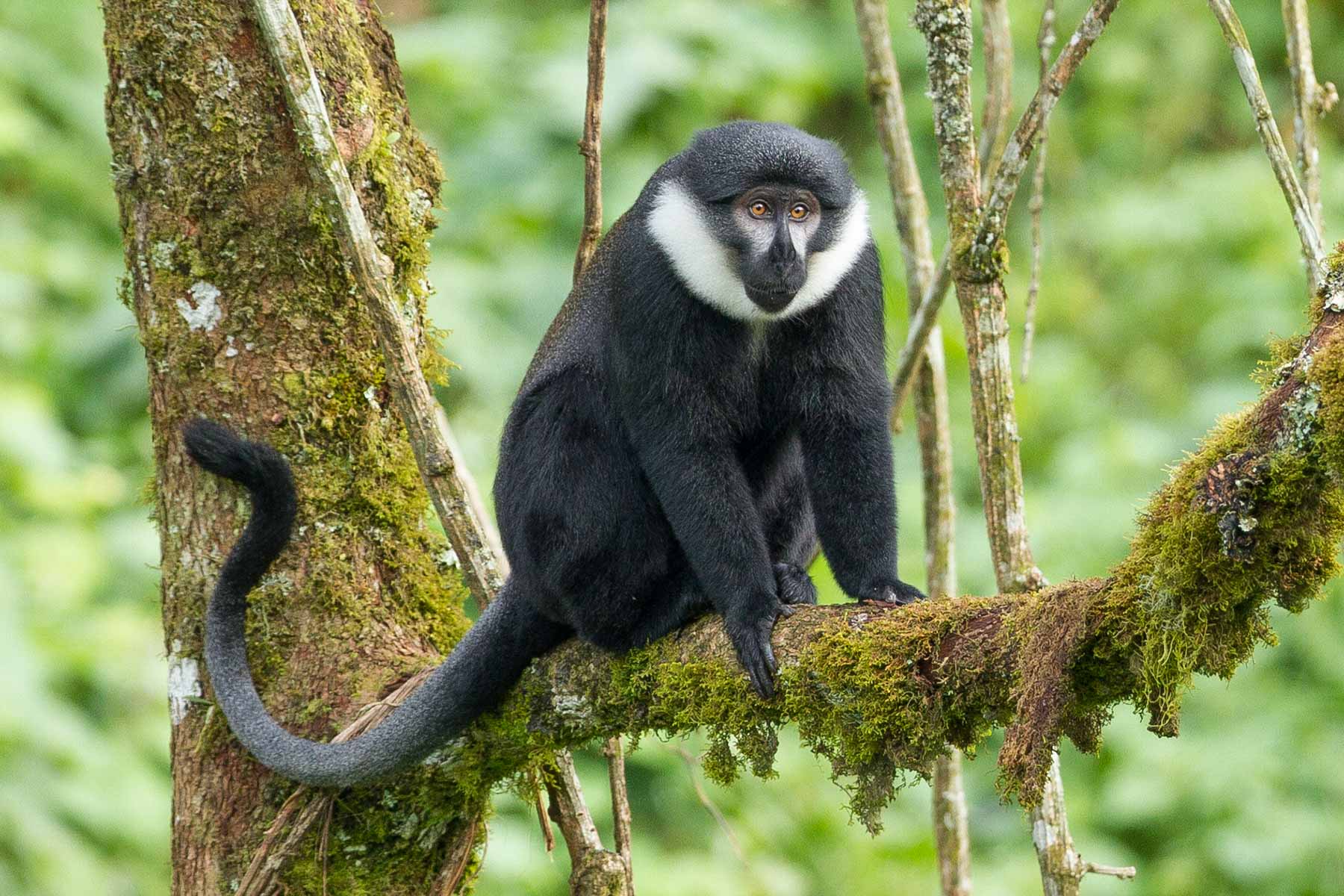
The L’Hoest monkey is immediately recognizable by its dark coat and contrasting white bib on the chest and throat. The back and flanks are dark brown to almost black. The face is dark with a slightly lighter brow and cheek area. The tail is held in a distinctive upward curl at the base and often carried with the tip curled upward—a posture unique among East African forest monkeys.
The white bib is the most reliable field mark. In the dim light of the mountain forest understory, the white chest is visible when the rest of the animal blends into the background. Male L’Hoest monkeys also develop a dramatic white-grey mantle on the back and flanks as they mature. This mantle is displayed during territorial calls and confrontations.
Mountain Forest Habitat and Rwanda Range
The L’Hoest monkey occupies montane forests from 1,000 to over 2,500 meters in altitude. It is the highest-altitude specialist among Uganda and Rwanda’s forest monkeys. In Rwanda, Nyungwe National Park is the primary stronghold. Nyungwe’s forest covers 970 square kilometers of montane forest and holds one of the largest and healthiest L’Hoest monkey populations in the Albertine Rift.
In Uganda, the Bwindi Impenetrable Forest and the Rwenzori foothills hold populations. The species is absent from lowland forest. It does not occur in Kibale, which is too low in altitude for its montane habitat requirements. The Albertine Rift’s chain of mountain forests — from the Rwenzori through Bwindi and Nyungwe — forms the core of the species’ East African range.
Social Structure and Group Behaviour
L’Hoest’s monkeys live in one-male groups of 5 to 17 individuals. The single adult male defends the group and calls loudly in territorial confrontations. Females form the stable group core and are philopatric. The groups are unusually quiet compared to most forest monkeys. They move slowly and deliberately through the understory, spending significant time on the forest floor searching for fallen fruits, fungi, and invertebrates.
This ground-foraging habit makes them more vulnerable to terrestrial predators than arboreal monkeys. They respond to ground predators by climbing rapidly to mid-canopy height and calling. Their quiet nature and willingness to freeze in cover make them harder to find than louder, more arboreal species.
Conservation Status
The L’Hoest monkey is classified as Vulnerable by the IUCN. Population estimates are uncertain due to limited survey coverage in the Congo Basin, which holds most of the global population. In Rwanda and Uganda, protected area populations are considered stable. Nyungwe National Park’s strong management and anti-poaching program protect the Rwanda population effectively. Outside protected areas, habitat loss and hunting for bushmeat reduce populations significantly.
Plan Your Safari
Nyungwe National Park in Rwanda provides the best opportunity to see L’Hoest monkeys in East Africa. The park’s guided primate walks target multiple species, and the L’Hoest monkey is regularly encountered on the forest trails. The canopy walkway trail and the Isumo Waterfall trail pass through L’Hoest’s habitat. Rwanda’s well-maintained park infrastructure and professional guide network make Nyungwe one of the most rewarding forest primate destinations in Africa.
African Wild Trekkers designs Rwanda itineraries that combine gorilla trekking in the Virunga volcanoes with primate diversity walks in Nyungwe. Contact us to plan a Rwanda safari that captures both.