Best Safari Camera 2026: Top Cameras & Lenses for Wildlife Photography
Photographing Africa’s Wildlife: Equipment That Works
The question most travelers ask before an Africa safari. After “when should I go?” and “which country?”. Is “what camera should I bring?” The honest answer is more nuanced than most camera review sites suggest. The best safari camera is not the most technically capable camera. It is the camera that matches your photography skills, your budget. And the physical and logistical constraints of game drive photography.
The goal is images you are proud of rather than equipment you barely know how to operate. A skilled photographer with a mid-range camera consistently outperforms an inexperienced photographer with professional-grade equipment. The weight, size, and cost of a full professional camera system can transform an enjoyable activity into a stressful burden for travelers who would be better served by a simpler, lighter setup.
This guide covers the key considerations for safari camera choice in 2026 across three budget tiers, with recommendations for both camera bodies and lenses. It focuses specifically on the requirements of African wildlife photography. Telephoto reach, autofocus performance on fast-moving subjects. And the ability to produce usable images in early morning and late evening low light. These are the conditions that characterize the best game drive periods.
The best setup for shooting African wildlife is not the same as the best setup for landscape or street photography. The recommendations here are calibrated to the specific conditions and subjects that safari photography involves.
Camera Body Recommendations by Budget
Entry Level, Mid-Range, and Professional Options
Entry Level: Bridge Cameras and Mirrorless Under $1,500
At the entry level, bridge cameras. All-in-one camera and zoom lens units. Offer the most accessible route to wildlife photography for travelers who do not own or want to invest in interchangeable lens systems. The Sony RX10 IV, Panasonic FZ2500, and Canon PowerShot SX70 HS all provide substantial optical zoom ranges equivalent to 400mm to 1,600mm. This is far longer than most safari travelers can carry in a separate telephoto lens.
They also feature reasonably fast autofocus systems that handle moving subjects adequately in good light. The image quality of bridge cameras falls below what a mirrorless or DSLR system with a good telephoto delivers, particularly in low light.
For travelers whose primary objective is documenting wildlife encounters rather than producing exhibition-quality prints, however, bridge cameras deliver a completely satisfying safari photography experience at a fraction of the cost and weight of an interchangeable lens system.
For travelers who already own a mirrorless or DSLR camera body and want to step into wildlife photography with a minimum investment, a used Sony APS-C mirrorless body is a good starting point. The Sony a6600 or its successors combined with a Sony 70-350mm f/4.5-6.3 G OSS lens provides an excellent entry-level wildlife photography setup with genuinely capable autofocus performance.
The APS-C sensor’s crop factor gives a 1.5x multiplication to lens focal length. This makes the 350mm lens effectively equivalent to 525mm. Sufficient for most safari wildlife photography situations outside of very distant subjects or extreme telephoto needs. Total cost for this combination new runs in the range of $1,200 to $1,500. Used examples from reputable second-hand camera retailers cost considerably less.
Mid-Range: APS-C and Full-Frame Mirrorless $1,500-$4,000
The mid-range tier has improved dramatically as mirrorless autofocus technology matured in 2023 and 2024. Subject recognition and tracking systems in cameras from Sony, Canon, Nikon. And OM System now significantly outperform anything available in DSLR systems at any price.
For safari photography specifically, the Sony a7C II or a7R V (full frame), the Canon R6 Mark II or R8 (full frame), the Nikon Z6 III (full frame). And the OM System OM-1 Mark II (Micro Four Thirds) all deliver exceptional wildlife autofocus performance at prices that represent genuine value. Animal eye-tracking, subject recognition across multiple animal species, and predictive tracking that maintains focus through irregular motion are now standard on all of these bodies. These capabilities were exclusive to professional cameras just five years ago.
Lens selection at this tier depends significantly on which camera system you choose. Sony users with A7-series bodies should look at the Sony 100-400mm f/4.5-5.6 GM OSS. An exceptional telephoto zoom that covers the full range of safari photography situations. The more affordable Sigma 100-400mm f/5-6.3 DG DN for Sony E-mount is also a strong option. Canon R-system users benefit from the Canon RF 100-500mm f/4.5-7.1 L IS USM.
Which is slightly longer and among the best safari lenses available for any system. Nikon Z-mount users should look at the Nikkor Z 100-400mm f/4.5-5.6 VR S. OM System’s Micro Four Thirds format offers a significant weight advantage with excellent reach.
The OM System 100-400mm f/5-6.3 IS on an OM-1 Mark II body produces an effective 800mm reach in an impressively compact and lightweight package. Well suited to the limited weight allowances of bush flight transfers between safari camps.
Professional Safari Photography
The Best Systems for Serious Wildlife Photographers
Full-Frame Pro Bodies and Super-Telephoto Lenses
For serious wildlife photographers whose primary purpose in visiting Africa is producing high-quality images for print, publication, or competition, the professional tier in 2026 is dominated by three cameras. These are the Sony a1, Canon EOS R5 Mark II, and Nikon Z9. All three offer 45+ megapixel sensors with exceptional dynamic range. They feature autofocus systems with near-perfect subject tracking at up to 30 frames per second, blackout-free electronic viewfinders.
And weather sealing that handles the dust of the African bush better than most entry-level alternatives. The Sony a1’s combination of resolution, speed, and autofocus sophistication makes it the benchmark against which other professional wildlife cameras are measured.
The Canon R5 Mark II’s improved autofocus. With subject recognition that correctly identifies individual animal species at extraordinary accuracy. Has produced a genuinely competitive professional tier. The Nikon Z9’s 45.7mp high-speed capture with no mechanical shutter compromise adds further competition.
Super-telephoto prime lenses — the Sony 400mm f/2.8 GM OSS, Canon RF 400mm f/2.8 L IS USM, or Nikon Nikkor Z 400mm f/2.8 TC VR S — represent the peak of wildlife photographic equipment. They are the standard for safari photography at the professional level.
Their large maximum apertures deliver unmatched image quality in low-light dawn and dusk conditions. The cost (typically $12,000 to $16,000 new) and weight (3 to 4 kilograms each) put these outside the consideration of most safari travelers. Professional safari photographers who shoot pre-dawn lion hunts or night drive leopard encounters on a standard basis build their investment calculations around exactly these capabilities.
The Sony 600mm f/4 GM OSS and Canon RF 600mm f/4 L IS USM provide even greater reach at equivalent optical quality. These are the lens of choice for professional wildlife publications’ Africa coverage. Ideal for elephants in open Amboseli or distant cheetahs on the Serengeti short-grass plains.
Practical Safari Photography Tips
The most effective safari photography improvement for most travelers is not equipment-based — it is behavioral. Arriving at game drive departure before dawn significantly improves results. Staying at wildlife encounters longer than feels natural is equally important. Shooting in continuous burst mode throughout the key moments of any behavioral sequence captures action you would otherwise miss. Choosing to photograph animal behavior over animal presence.
The expression during a hunt over a static portrait at a waterhole. Produces dramatically better results than the camera upgrade that most photographers assume will solve their image quality problems.
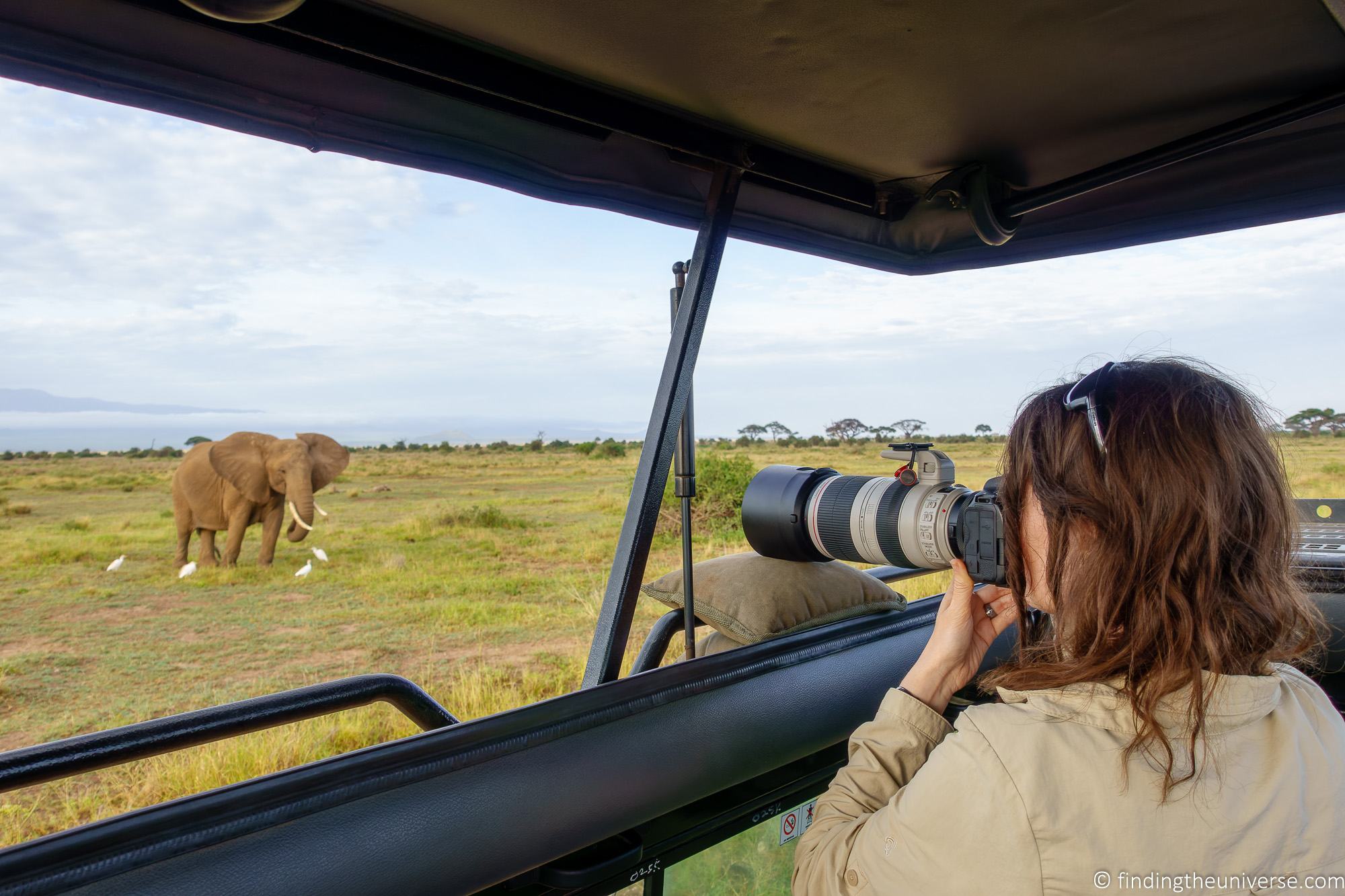
The single most useful equipment-based improvement for safari photography is a solid beanbag that sits on the vehicle’s door or roof. It eliminates the camera shake that hand-holding a long telephoto lens produces. This inexpensive accessory produces a visible improvement in image sharpness at every focal length above 200mm and in every lighting condition.
Memory cards and battery management are practical considerations that experienced safari photographers address before departure. High-capacity, high-speed SD or CFexpress cards. With enough capacity for several thousand RAW images per day.
Are essential for burst-shooting wildlife without losing shots while the camera buffer clears. Bringing twice as many batteries as you think you need. And fully charging all batteries the night before every game drive, prevents the frustration of a dead camera during the morning’s best encounter. Dust and moisture protection is also critical.
Dust storms are not uncommon in the African dry season. Condensation from moving between air-conditioned lodges and hot outdoor environments can affect lenses and sensors. A camera bag with a well-sealing dust cover and silica gel packets stored inside the bag between use addresses both risks effectively.
Plan Your Safari
Camera choice matters less than guide knowledge and vehicle positioning for the quality of photographic opportunities your safari delivers. The best photography safari experiences come from camps whose guides understand light direction, animal behavior, and vehicle positioning. They put the subject in the best light at the best angle for the shooting distance available rather than simply finding animals and stopping at any angle.
African Wild Trekkers selects camps with the best photography-oriented guiding. We can arrange dedicated photography-focused safari vehicles with extended front-seat shooting positions, specialist photography guide programs. And camps where photography is treated as a primary activity rather than an afterthought to standard game drives.
Contact African Wild Trekkers at africanwildtrekkers.com/contact with your travel dates and photography goals and we will design a photography safari itinerary with the guiding quality and vehicle access that produces exceptional images within 24 hours.