info@africanwildtrekkers.com

info@africanwildtrekkers.com

blog

Swahili Phrases for Safari: 50 Words That Will Delight the Locals

Communication for Markets, Meals, and Daily Life

Wildlife Vocabulary on the Game Drive

Learning the Swahili names for the major safari wildlife species adds an immediate and practical dimension to every game drive conversation, because your guide uses these names constantly and the English equivalent — particularly for specific subspecies, bird families, and behavioral terms — is sometimes less precise or less immediately communicative than the Swahili original. Simba — lion — is the most universally known, reinforced by several decades of popular culture, and Tembo for elephant and Twiga for giraffe complete the trio of most frequently used mega-fauna names that safari visitors learn almost involuntarily through repetition on their first morning drive. Chui — leopard — carries a specific cultural weight in Swahili because leopard’s nocturnal secrecy and cultural associations with cunning and power make it a word that guides often say with a particular quality of excitement and reverence when a sighting occurs. Kifaru — rhinoceros — and Nyati — buffalo — complete the Big Five vocabulary, and knowing all five in Swahili allows you to participate actively in “what’s on the itinerary today” conversations with your guide in a way that transforms from tourist interrogation into genuine planning discussion.

Beyond the Big Five, the Swahili safari vocabulary that produces the most rewarding conversations with guides covers behavioral observations and ecological phenomena that your guide narrates continuously during a drive. Chakula — food — and its verbal form Kula — to eat — appear in descriptions of foraging behavior; Uwindaji — hunting — and Kulinda — to protect or guard — describe predator and prey behavior; Maji — water — is one of the most important words in understanding daily animal movement patterns since water access drives the temporal structure of every wildlife community’s day. The word Ajabu — wonderful, amazing, extraordinary — is perhaps the most universally applicable Swahili wildlife reaction term and can be applied to any sighting from a spectacular bird to a dramatic predator encounter; your guide will immediately recognize and appreciate the sentiment it expresses regardless of whether your pronunciation is perfect or imperfect, because the word itself carries enough cultural weight that even an approximation communicates genuine enthusiasm for what you have both just witnessed.

Practical Phrases and Cultural Interactions

Communication for Markets, Meals, and Daily Life

Numbers, Directions, and Basic Requests

Basic number vocabulary — moja (one), mbili (two), tatu (three), nne (four), tano (five), kumi (ten), mia (hundred) — enables price negotiation at markets and curio shops throughout East Africa and immediately signals to vendors that you are an informed and engaged buyer rather than a tourist who accepts whatever price is named first. The convention at most informal East African markets is that the first price quoted is significantly above the expected transaction price, and responding to Shilingi elfu kumi (ten thousand shillings) with a counter of Shilingi elfu tano (five thousand shillings) in Swahili produces a qualitatively different negotiation dynamic than the same transaction conducted entirely in English through pointing and calculator-display price-showing, because the Swahili engagement signals cultural literacy and mutual respect that skilled vendors recognize and respond to with more genuine pricing flexibility. Ngapi? — “how much?” — is the indispensable single-word market phrase that initiates every purchase inquiry, and Ni ghali sana — “it’s very expensive” — provides the essential negotiation opening once the first price has been stated.

Safari lodge and camp interactions in Swahili create the most affecting moments of cross-cultural connection precisely because they are unexpected from an international visitor in a context where English is the operational language of all formal transactions. Asking the camp chef Chakula kilikuwa kizuri sana — “the food was very good” — after dinner, or telling the laundry attendant Asante kwa kazi nzuri — “thank you for the good work” — when collecting your clean clothes, or saying Lala salama — “sleep well/safely” — to lodge staff at the end of the evening produces moments of genuine delight and surprise that generate a quality of human connection between guest and staff that the most expensive lodge upgrade cannot manufacture but that a few memorized Swahili phrases deliver reliably and without cost. The willingness to speak imperfectly in another person’s language is one of the most universally appreciated human gestures across all cultures, and Swahili-speaking Africa is no exception — the laugh of recognition when a visitor tries and partially succeeds at a Swahili sentence is warmer, more inclusive, and more connecting than any perfectly delivered compliment in English.

Plan Your Safari

African Wild Trekkers provides every guest with a pre-departure Swahili language preparation guide tailored to the specific regions and communities on their itinerary, because the specific Swahili vocabulary most useful in Kenya’s Masai Mara differs from the vocabulary most useful in Tanzania’s Zanzibar coast or in Uganda’s Bwindi community visits. Our guides are also specifically briefed to act as enthusiastic Swahili teachers during game drives — making time at quieter moments to teach vocabulary, share the etymology and cultural context of specific words, and create the kind of linguistic immersion that transforms a safari from a wildlife viewing exercise into a genuine cultural encounter with the living language of the landscape.

We have found consistently over many years of hosting international safari guests that the travelers who invest even a modest amount of pre-departure effort in learning basic Swahili return home with a qualitatively richer and more personally meaningful Africa experience than those who rely entirely on English — not because of the specific words they learn but because the act of learning them creates an attitude of genuine cultural curiosity and openness to encounter that shapes every interaction throughout the trip in ways that no amount of luxury accommodation or exclusive wildlife access can replicate.

Contact African Wild Trekkers at africanwildtrekkers.com/contact with your planned destination and we will send your personalized Swahili safari language guide as part of your pre-departure preparation documents within 24 hours.
Greetings for Every Time of Day

Jambo — a simplified greeting derived from the fuller form Hujambo — is the most recognizable Swahili word for most international visitors and functions as a general “hello” appropriate in most contexts, though Swahili speakers often appreciate the more culturally specific greetings that vary by time of day and formality level. Habari ya asubuhi — “news of the morning,” or simply “good morning” in functional translation — is the appropriate greeting for the pre-dawn game drive departure, and responding with Nzuri sana — “very good” — to the expected follow-up question Habari gani? — “What news?” or “How are things?” — completes the basic morning greeting exchange that your guide will almost certainly initiate on the first drive. Habari za mchana (good afternoon) and Habari za jioni (good evening) follow the same pattern for their respective times of day, and using the time-specific greeting rather than the generic Jambo signals a level of effort and cultural interest that guides and lodge staff consistently respond to with warmth and willingness to teach further. Shikamoo — a respectful greeting directed to elders or people of higher social status — and its response Marahaba are the expressions of generational deference that Swahili culture uses to acknowledge age and experience, and using Shikamoo with older lodge staff or community elders produces a visibly delighted response that no other Swahili phrase generates as reliably.

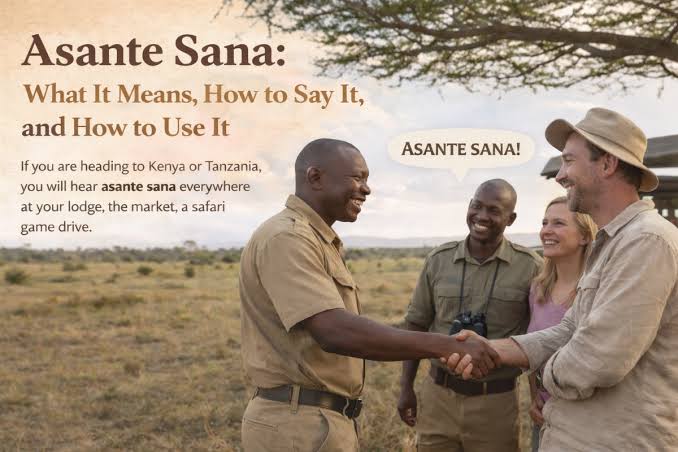
Asante — “thank you” — and its emphatic form Asante sana — “thank you very much” — are the highest-frequency words any safari visitor uses, and they should be applied liberally and genuinely throughout every day of an East Africa trip. The cultural significance of expressed gratitude in Swahili-speaking communities is different from its Western equivalent — it is not merely polite formality but a meaningful acknowledgment of the effort and service that has been provided — and consistent, sincere use of Asante sana throughout your stay builds a cumulative effect of mutual regard with guides and lodge staff that produces the kind of unhurried, generous service and personal attention that money alone cannot purchase. The standard response to Asante is Karibu — “you’re welcome,” which is also the standard Swahili word for “welcome” in all its senses including the welcoming of guests to a home or establishment. Hearing the lodge manager say Karibu sana as you arrive, and responding with Asante sana, completes a brief cultural exchange that happens in ten seconds and establishes a social register of warmth and mutual respect that shapes every subsequent interaction during your stay.

Wildlife Vocabulary on the Game Drive

Learning the Swahili names for the major safari wildlife species adds an immediate and practical dimension to every game drive conversation, because your guide uses these names constantly and the English equivalent — particularly for specific subspecies, bird families, and behavioral terms — is sometimes less precise or less immediately communicative than the Swahili original. Simba — lion — is the most universally known, reinforced by several decades of popular culture, and Tembo for elephant and Twiga for giraffe complete the trio of most frequently used mega-fauna names that safari visitors learn almost involuntarily through repetition on their first morning drive. Chui — leopard — carries a specific cultural weight in Swahili because leopard’s nocturnal secrecy and cultural associations with cunning and power make it a word that guides often say with a particular quality of excitement and reverence when a sighting occurs. Kifaru — rhinoceros — and Nyati — buffalo — complete the Big Five vocabulary, and knowing all five in Swahili allows you to participate actively in “what’s on the itinerary today” conversations with your guide in a way that transforms from tourist interrogation into genuine planning discussion.

Beyond the Big Five, the Swahili safari vocabulary that produces the most rewarding conversations with guides covers behavioral observations and ecological phenomena that your guide narrates continuously during a drive. Chakula — food — and its verbal form Kula — to eat — appear in descriptions of foraging behavior; Uwindaji — hunting — and Kulinda — to protect or guard — describe predator and prey behavior; Maji — water — is one of the most important words in understanding daily animal movement patterns since water access drives the temporal structure of every wildlife community’s day. The word Ajabu — wonderful, amazing, extraordinary — is perhaps the most universally applicable Swahili wildlife reaction term and can be applied to any sighting from a spectacular bird to a dramatic predator encounter; your guide will immediately recognize and appreciate the sentiment it expresses regardless of whether your pronunciation is perfect or imperfect, because the word itself carries enough cultural weight that even an approximation communicates genuine enthusiasm for what you have both just witnessed.

Practical Phrases and Cultural Interactions

Communication for Markets, Meals, and Daily Life

Numbers, Directions, and Basic Requests

Basic number vocabulary — moja (one), mbili (two), tatu (three), nne (four), tano (five), kumi (ten), mia (hundred) — enables price negotiation at markets and curio shops throughout East Africa and immediately signals to vendors that you are an informed and engaged buyer rather than a tourist who accepts whatever price is named first. The convention at most informal East African markets is that the first price quoted is significantly above the expected transaction price, and responding to Shilingi elfu kumi (ten thousand shillings) with a counter of Shilingi elfu tano (five thousand shillings) in Swahili produces a qualitatively different negotiation dynamic than the same transaction conducted entirely in English through pointing and calculator-display price-showing, because the Swahili engagement signals cultural literacy and mutual respect that skilled vendors recognize and respond to with more genuine pricing flexibility. Ngapi? — “how much?” — is the indispensable single-word market phrase that initiates every purchase inquiry, and Ni ghali sana — “it’s very expensive” — provides the essential negotiation opening once the first price has been stated.

Safari lodge and camp interactions in Swahili create the most affecting moments of cross-cultural connection precisely because they are unexpected from an international visitor in a context where English is the operational language of all formal transactions. Asking the camp chef Chakula kilikuwa kizuri sana — “the food was very good” — after dinner, or telling the laundry attendant Asante kwa kazi nzuri — “thank you for the good work” — when collecting your clean clothes, or saying Lala salama — “sleep well/safely” — to lodge staff at the end of the evening produces moments of genuine delight and surprise that generate a quality of human connection between guest and staff that the most expensive lodge upgrade cannot manufacture but that a few memorized Swahili phrases deliver reliably and without cost. The willingness to speak imperfectly in another person’s language is one of the most universally appreciated human gestures across all cultures, and Swahili-speaking Africa is no exception — the laugh of recognition when a visitor tries and partially succeeds at a Swahili sentence is warmer, more inclusive, and more connecting than any perfectly delivered compliment in English.

Plan Your Safari

African Wild Trekkers provides every guest with a pre-departure Swahili language preparation guide tailored to the specific regions and communities on their itinerary, because the specific Swahili vocabulary most useful in Kenya’s Masai Mara differs from the vocabulary most useful in Tanzania’s Zanzibar coast or in Uganda’s Bwindi community visits. Our guides are also specifically briefed to act as enthusiastic Swahili teachers during game drives — making time at quieter moments to teach vocabulary, share the etymology and cultural context of specific words, and create the kind of linguistic immersion that transforms a safari from a wildlife viewing exercise into a genuine cultural encounter with the living language of the landscape.

We have found consistently over many years of hosting international safari guests that the travelers who invest even a modest amount of pre-departure effort in learning basic Swahili return home with a qualitatively richer and more personally meaningful Africa experience than those who rely entirely on English — not because of the specific words they learn but because the act of learning them creates an attitude of genuine cultural curiosity and openness to encounter that shapes every interaction throughout the trip in ways that no amount of luxury accommodation or exclusive wildlife access can replicate.

Contact African Wild Trekkers at africanwildtrekkers.com/contact with your planned destination and we will send your personalized Swahili safari language guide as part of your pre-departure preparation documents within 24 hours.
Why Learning Basic Swahili Transforms Your Safari Experience

Kiswahili — commonly called Swahili — is the most widely spoken African language on the continent, functioning as the primary language of cross-cultural communication across Kenya, Tanzania, Uganda, Rwanda, Burundi, the Democratic Republic of Congo, and the coastal regions of Mozambique and Somalia, with an estimated 200 million speakers using it as either a first or second language. Its status as a lingua franca across East and Central Africa means that learning even twenty or thirty words of Swahili before a safari trip creates connection and warmth with guides, lodge staff, community members, and market vendors across the full geographic range of the East African safari circuit — from the Kenyan coast to the Tanzanian highlands, from the Ugandan jungle to the Rwandan volcanic mountains. The effort required to learn functional basic Swahili is minimal; the language has a largely regular phonetic system without the tonal complexities of many other African languages, its grammatical structures can be approximated rather than mastered for basic communication purposes, and the cultural appreciation that even imperfect Swahili attempts generate from native speakers makes the learning investment pay dividends from the first morning game drive conversation with your guide.

The specific value of Swahili on safari goes beyond basic politeness, though that dimension alone is significant. Swahili is the language in which your guide narrates their internal monologue about what is happening in the landscape — the sound that betrays an approaching predator, the track pattern that suggests a specific animal’s behavior, the alarm call network that carries information about a kill in the next valley — and even partial understanding of the Swahili terms your guide uses to describe wildlife and ecological phenomena adds a layer of comprehension to the game drive that an entirely passive translation-dependent experience cannot replicate. When your guide says “Simba pale” and points, you already know what they saw before the vehicle has turned; when they call out “Ndege wa ajabu” over a spectacular bird, you understand that they are sharing your sense of wonder rather than simply filing a sighting report. These moments of shared language create a fundamentally different quality of guide-guest relationship — one of genuine communication between two people rather than the one-directional delivery of information from expert to tourist — and that quality of relationship determines more than any other single factor how memorable and personally affecting the safari experience becomes.

Essential Greetings and Polite Phrases

The Words That Open Every Conversation

Greetings for Every Time of Day

Jambo — a simplified greeting derived from the fuller form Hujambo — is the most recognizable Swahili word for most international visitors and functions as a general “hello” appropriate in most contexts, though Swahili speakers often appreciate the more culturally specific greetings that vary by time of day and formality level. Habari ya asubuhi — “news of the morning,” or simply “good morning” in functional translation — is the appropriate greeting for the pre-dawn game drive departure, and responding with Nzuri sana — “very good” — to the expected follow-up question Habari gani? — “What news?” or “How are things?” — completes the basic morning greeting exchange that your guide will almost certainly initiate on the first drive. Habari za mchana (good afternoon) and Habari za jioni (good evening) follow the same pattern for their respective times of day, and using the time-specific greeting rather than the generic Jambo signals a level of effort and cultural interest that guides and lodge staff consistently respond to with warmth and willingness to teach further. Shikamoo — a respectful greeting directed to elders or people of higher social status — and its response Marahaba are the expressions of generational deference that Swahili culture uses to acknowledge age and experience, and using Shikamoo with older lodge staff or community elders produces a visibly delighted response that no other Swahili phrase generates as reliably.

Asante — “thank you” — and its emphatic form Asante sana — “thank you very much” — are the highest-frequency words any safari visitor uses, and they should be applied liberally and genuinely throughout every day of an East Africa trip. The cultural significance of expressed gratitude in Swahili-speaking communities is different from its Western equivalent — it is not merely polite formality but a meaningful acknowledgment of the effort and service that has been provided — and consistent, sincere use of Asante sana throughout your stay builds a cumulative effect of mutual regard with guides and lodge staff that produces the kind of unhurried, generous service and personal attention that money alone cannot purchase. The standard response to Asante is Karibu — “you’re welcome,” which is also the standard Swahili word for “welcome” in all its senses including the welcoming of guests to a home or establishment. Hearing the lodge manager say Karibu sana as you arrive, and responding with Asante sana, completes a brief cultural exchange that happens in ten seconds and establishes a social register of warmth and mutual respect that shapes every subsequent interaction during your stay.

Wildlife Vocabulary on the Game Drive

Learning the Swahili names for the major safari wildlife species adds an immediate and practical dimension to every game drive conversation, because your guide uses these names constantly and the English equivalent — particularly for specific subspecies, bird families, and behavioral terms — is sometimes less precise or less immediately communicative than the Swahili original. Simba — lion — is the most universally known, reinforced by several decades of popular culture, and Tembo for elephant and Twiga for giraffe complete the trio of most frequently used mega-fauna names that safari visitors learn almost involuntarily through repetition on their first morning drive. Chui — leopard — carries a specific cultural weight in Swahili because leopard’s nocturnal secrecy and cultural associations with cunning and power make it a word that guides often say with a particular quality of excitement and reverence when a sighting occurs. Kifaru — rhinoceros — and Nyati — buffalo — complete the Big Five vocabulary, and knowing all five in Swahili allows you to participate actively in “what’s on the itinerary today” conversations with your guide in a way that transforms from tourist interrogation into genuine planning discussion.

Beyond the Big Five, the Swahili safari vocabulary that produces the most rewarding conversations with guides covers behavioral observations and ecological phenomena that your guide narrates continuously during a drive. Chakula — food — and its verbal form Kula — to eat — appear in descriptions of foraging behavior; Uwindaji — hunting — and Kulinda — to protect or guard — describe predator and prey behavior; Maji — water — is one of the most important words in understanding daily animal movement patterns since water access drives the temporal structure of every wildlife community’s day. The word Ajabu — wonderful, amazing, extraordinary — is perhaps the most universally applicable Swahili wildlife reaction term and can be applied to any sighting from a spectacular bird to a dramatic predator encounter; your guide will immediately recognize and appreciate the sentiment it expresses regardless of whether your pronunciation is perfect or imperfect, because the word itself carries enough cultural weight that even an approximation communicates genuine enthusiasm for what you have both just witnessed.

Practical Phrases and Cultural Interactions

Communication for Markets, Meals, and Daily Life

Numbers, Directions, and Basic Requests

Basic number vocabulary — moja (one), mbili (two), tatu (three), nne (four), tano (five), kumi (ten), mia (hundred) — enables price negotiation at markets and curio shops throughout East Africa and immediately signals to vendors that you are an informed and engaged buyer rather than a tourist who accepts whatever price is named first. The convention at most informal East African markets is that the first price quoted is significantly above the expected transaction price, and responding to Shilingi elfu kumi (ten thousand shillings) with a counter of Shilingi elfu tano (five thousand shillings) in Swahili produces a qualitatively different negotiation dynamic than the same transaction conducted entirely in English through pointing and calculator-display price-showing, because the Swahili engagement signals cultural literacy and mutual respect that skilled vendors recognize and respond to with more genuine pricing flexibility. Ngapi? — “how much?” — is the indispensable single-word market phrase that initiates every purchase inquiry, and Ni ghali sana — “it’s very expensive” — provides the essential negotiation opening once the first price has been stated.

Safari lodge and camp interactions in Swahili create the most affecting moments of cross-cultural connection precisely because they are unexpected from an international visitor in a context where English is the operational language of all formal transactions. Asking the camp chef Chakula kilikuwa kizuri sana — “the food was very good” — after dinner, or telling the laundry attendant Asante kwa kazi nzuri — “thank you for the good work” — when collecting your clean clothes, or saying Lala salama — “sleep well/safely” — to lodge staff at the end of the evening produces moments of genuine delight and surprise that generate a quality of human connection between guest and staff that the most expensive lodge upgrade cannot manufacture but that a few memorized Swahili phrases deliver reliably and without cost. The willingness to speak imperfectly in another person’s language is one of the most universally appreciated human gestures across all cultures, and Swahili-speaking Africa is no exception — the laugh of recognition when a visitor tries and partially succeeds at a Swahili sentence is warmer, more inclusive, and more connecting than any perfectly delivered compliment in English.

Plan Your Safari

African Wild Trekkers provides every guest with a pre-departure Swahili language preparation guide tailored to the specific regions and communities on their itinerary, because the specific Swahili vocabulary most useful in Kenya’s Masai Mara differs from the vocabulary most useful in Tanzania’s Zanzibar coast or in Uganda’s Bwindi community visits. Our guides are also specifically briefed to act as enthusiastic Swahili teachers during game drives — making time at quieter moments to teach vocabulary, share the etymology and cultural context of specific words, and create the kind of linguistic immersion that transforms a safari from a wildlife viewing exercise into a genuine cultural encounter with the living language of the landscape.

We have found consistently over many years of hosting international safari guests that the travelers who invest even a modest amount of pre-departure effort in learning basic Swahili return home with a qualitatively richer and more personally meaningful Africa experience than those who rely entirely on English — not because of the specific words they learn but because the act of learning them creates an attitude of genuine cultural curiosity and openness to encounter that shapes every interaction throughout the trip in ways that no amount of luxury accommodation or exclusive wildlife access can replicate.

Contact African Wild Trekkers at africanwildtrekkers.com/contact with your planned destination and we will send your personalized Swahili safari language guide as part of your pre-departure preparation documents within 24 hours.