Slender Mongoose Guide: The Bold Daytime Predator of African Thornbush
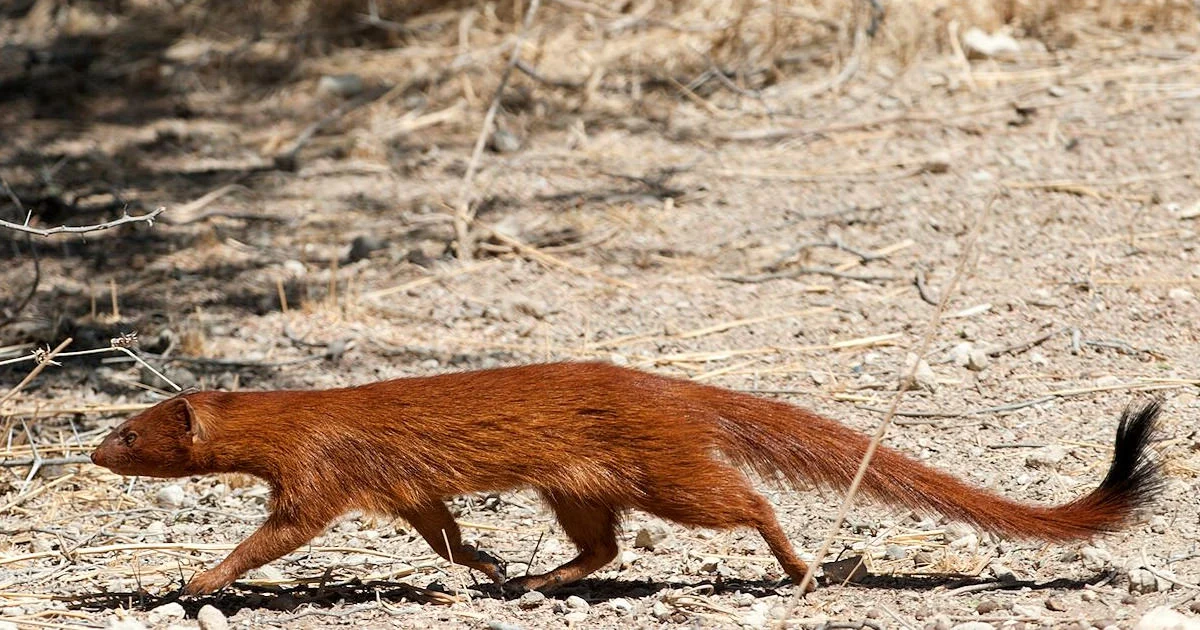
Most mongooses are sociable. The slender mongoose is not. It hunts alone in full daylight. It is fast, curious, and perpetually alert, and it crosses open ground at speed with its back arched and its tail held vertically—a signature silhouette that experienced safari watchers recognize in an instant.
What Is the Slender Mongoose?
The slender mongoose, Galerella sanguinea, is a small mongoose species in the family Herpestidae. It is one of the most widely distributed mongooses in sub-Saharan Africa. Multiple subspecies exist across the continent, differing mainly in coat color. The species name “sanguinea” means “blood red” in Latin—a reference to the reddish coloring of certain southern African populations.
An adult slender mongoose weighs between 370 and 800 grams. Body length reaches about 33 centimeters. The tail adds another 25 centimeters. The build is lean, elongated, and low to the ground—features that aid pursuit of prey through dense vegetation and between rocks.
Physical Features and Colour Variation
The slender mongoose varies considerably in color across its range. In East Africa, most individuals are olive-brown or greyish-brown with a faintly grizzled coat. The underside is slightly paler. The tail is darker than the body and ends in a black tip. This black-tipped tail, held upright when the animal runs, is the most consistent identification feature across all color forms.
The face is pointed with a sharp snout and large dark eyes. The ears are small and pressed close to the head. The legs are short relative to the body, giving the animal a low, sinuous running posture. The claws are sharp and slightly recurved—effective for digging and gripping prey.
Diet and Hunting: Snakes, Lizards, and More
The slender mongoose eats lizards, small snakes, rodents, birds, eggs, insects, and small frogs. It kills prey with a bite to the back of the skull or the neck. It is fast and decisive. Prey has little time to react once the mongoose commits to an attack.
The slender mongoose attacks snakes, including venomous species. It is partially resistant to neurotoxic venom. It approaches a snake with a series of rapid feints, forcing the snake to strike repeatedly and exhaust itself. Then the mongoose moves in and bites the snake behind the head. The attack sequence is rapid, precise, and largely immune to counterattack.
Solitary and Territorial Behaviour
Slender mongooses are solitary. Each individual holds a territory and defends it actively against same-sex rivals. They mark territory boundaries with anal gland secretions and urine. Males hold larger territories that overlap with those of several females. Encounters between males at shared boundary points involve chasing and occasional brief combat.
Slender mongooses are diurnal—active in daylight hours. They forage most intensively in the morning and late afternoon. They rest in the shade or in a burrow during midday heat. This daytime activity pattern makes them among the most visible small carnivores in East Africa. They regularly cross roads and open areas without hesitation.
Range and Habitat in East Africa
Slender mongooses live across sub-Saharan Africa from Senegal to Ethiopia and south to the Cape. In East Africa they are common throughout Uganda, Kenya, and Tanzania. They occupy savannas, dry woodlands, thornbushes, rocky hillsides, and the edges of cultivation. They tolerate modified habitat better than most small carnivores.
In Uganda they live in almost every park and protected area. Murchison Falls, Queen Elizabeth, and Kidepo all hold them. In Kenya they are particularly common in the dry areas of Tsavo and Samburu. Tanzania’s Serengeti and Tarangire hold healthy populations in open woodland.
The Slender Mongoose’s Bold Personality
The slender mongoose is unusually bold for an animal of its size. It crosses open ground without the hesitant, stop-start behavior most small carnivores display in exposed areas. It approaches novel objects with curiosity rather than avoidance, and it will approach a stationary vehicle closely and stand upright on its hind legs to investigate. This boldness serves it well in the daytime environment where rapid, confident movement reduces the time spent vulnerable in the open.
The slender mongoose is also remarkably persistent at killing. It will defend a food item against animals several times its size through determined aggression. Repeated biting and scratching at an aggressor’s face and feet often cause the larger animal to retreat simply to avoid the irritation. This tenacity allows the slender mongoose to hold onto prey against competition that would displace most animals of its size.
Conservation Status and Population
The slender mongoose is classified as Least Concern by the IUCN. Multiple subspecies exist with slightly different ranges and color forms. The species is common across East Africa in suitable habitat. Population trends show no significant decline. The slender mongoose is one of the small carnivores most likely to persist in modified habitats because it tolerates light agricultural land and secondary bush.
Road mortality affects slender mongoose populations near heavily trafficked roads. The species’ bold, rapid crossing behavior puts it at risk from fast-moving vehicles on sealed roads through national parks and conservancies. This is a known issue in Kenya’s Tsavo and Tanzania’s Serengeti, where road mortality monitoring has documented slender mongooses among the most frequently killed small carnivores on main tarmac routes through protected areas.
Plan Your Safari
The slender mongoose is one of the easiest small carnivores to watch in East Africa. Drive slowly through dry woodland or along game tracks through thornbush at any time of day. The upright black-tipped tail crossing a patch of open ground at speed is the most common encounter. The animal usually pauses to look back before disappearing into cover.
Kenya’s Tsavo East and Tsavo West produce excellent slender mongoose encounters. Tanzania’s Tarangire open woodland is equally good. Uganda’s northern savanna parks hold them wherever thornbush and rocky outcrops provide hunting habitat.
African Wild Trekkers designs East Africa safaris that pay attention to small mammals as well as the iconic big game. Contact us to build a trip that captures the full breadth of East Africa’s extraordinary carnivore diversity.