L’Hoest’s Monkey Uganda: The Terrestrial Forest Primate of the Albertine Rift
L’Hoest’s monkey spends more time on the ground than any other guenon in East Africa. While blue monkeys, red-tailed monkeys, and colobus species keep primarily to the canopy, L’Hoest’s troops move along the forest floor—crossing clearings, following stream channels, and feeding on the ground-level plants of the forest understory.
This terrestrial tendency makes L’Hoest’s monkeys distinctly different to observe from other Ugandan forest primates. A troop moving along a forest floor trail in Bwindi passes almost at foot level—the white beard and dark face of each individual are visible at close range without the neck-craning canopy observation that most forest primate encounters require.
What Is L’Hoest’s Monkey?
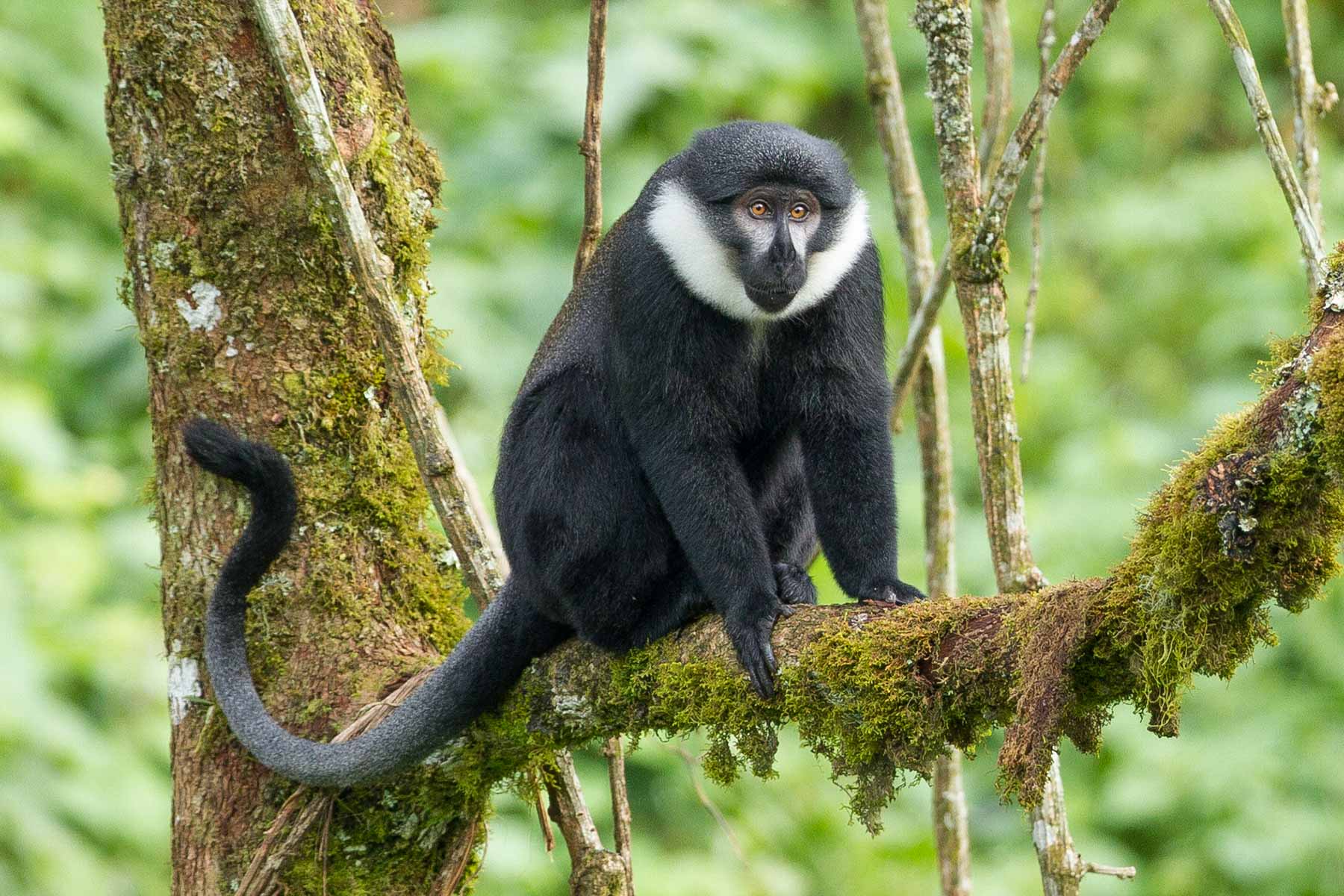
L’Hoest’s monkey, Allochrocebus lhoesti, is a medium-sized guenon. Adults weigh between 3.5 and 6 kilograms. Body length reaches 46 to 60 centimeters with a tail of 52 to 65 centimeters.
The coat is dark, almost blackish-grey on the back and limbs, with reddish-brown saddle markings on the mid-back. The face is dark grey with a distinctive white bib or beard covering the throat and lower cheeks—the most immediate field identification feature.
The tail carries a characteristic backward-curving tip that arches upward at the end. Both sexes look similar, though males are larger.
The species belongs to the same taxonomic group as the Preuss’s monkey and the Dryas monkey of Central Africa. It occupies the Albertine Rift’s forest zone and represents one of the region’s most distinctive primate endemics.
Terrestrial Behaviour and Forest Floor Life
L’Hoest’s monkeys forage on the forest floor for fallen fruit, fungi, roots, and invertebrates. They also feed in the lower canopy on leaves, buds, and fruit.
The terrestrial component of the diet allows exploitation of food resources — roots, fungi, and fallen seeds — that strict canopy species cannot efficiently access. Troops move in a cohesive group along the forest floor, with adults at the periphery and juveniles moving inside the group.
When alarmed, the troop retreats upward into the lower canopy rather than deeper into ground-level vegetation.
Social Structure and Single-male Groups
L’Hoest’s monkey troops contain one adult male and multiple adult females with offspring. Group size ranges from 5 to 17 individuals. The single male defends the group from rival males and produces a loud territorial call—a series of loud crashing barks that carry through the forest.
Males transfer between groups, while females remain in their birth group. The male’s peripheral and defensive role mirrors the pattern seen in other single-male cercopithecine groups.
This social system concentrates the benefits of male defense without the competition and caloric costs of maintaining multiple adult males in the group.
Range in Uganda
L’Hoest’s monkeys occur in Uganda’s Bwindi Impenetrable Forest and Kibale National Park—the two main Ugandan forest primate destinations. They also appear in Mgahinga Gorilla National Park and in the forests of the Rwenzori Mountains.
Rwanda’s Nyungwe Forest holds a significant L’Hoest’s monkey population. The species’ Albertine Rift distribution means it does not occur in Kenya or Tanzania’s forest areas.
Plan Your Safari
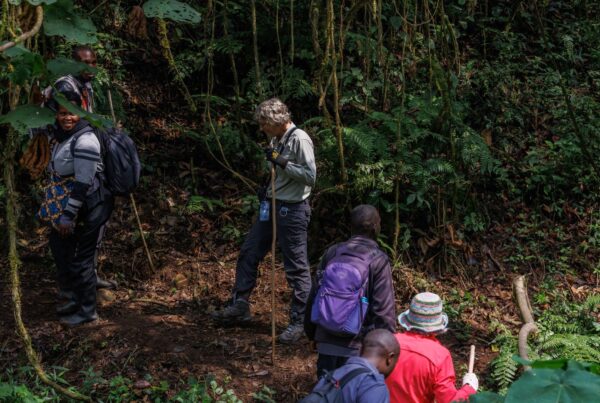
Uganda’s Bwindi Impenetrable Forest and Kibale National Park both produce L’Hoest’s monkey encounters on guided forest walks. Bwindi’s gorilla tracking trails pass through L’Hoest’s monkey territory regularly—a troop moving along the forest floor during a gorilla tracking day adds a significant primate sighting to what is already one of East Africa’s premier wildlife experiences.
Kibale’s chimp-tracking circuits produce encounters in the lower canopy and forest edge zones. Rwanda’s Nyungwe Forest primate walks include L’Hoest’s monkeys alongside colobus and other Albertine Rift specialties.
African Wild Trekkers designs Uganda and Rwanda forest safari itineraries combining gorilla tracking, chimpanzee tracking, and full primate diversity walks across the Albertine Rift. Contact us to plan a forest safari capturing East Africa’s most extraordinary primate community.