Cheetah Tracking Safari Africa: Following the World’s Fastest Land Animal Across the Plains
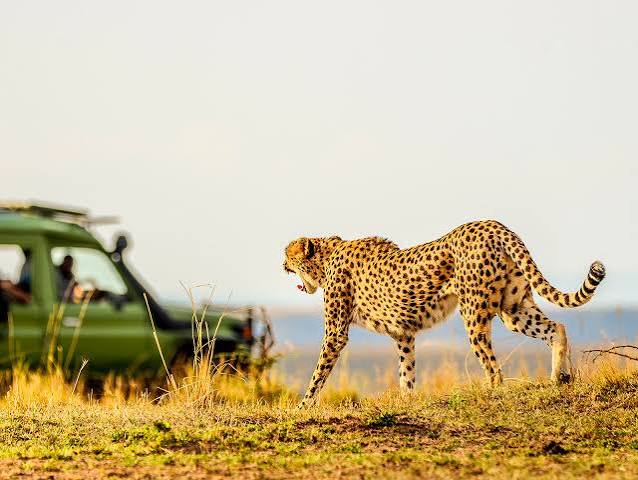
The cheetah is the most diurnal of Africa’s large predators. It hunts in the morning and late afternoon — the same hours that game drives operate. Unlike the leopard and lion, which rely on darkness as their primary hunting advantage, the cheetah relies on open-country visibility and pure speed. It climbs onto a termite mound, surveys the surrounding plain, and selects a target gazelle. Then it initiates a sprint that accelerates from 0 to 100 kilometres per hour in 3 seconds. This hunt takes place in full daylight, in open grassland, visible from 500 metres. The cheetah is East Africa’s most watchable predator — not the most dangerous or dramatic, but the most accessible to genuine behavioural observation across a full hunting sequence.
Hunting Behaviour: The Full Sequence
A cheetah hunt follows a predictable sequence that patient observation from a stationary vehicle captures completely. The cheetah positions itself on elevated ground — a termite mound, a fallen tree, or a rocky outcrop. It scans the surrounding plain with fixed attention. Its gaze locks on a specific target and tracks it. This stalk phase can last 20 to 40 minutes as the cheetah approaches using available cover. The sprint begins without warning — acceleration is explosive. The target gazelle bolts. The cheetah cuts corners in the zigzag pursuit. If the cheetah closes to within 5 metres and the sprint is under 300 metres, it succeeds on approximately 50 to 60 percent of attempts. However, a sprint exceeding 500 metres causes heat exhaustion. The cheetah then rests and cools for 20 to 30 minutes before it can eat.
Coalition Males and Mother Groups
Cheetahs live in three social configurations. Solitary females raise cubs alone. Male coalitions of two to three brothers hold territories together, increasing hunting success on larger prey. Female cheetahs with cubs of 3 to 18 months form the most photogenic group for safari observation. The cubs practice hunting on small prey. They play with each other across the savanna grass. The mother teaches through demonstration — bringing injured live prey for the cubs to practice the kill. Furthermore, older cubs attempt independent hunts while the mother watches nearby. She intervenes only when the young cheetah is about to lose its quarry. This teaching sequence, observed over a 2 to 3 hour morning session, is one of East Africa’s most compelling predator behaviour encounters.
Best East Africa Cheetah Locations
The Maasai Mara ecosystem in Kenya and the Serengeti in Tanzania carry the highest cheetah densities in East Africa. Open grassland with high prey density and reliable gazelle populations provides ideal cheetah habitat. The Mara’s conservancies particularly Naboisho, Ol Kinyei, and Mara North carry resident cheetah populations whose daily movements guides track systematically. Tanzania’s Ndutu area in the Serengeti’s southern sector is productive between January and March. This is the wildebeest calving season, which provides easy prey for cheetah mothers feeding large cubs.
Plan Your Safari
Cheetah tracking in the Maasai Mara conservancies is most productive between July and October during the dry season. Short grass maximises visibility and game concentrations are highest during this period. A minimum stay of four nights in the Mara ecosystem allows multiple tracking mornings. This significantly increases the probability of witnessing a complete hunt sequence. Tanzania’s Serengeti southern sector is most productive between January and March. Camps positioned in the short grass plains rather than the woodlands provide the open-country access that cheetah tracking requires.
African Wild Trekkers designs Kenya and Tanzania safari itineraries timed and positioned for optimal cheetah tracking. Contact us to plan a safari that focuses on the full range of East Africa’s big cat encounters from dawn to dusk.