Saddle-billed Stork: Africa’s Most Dramatically Coloured Large Wading Bird
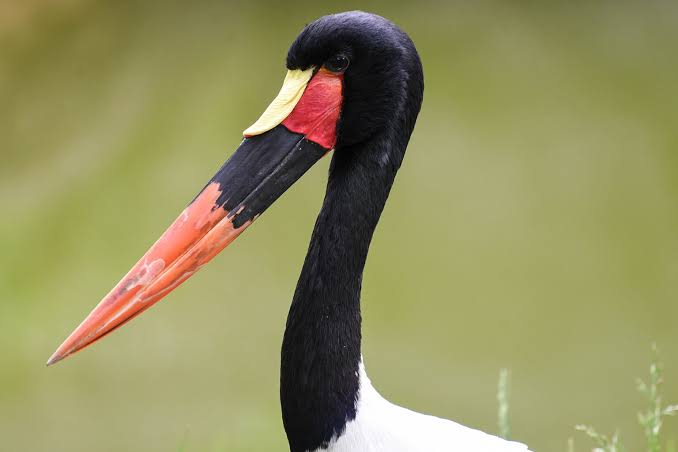
The saddle-billed stork is widely regarded as Africa’s most beautiful stork. The vivid combination of red and black on the bill, the bright yellow frontal saddle that gives the species its name, the black and white body plumage, and the striking red and yellow legs creates a colour palette that makes this stork look more like a stylised illustration than a wild bird. When one stands in shallow water with the full plumage visible in good morning light, it is one of the most visually arresting birds in East Africa.
The species is large, standing up to 1.5 metres tall with a wingspan of up to 2.7 metres. Despite its size, it is less common than the yellow-billed stork and encounters at good viewing range are genuinely special moments on any East Africa safari that produces them.
Identification
The saddle-billed stork’s bill is the most immediately distinctive feature of any stork in Africa. The bill is vivid red at the base with a black central band. The tip is red. Between the red base and the black band sits the bright yellow frontal “saddle” — a flattened shield of yellow skin at the top of the bill base. The bill measures up to 30 centimetres and the colour pattern is visible from a considerable distance.
The body plumage is black and white with a bold division between the black head and neck and the white body. The wings are black with a white wing patch. The legs are red with yellow “knee” joints. The male shows a yellow eye. The female shows a yellow eye ring around a dark eye pupil. This eye difference is the only reliable plumage distinction between male and female birds.
Immature saddle-billed storks show grey-brown plumage gradually replaced by the adult black and white pattern over 3 to 4 years. Young birds show a less vivid bill pattern than adults. However, even in young birds, the yellow saddle is present and immediately distinguishes the species from any other young stork species in the region.
Feeding and Behaviour
Saddle-billed storks feed in shallow water on fish, frogs, crabs, and aquatic invertebrates. They are visual hunters, standing motionless or wading slowly through the shallows while watching the water surface for prey movement. The long bill is thrust forward in a fast, direct strike when prey is detected.
The species is typically encountered singly or in pairs. It does not form the large feeding groups that yellow-billed storks sometimes create at productive foraging sites. The pair bond is strong and long-term, with established pairs occupying the same wetland territory across multiple breeding seasons.
The nest is a large platform of sticks built high in a tall tree near water. The same nest tree may be used for several consecutive breeding seasons. Both parents incubate the 2 to 5 eggs and share the chick-feeding duties throughout the extended fledging period.
Where to See Saddle-billed Storks in East Africa
Saddle-billed storks are present at large wetland areas throughout East Africa but at relatively low density. The most reliable East African locations are Uganda’s Queen Elizabeth National Park wetlands, Tanzania’s Selous-Nyerere and Ruaha rivers, and Kenya’s Maasai Mara seasonal marshes.
Uganda’s Murchison Falls National Park carries saddle-billed storks along the Nile River banks and in the delta wetlands. The park’s boat trips on the Nile regularly encounter the species at close range along the river margins.
Tanzania’s Serengeti seasonal marshes during the long rains season and the Grumeti River along the western corridor provide saddle-billed stork encounters. The Selous-Nyerere ecosystem’s lake system, particularly Lake Tagalala and the seasonal floodplains, carries reliable saddle-billed stork populations accessible on game drives and walking safaris in the park.
Plan Your Birding Safari
Saddle-billed stork sightings require wetland destinations with large permanent water and low visitor disturbance. Uganda’s Murchison Falls and Tanzania’s Selous-Nyerere provide the most reliable environments within established safari circuits.
The saddle-billed stork rewards patient observation. Watching a pair feed in shallow water with the full plumage visible in early morning light is one of East Africa’s most spectacular waterbird encounters and a defining moment of any safari that achieves it.
African Wild Trekkers designs East Africa safari itineraries that include the wetland destinations where saddle-billed stork encounters are most likely. Contact us to plan a safari that experiences the full range of East Africa’s extraordinary stork diversity.