Uganda Hornbill Species: 15 Remarkable Birds Across the Pearl of Africa
Uganda hornbill species diversity extends to 15 confirmed species across the country’s forest and savanna habitats. The horn bill species include the enormous southern ground hornbill of the open savanna and the tiny red-billed dwarf hornbill of the Congo Basin lowland forest. Uganda hornbill species are some of the most conspicuous and loudest birds in any Uganda habitat. Their calls carry far through the forest or across the savanna and alert visiting birders to their presence before visual location is made. Uganda hornbill species divide clearly between forest species and open-country species with very little habitat overlap between the two groups. Understanding this division helps visitors find Uganda hornbill species efficiently at each safari destination.
Uganda hornbill species are long-lived, slow-breeding birds that mate for life. Hornbill pairs use the same nest hole for multiple consecutive breeding seasons. The female seals herself inside the nest hole during incubation and raises the chicks inside the sealed chamber. The male feeds her through a narrow slit for the two to three months of the nesting period. This nesting behaviour is one of Africa’s most extraordinary breeding strategies. Uganda hornbill species are therefore very sensitive to nest hole availability and forest quality. Habitat destruction affects Uganda hornbill species populations more severely than many other African bird groups.
Forest Uganda Hornbill Species
Semuliki Uganda Hornbill Species
Semuliki National Park holds the richest Uganda hornbill species community in the country. Five Uganda hornbill species inhabit the Semuliki lowland forest and all five occur together in the Royal Mile section. Red-billed dwarf hornbill is the smallest and most distinctive Uganda hornbill species at Semuliki. Its loud call immediately announces its presence in the forest canopy. Piping hornbill is the largest Uganda hornbill species at the Semuliki site. Its metallic piping call carries far across the forest canopy. White-crested hornbill moves through the Semuliki canopy in groups of four to eight birds, creating a conspicuous movement pattern in the upper canopy.
Long-tailed hornbill is a Semuliki Uganda hornbill species with a very restricted Uganda range. This beautiful bird inhabits the mid-altitude forest interior and is rarely encountered outside Semuliki in Uganda. Black dwarf hornbill is the most secretive Uganda hornbill species in the Semuliki forest. Its quiet calls and understorey habitat make it far harder to locate than the conspicuous piping hornbill above it. The combination of five Uganda hornbill species in one forest site at Semuliki is unique in Uganda. No other single Uganda site produces this number of simultaneous Uganda hornbill species encounters.
Budongo and Kibale Uganda Hornbill Species
Budongo Forest holds three Uganda hornbill species. African grey hornbill inhabits the forest edge and Acacia zone above the Budongo escarpment rather than the forest interior. Black-and-white casqued hornbill is the most common and conspicuous Uganda hornbill species in Budongo. Its loud, laughing call is one of Budongo’s most characteristic forest sounds throughout the day. Pairs and small groups move through the Budongo Royal Mile canopy frequently during productive morning birding sessions. Kibale National Park similarly holds black-and-white casqued hornbill as the dominant forest Uganda hornbill species. Adding Semuliki to a Kibale birding visit significantly expands the Uganda hornbill species total for the western Uganda circuit.
Chocolate-backed kingfisher is often listed alongside the Budongo and Kibale Uganda hornbill species on morning forest bird lists. Although not a hornbill, it occupies a similar understorey foraging niche. The African pied hornbill inhabits the Kibale forest edge and the surrounding farmland and gardens. This small Uganda hornbill species is very common and tame in the Fort Portal area settlements. Black dwarf hornbill appears at Kibale in the forest interior sections but is rarely encountered. A specialist guide with current territory knowledge maximises black dwarf hornbill Uganda hornbill species encounter probability at Kibale.
Savanna Uganda Hornbill Species
Southern Ground Hornbill Uganda Hornbill Species
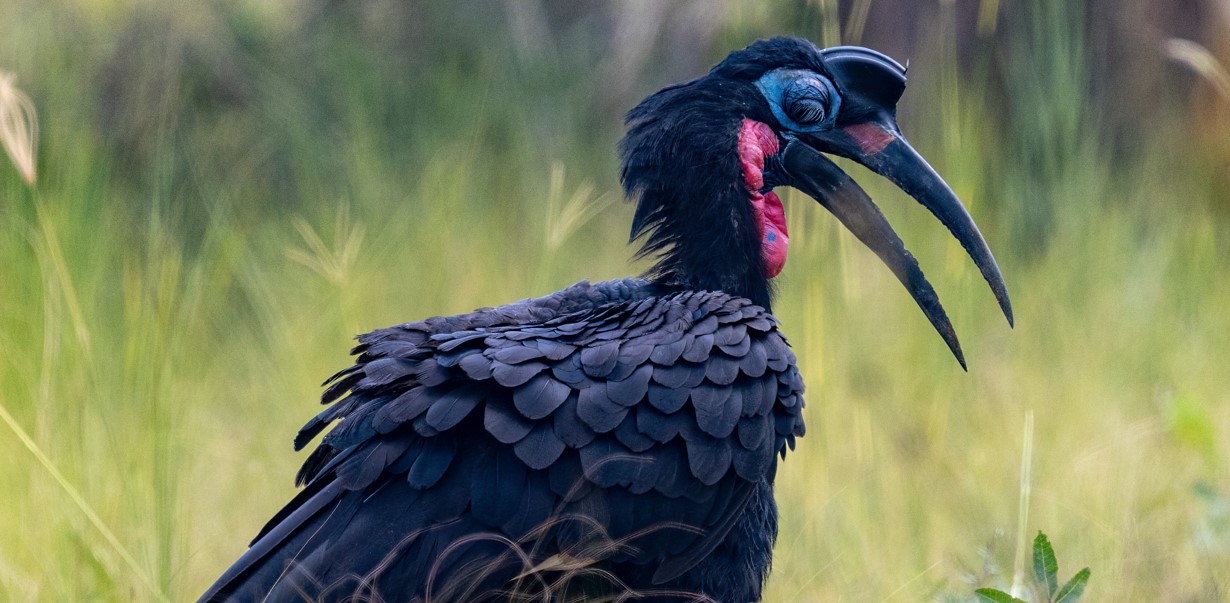
Southern ground hornbill is the largest and most impressive of all Uganda hornbill species. This enormous, turkey-sized bird strides through open savanna in pairs and small family groups. Southern ground hornbill has an entirely black body with vivid red facial skin and throat pouch. It calls with deep, resonant booming calls at dawn that carry across many kilometres of savanna. Southern ground hornbill is reliably seen at Murchison Falls, Queen Elizabeth, and Kidepo in open savanna habitat. A close encounter with a foraging southern ground hornbill family group at Murchison is one of Uganda’s most dramatic Uganda hornbill species experiences.
The southern ground hornbill Uganda hornbill species has a very slow breeding rate. Pairs breed only once every nine years on average. The species is therefore sensitive to any persecution or habitat loss that removes breeding adults from the population. Uganda’s national park populations are stable and provide reliable southern ground hornbill Uganda hornbill species encounters for visitors on game drives. The Uganda Wildlife Authority tracks breeding pairs in key sites. This population monitoring contributes to a broader African ground hornbill conservation programme that links Uganda sites to populations across the continent.
Other Savanna Uganda Hornbill Species
African grey hornbill is the most common savanna Uganda hornbill species across all Uganda national parks. Its descending wailing call from Acacia trees is one of the most characteristic savanna sounds. Yellow-billed hornbill inhabits the dry northern savanna and is the most conspicuous Uganda hornbill species at Kidepo Valley National Park. This hornbill feeds on the ground and in low shrubs, making it very easy to observe at close range from a safari vehicle. Northern red-billed hornbill is another Kidepo-specific Uganda hornbill species that inhabits the dry Acacia savanna of the Narus Valley. Both yellow-billed and red-billed hornbill are easiest to find at Kidepo and do not occur at the southern Uganda national parks.
Crowned hornbill inhabits the forest edge and woodland Uganda hornbill species zone in the central and western Uganda region. It differs from the savanna hornbills in its darker plumage and preference for more wooded habitats. Hemprich’s hornbill inhabits river courses in northern Uganda and is a localised Uganda hornbill species in the Murchison area. Both crowned and Hemprich’s hornbill complement the savanna Uganda hornbill species list with additional records in the woodland-savanna transition zone. A complete Uganda hornbill species list of 10 or more species requires visits to both the forest sites of western Uganda and the savanna and dry country sites of the north.
Plan Your Safari
Plan a Uganda hornbill species safari covering Semuliki for five forest species, Murchison for southern ground hornbill and savanna species, and Kidepo for yellow-billed and northern red-billed hornbill. Allow a minimum of two mornings at Semuliki for a comprehensive forest Uganda hornbill species encounter. Combine the Semuliki visit with a Fort Portal base and a western Uganda birding circuit.
African Wild Trekkers designs Uganda hornbill species safari itineraries for birders targeting the complete hornbill list. We arrange specialist guides at Semuliki, Budongo, and Kidepo, and design Uganda programmes that cover all 15 Uganda hornbill species in the most efficient circuit available.
Contact African Wild Trekkers to target Uganda hornbill species on your safari. We respond within 24 hours and build Uganda birding programmes that access the full range of forest and savanna hornbill species in the Pearl of Africa.