Wildebeest Migration Facts: The Annual Cycle Behind Africa’s Greatest Show
Over one and a half million wildebeest, 250,000 zebras, and 500,000 Thomson’s gazelles complete an annual loop through the Serengeti-Mara ecosystem. They cover 3,000 kilometers in a year and are driven by rainfall and grass rather than any internal calendar. They lose hundreds of thousands of individuals to predators and river crossings every year. And they reproduce enough to replace those losses and maintain the population’s size. The wildebeest migration is the largest terrestrial animal movement on earth.
What Drives the Migration?
The migration follows grass. Specifically, it follows the leading edge of short green grass that emerges after rainfall. The wildebeest do not anticipate rainfall — they respond to the grass that rain produces. The short-grass plains of the southern Serengeti receive their rains from December to April and produce the most nutrient-dense grass in the ecosystem. The wildebeest flood onto these plains and stay until the grass is gone.
As the southern plains dry, the grass on the western corridor of the Serengeti greens in response to long rains that arrive later from the west. The herds move west, then northwest. By May and June, they push into the tall-grass western corridor. By July, they are moving into the Maasai Mara in Kenya. In November, the short rains begin again in the south, and the wildebeest reverse course, flooding back to the short-grass plains to begin the cycle again.
The Calving Season: January to March
Approximately 500,000 wildebeest calves are born on the southern Serengeti plains between late January and mid-March. The synchrony of this birth event is one of the most extraordinary features of the migration. Over 80 percent of calves are born within a three-week window. This synchrony swamps predator capacity—lions, hyenas, and cheetahs cannot possibly kill calves fast enough to keep up with the supply. The predators eat to capacity for weeks, but the sheer number of calves means that most survive their first days.
A wildebeest calf stands within 3 to 7 minutes of birth. It runs with the herd within 24 hours. This accelerated development is essential in an environment where predators patrol constantly. Calves that cannot keep up with the herd within hours of birth die. The synchronous birth system evolved because the fitness advantage of being born in the safety-in-numbers window is enormous compared to being born outside it.
The Mara River Crossings: Risk and Drama
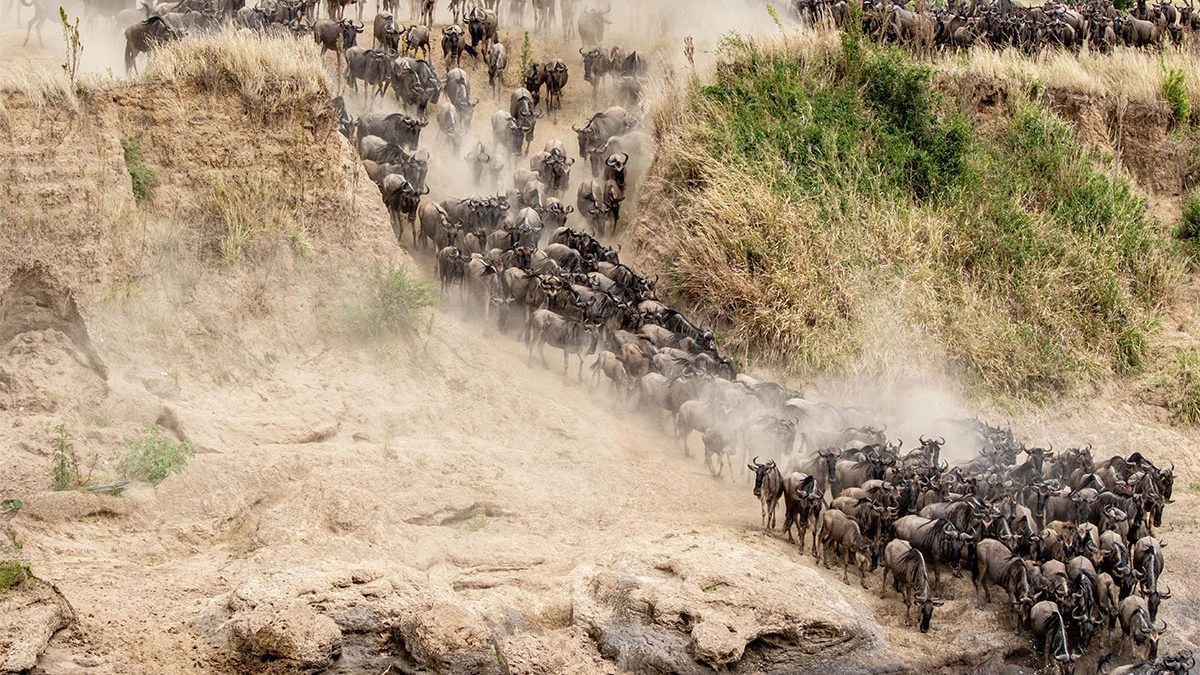
The Mara River crossings are the migration’s most visually dramatic feature. The river flows between Tanzania and Kenya’s Maasai Mara. Wildebeest herds build up on the southern bank—sometimes for days—before the collective nervous energy of the herd triggers a crossing attempt. The first animal to enter creates the cascade. Within minutes, thousands of wildebeest are swimming, scrambling over each other, and fighting the current.
Nile crocodiles wait at the crossings. A large Mara River crocodile weighing over 500 kilograms is capable of pulling a full-grown wildebeest underwater. Dozens of wildebeest drown or are taken by crocodiles at major crossings. Many more are injured by the stampede. The river bank becomes littered with carcasses after a large crossing. The caloric benefit to the crocodile population from the annual migration is extraordinary—Mara River crocodiles put on much of their annual body mass during the July-to-October crossing season.
What the Migration Means for the Ecosystem
The wildebeest migration is the engine of the Serengeti-Mara ecosystem. The annual passage of 1.5 million large grazers across 25,000 square kilometers of savanna maintains grass-dominated landscapes, fertilizes soils, and supports predator populations that would not survive at current density without the seasonal prey flush. Remove the wildebeest and the ecosystem changes at every trophic level. The migration is not a spectacle on top of the ecosystem — it is the ecosystem.
Plan Your Safari
The calving season — late January to mid-March — on the southern Serengeti plains around Ndutu is one of the least-visited and most rewarding times to visit. July through October in the Maasai Mara offers the famous river crossings. Both seasons deliver extraordinary wildlife encounters at very different scales. The full circle of the migration is best understood by visiting both ends of the cycle.
African Wild Trekkers designs Serengeti and Maasai Mara itineraries timed to every stage of the migration cycle. Contact us to plan a safari around Africa’s greatest wildlife event.