Common Warthog Facts: The Kneeling Digger of Africa’s Open Savanna
You will see the warthog every day on safari. It is the most visible and most consistently watched large pig in Africa and runs with its tail held straight up like a radio antenna.
It kneels to graze and reverses into burrows tail-first at sunset. Also charges lions and leopards with more determination than caution.
The warthog is as much a part of East Africa’s savanna character as the lion or the elephant—and considerably easier to find.
What Is the Common Warthog?
The common warthog, Phacochoerus africanus, is the most widespread wild pig in Africa. It belongs to the family Suidae and is related to domestic pigs, wild boars, and the much rarer giant forest hog.
The species occurs in four subspecies across sub-Saharan Africa. It prefers open savanna, grassland, and woodland edges with short grass and abundant burrow sites.
An adult male common warthog weighs between 60 and 150 kilograms. Females are smaller at 45 to 75 kilograms. Body length reaches 1.4 meters.
The skin is mostly bare with sparse, coarse hair. A mane of longer hair runs from the back of the head down the spine to the tail base.
The tail is thin and tipped with a small tuft of hair—held erect when the animal runs, the familiar signal of a warthog departing at speed.
The Warts: Their Function
The facial warts that give the warthog its name are not random dermal growths. Males have four warts — two large ones below the eyes and two smaller ones at the base of the upper tusks.
Females have only two or sometimes four smaller warts. The large warts in males function as protective cushions during the head-to-head combat that males engage in during competition for females.
Warthog fights involve direct head contact with the heavily armored face taking the impacts. The wart padding protects the eyes and the tusk bases during these collisions.
Larger warts correlate with fighting experience and competitive success.
Tusks and Defensive Use
The upper tusks of an adult male warthog curve upward and outward to lengths of 25 to 60 centimeters. The lower tusks are shorter, kept razor-sharp through constant contact with the upper tusks when the jaw closes.
Both sets of tusks are used in defense and in territorial male combat. A charging warthog uses the upper tusks in an upward slashing motion.
Documented cases of warthogs killing or seriously injuring leopards and cheetahs through tusk strikes exist from Kenya and Tanzania.
The warthog’s defensive response depends on the context. A solitary warthog confronted by a leopard will frequently charge rather than flee—particularly sows defending piglets.
The charge is low, fast, and directed at the underside of the predator. The upward tusk movement during the charge is aimed at the predator’s belly. Small predators retreat from this charge more often than not.
Kneeling to Graze
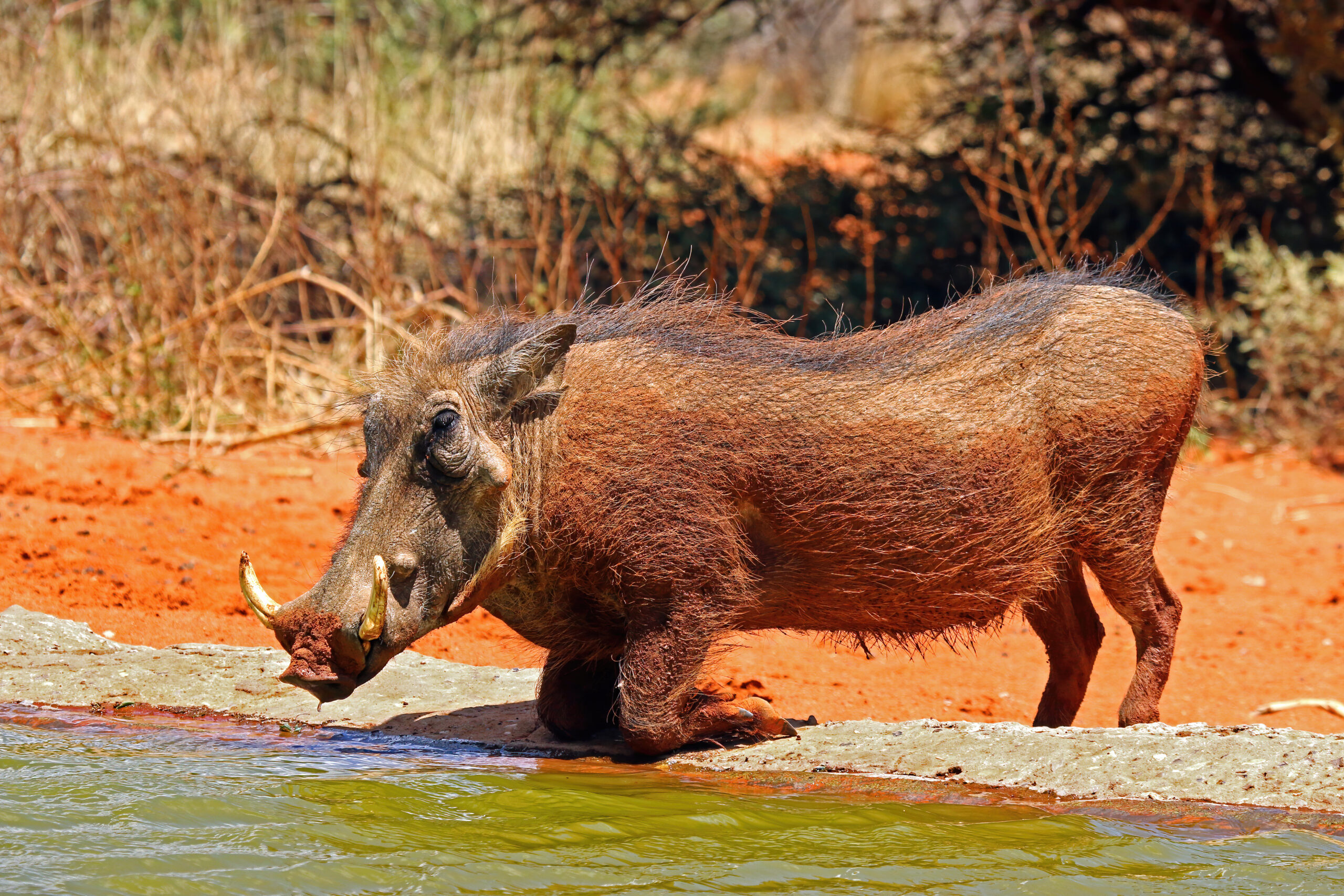
The warthog’s habit of kneeling while grazing is one of the most distinctive and charming behaviors visible on any East Africa game drive.
The animal drops to its knees on calloused knee pads—thickened skin developed specifically for this posture—and roots through short grass and bare soil with the snout and the flat, reinforced nose disc.
This kneeling posture allows the animal to access short grass and underground roots and bulbs efficiently without stretching its relatively short neck to reach the ground in a standing position.
Burrow Life
Warthogs do not dig their own burrows. They occupy burrows excavated by aardvarks. A family group uses several burrows within a home range, reversing into the entrance at sunset tail-first.
This reverse entry means the animal faces outward with tusks presented at the entrance—a functional defensive posture against any predator that attempts to follow it in.
The burrow provides safe sleeping, escape from predators, and shelter from temperature extremes during the heat of the day.
Plan Your Safari
Warthogs are everywhere in East Africa’s open parks. Queen Elizabeth National Park, Maasai Mara, Serengeti, Amboseli, and Akagera all hold abundant populations.
Uganda’s Murchison Falls and Lake Mburo are particularly good for close-approach warthog watching.
Watching a family group kneel to graze while their tails stand straight up in the morning light is one of those small, perfect safari moments that stays with visitors long after the lions and elephants have faded into a general memory of Africa.
African Wild Trekkers includes warthog habitats in all East Africa safari circuits. Contact us to design a trip that covers the full range of East Africa’s extraordinary wildlife — from the iconic to the irresistible.