Grevy’s Zebra Kenya: The World’s Largest Wild Equid and Its Fight for Survival
Most visitors to East Africa see the plains zebra and think they have seen Africa’s only zebra. They have not. In Kenya’s dry northern rangelands, a different animal moves across an entirely different landscape. The Grevy’s zebra is larger, more narrowly striped, and more behaviorally distinct from the plains zebra than most people realize. It is also far more endangered — a species in genuine trouble in a landscape that is changing rapidly around it.
What Is the Grévy’s Zebra?
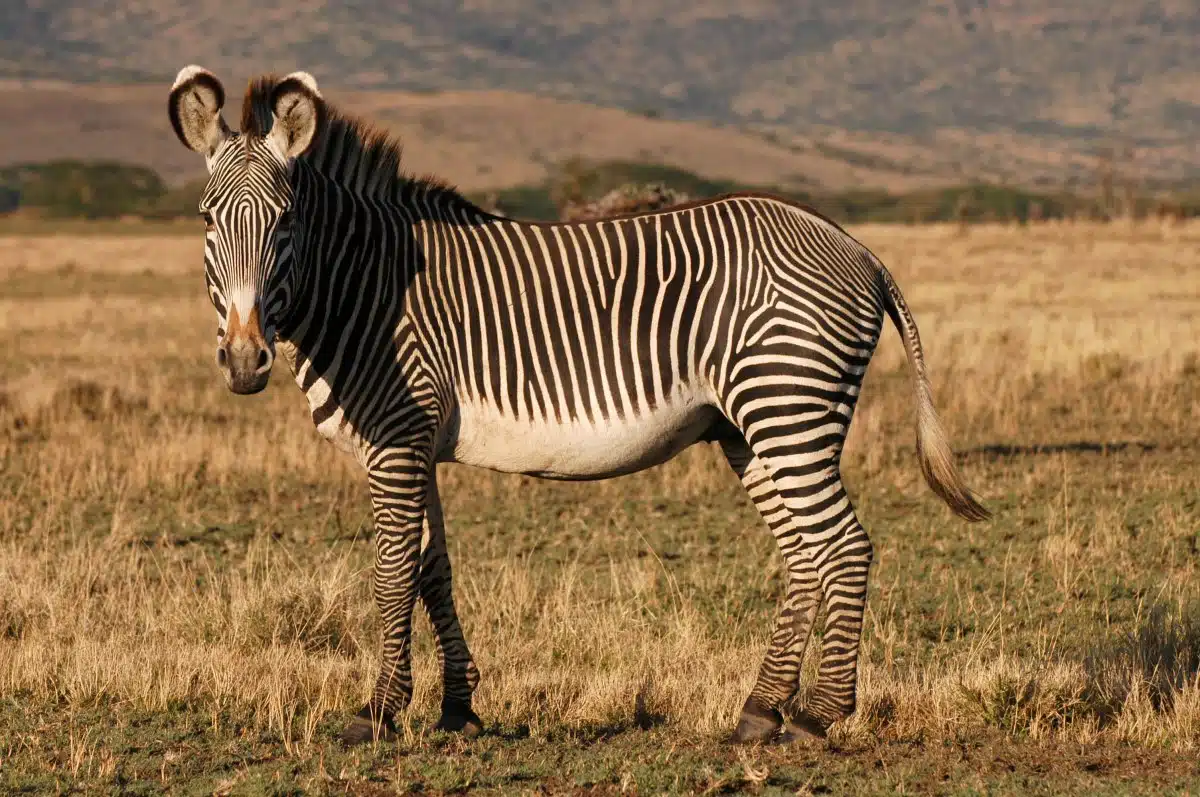
The Grevy’s zebra, Equus grevyi, is the largest wild equid on earth. An adult male weighs up to 450 kilograms. Body length reaches 2.5 to 3 meters. The animal is named after Jules Grévy, president of France in the 1880s, who received a specimen as a diplomatic gift from the emperor of Ethiopia. The species has a dramatically narrower stripe pattern than the plains zebra — thin, closely spaced black stripes on a white-cream background, with a distinctive white belly and a large, rounded ear with dark hair on the outer margin.
The stripe pattern is immediately distinctive even to an inexperienced observer. The stripes on a Grevy’s zebra neck are noticeably narrower and more numerous than those of a plains zebra of the same body size. The facial stripes are particularly tight around the muzzle. The white belly — free of stripes — is visible from a considerable distance.
Habitat: Kenya’s Northern Drylands
Grevy’s zebra lives in semi-arid and arid grasslands and bush. Its range in Kenya covers the Laikipia Plateau, Samburu National Reserve, Buffalo Springs, Shaba National Reserve, and the communities of the Isiolo and Marsabit counties. In Ethiopia, small populations survive in the Afar region. The species is absent from wetter highland areas and from the moist savanna of the Maasai Mara ecosystem. It is a dry-country specialist in every sense.
The ability to survive on low-quality, dry-season grass that plains zebras abandon reflects the Grevy’s zebra’s superior digestive efficiency for fibrous vegetation. It can also survive longer between water drinks than plains zebras—a critical advantage in its arid habitat where surface water is scarce and unpredictable.
Social Structure: Territories Not Harems
The Grevy’s zebra social system differs fundamentally from the plains zebra’s harem model. Adult male Grevy’s zebras hold large territories—up to 10 square kilometers—rather than maintaining permanent harems of mares. Females and their foals roam freely across the landscape without permanent attachment to any male. When a female moves through a male’s territory, he accompanies her and mates with her if she is in oestrus. When she moves on, he stays behind.
This territorial system means that females choose which male territory to spend time in—they walk through multiple territories, and their mate choice is a function of which territorial male they spend most time near. Territory quality—distance to water, grass abundance, shade—influences female choice. Males with territories near permanent water sources have more female visits and higher mating frequency.
Conservation Status: Endangered
The Grevy’s zebra population has declined from around 15,000 in the 1970s to approximately 2,800 today. The causes are multiple: habitat loss from expanding pastoralism, competition with livestock for grass and water, hunting for skin and meat, and mortality from predation on foals. Kenya holds over 90 percent of the global population. The Grevy’s Zebra Trust, working with Kenyan communities on the Laikipia Plateau and in Samburu, has stabilized and slightly increased the Kenyan population through community-based conservation programs.
Plan Your Safari
Kenya’s Samburu National Reserve offers the most reliable Grevy’s zebra sightings in East Africa. Large herds of Grevy’s—sometimes mixed with plains zebras—are a daily feature of game drives in the reserve. The Laikipia Plateau’s private conservancies—Lewa, Ol Pejeta, and Borana, among others—hold significant populations in an unfenced landscape where the zebras mix freely with other wildlife. A Samburu and Laikipia circuit is the definitive Kenya Grevy’s zebra safari.
African Wild Trekkers designs northern Kenya circuits that cover Samburu and Laikipia. Contact us to plan a Kenya safari that includes the world’s most endangered zebra species.