Bushpig Africa: The Forest Pig That Stays Hidden in Plain Sight
The bushpig is everywhere in East Africa and almost never seen. Forest, dense thicket, riverine woodland, and bush are its habitats — terrain that game drives rarely penetrate. Strictly nocturnal, it emerges after dark and returns to cover before dawn. Most guides with decades of experience have seen bushpigs only on night drives, at waterholes, or as fleeting shadows crossing a road. Understanding the bushpig means imagining an East Africa that runs on a different clock.
What Is a Bushpig?
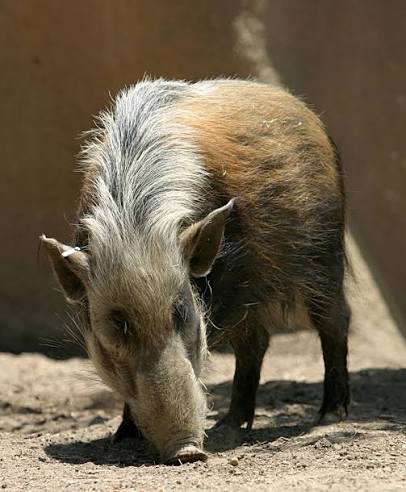
The bushpig, Potamochoerus larvatus, belongs to the family Suidae. Adult males — boars — weigh between 55 and 150 kilograms. Sows weigh 45 to 70 kilograms. Body length reaches 1 to 1.5 metres. The coat is reddish-brown to dark grey-brown with a distinct pale dorsal crest running from the neck to the mid-back. The face is paler than the body, with a white muzzle and white ear tufts at the tips of the large, pointed ears. Males develop prominent facial warts, though much smaller than those of the giant forest hog.
The bushpig’s closest relative in the region is the red river hog of West and Central Africa — a similar pig with a far more vivid red coat. In East Africa, no red river hog range overlap occurs. Safari visitors encounter only two pig species: the diurnal warthog of open country with its curved tusks and vertical tail, and the nocturnal, forest-dwelling, shorter-legged bushpig.
Nocturnal Lifestyle and Dense Habitat
The nocturnal lifestyle defines the bushpig for safari visitors. Daytime resting occurs in thicket so dense that directed searching rarely produces a sighting. After dark, bushpigs cover several kilometres in a night’s foraging. A sensitive snout roots for tubers, bulbs, roots, invertebrates, and fungi. Fallen fruit, carrion, and small vertebrates supplement this diet. This broad range of food and the rooting behaviour make bushpigs among the most effective ecosystem engineers in East Africa’s forest margins.
Agricultural areas adjacent to forest suffer significant bushpig crop damage — maize, cassava, and sweet potato fields near forest edges face regular nighttime raids. Farming communities respond with targeted hunting and trapping. The bushpig persists in farm-forest interfaces where other large mammals no longer survive, but this persistence comes at the cost of constant human-wildlife conflict.
Social Structure: The Sounder
Bushpigs live in sounders of 4 to 12 individuals — a dominant boar, one or more sows, and their offspring. The dominant boar defends the sounder’s home range against rival males. Rival encounters involve parallel walking displays, mane-raising, and shoulder contact. Full physical fights produce slash wounds from the short upper tusks. These wounds heal slowly in humid forest environments.
Sows give birth to litters of 2 to 6 piglets in a nest of grass and leaves within dense cover. Piglets carry striped coats that break up the outline against dappled forest-floor light. The stripes fade to the adult’s uniform reddish-brown within the first few months of life.
Predators and Defence
Leopards are the primary bushpig predator across most of East Africa. Lions take them on forest edges. African wild dogs hunt them where ranges overlap with forest-edge habitat. A sounder that turns to face a predator rather than flee presents a genuinely dangerous collective. Field research documents leopard injuries from bushpig tusk wounds.
Plan Your Safari
Night drives in forest-edge habitats produce the most reliable bushpig encounters — Uganda’s Queen Elizabeth and Bwindi margins, Kenya’s Aberdare National Park waterhole visits after dark, and Tanzania’s Selous and Ruaha forest margins all deliver sightings. The Aberdare tree hotels are the single most accessible location in East Africa for guaranteed bushpig observation. Animals arrive at the illuminated waterholes within minutes of dark on most nights.
African Wild Trekkers includes the Aberdare tree hotels in Kenya highland safari itineraries. Contact us to plan a Kenya circuit that adds the Aberdares’ extraordinary night wildlife to your main safari experience.