Flying Between Parks in Tanzania: Costs, Routes and When It Is Worth It
Tanzania’s national parks spread across a country the size of France and Spain combined, and the distances between them make internal flying an important logistics decision for anyone building a multi-park safari itinerary. Driving between Arusha and the Serengeti takes six to eight hours. Flying takes forty-five minutes. The cost is real — internal flights in Tanzania are not cheap — but the time savings are often decisive for travellers with limited days in the country. This guide covers every major internal flight route in Tanzania’s safari network, the cost ranges in 2026, and the honest assessment of when flying is worth paying for.
Major Internal Flight Routes in Tanzania
Northern Circuit Routes
Kilimanjaro to Serengeti
The Kilimanjaro International Airport to Serengeti route is Tanzania’s busiest internal safari flight, with Coastal Aviation and Auric Air operating daily scheduled services. The flight takes approximately forty-five to sixty minutes direct to Seronera in the central Serengeti, with some services making additional stops at Tarangire or Lake Manyara airstrips. In 2026 scheduled fares for this route run approximately USD 200 to USD 300 per person one way, depending on the carrier, the booking lead time, and the specific departure day. Charter flights on the same route cost approximately USD 1,200 to USD 2,000 for a full aircraft of four to six passengers, which becomes competitive with scheduled fares for small groups of three or more people.
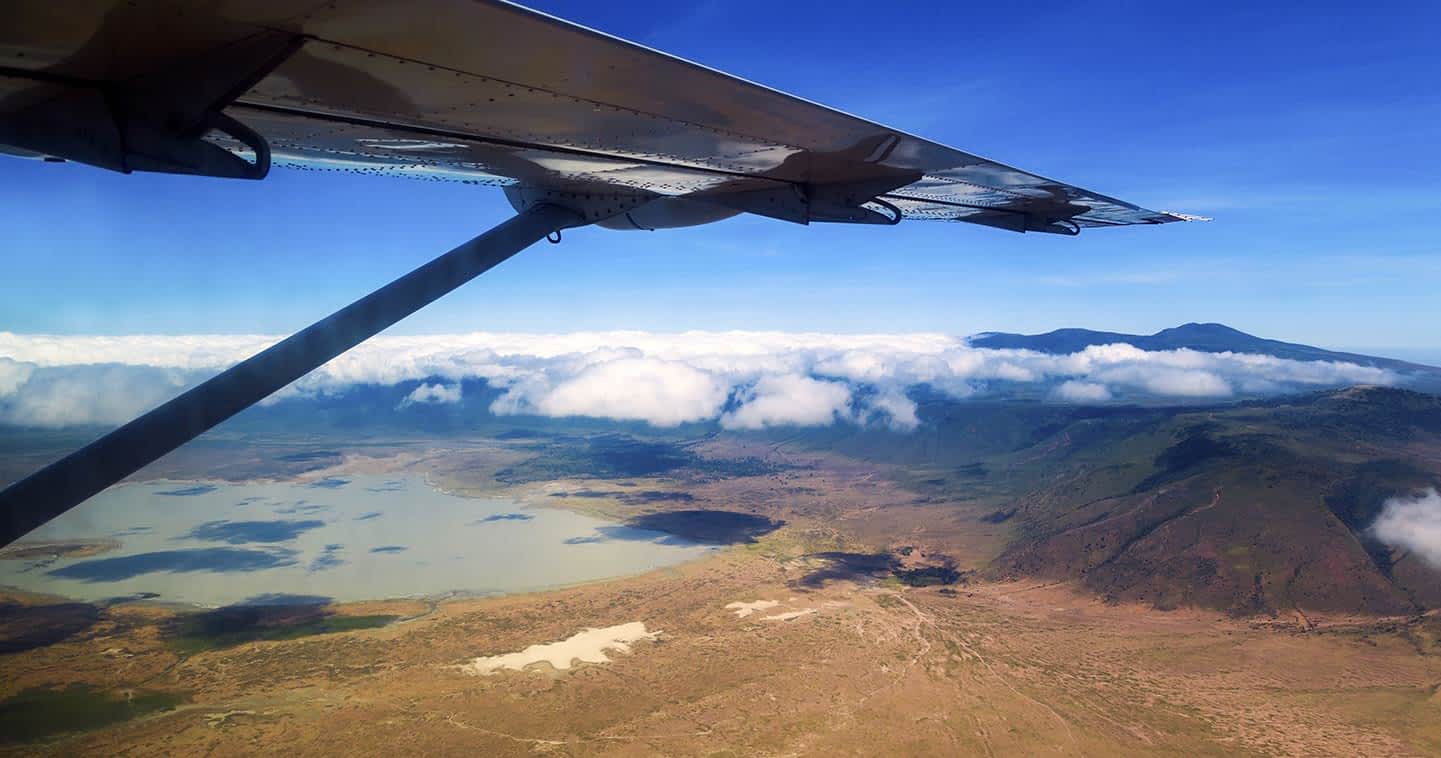
The value of flying this route is the conversion of an eight-hour road day into a forty-five minute flight that delivers you to the Serengeti in time for a full afternoon game drive. For a five-day northern circuit, the difference between flying and driving on this leg is approximately seven hours of game drive time — a number that, when expressed in those terms, tends to clarify the cost-benefit calculation for most travellers. The flight also provides an aerial view of the Rift Valley, Lake Manyara, and the Ngorongoro highlands below, which adds value to the transit rather than making it a purely logistical hop. African Wild Trekkers books Kilimanjaro-to-Serengeti flights for clients whose itineraries benefit from the time saving and whose budgets accommodate the additional cost.
Serengeti to Zanzibar
Flying from the Serengeti to Zanzibar at the end of a safari-and-beach itinerary involves either a direct bush-to-beach routing via Arusha Airport (ARK) or a connection through Kilimanjaro International Airport. Some scheduled services connect the Serengeti’s Seronera airstrip directly to Zanzibar with a brief refuelling stop at Arusha Airport, making the total travel time from Serengeti game drive to Zanzibar beach check-in approximately three to four hours. This direct routing is one of Tanzania’s most satisfying travel transitions — the contrast between the Serengeti plain visible below on departure and the Indian Ocean visible below on approach delivers the trip’s geographic breadth in a single flight. Fares for Serengeti-to-Zanzibar connections run approximately USD 250 to USD 400 per person one way.
The alternative to flying this leg is a combination of vehicle drive from the Serengeti to Arusha (six to eight hours), an Arusha overnight, and then a flight to Zanzibar the following morning — a two-day transit that reduces Zanzibar beach time and adds a travel day in the middle of the trip. For itineraries where beach days are important to the overall experience, flying directly from the Serengeti to Zanzibar protects those beach days at the cost of one flight. For itineraries where the additional beach days are less significant, the overland option through Arusha works adequately. African Wild Trekkers advises on the optimal routing for each client’s specific itinerary structure and beach-versus-safari balance.
Southern Circuit and Remote Park Access
Dar es Salaam to Ruaha and Selous
Access to Tanzania’s southern circuit parks — Ruaha National Park and the Selous-Nyerere ecosystem — requires light aircraft flights from Dar es Salaam, with no practical road alternative for most safari itineraries. Dar es Salaam to Ruaha’s Msembe airstrip takes approximately one hour fifteen minutes and costs approximately USD 200 to USD 280 per person on scheduled services. Dar es Salaam to the Selous-Nyerere’s main airstrips takes approximately forty-five to sixty minutes and costs approximately USD 180 to USD 250 per person. These flights are not optional extras for the southern circuit — they are the primary access method, and the safari package price for southern circuit camps typically includes the inter-camp and arrival/departure flights as part of the fly-in camp model.
Connecting the northern and southern circuits in a single Tanzania trip requires a Kilimanjaro-to-Dar routing, which multiple carriers serve daily with journey times of approximately ninety minutes. The Kilimanjaro-to-Dar leg costs approximately USD 150 to USD 220 per person and functions as the bridge between the two park systems. African Wild Trekkers coordinates all internal flight connections for combined northern-southern circuit itineraries, managing the Kilimanjaro-to-Dar-to-Ruaha or Selous routing as a single package. The team monitors flight schedules and confirms connections before departure to prevent the transit issues that arise when multiple separate bookings fail to align.
When Is Flying Worth the Extra Cost?
The Decision Framework
Time-Constrained Itineraries
Flying between parks is almost always worth the cost when the alternative eliminates a game drive opportunity. A USD 250 flight that saves a six-hour road day and delivers six additional hours of Serengeti game drive time costs approximately USD 41 per game drive hour saved — a number that compares favourably with the per-hour cost of the safari camp itself. Framing the decision this way clarifies it considerably: the question is not whether the flight is expensive, but whether the game drive time it protects is worth more than the flight cost in the context of the overall safari investment.
For travellers on five-to-seven day itineraries, flying between the two most distant parks is almost always the right call. For travellers on ten-to-fourteen day itineraries with more time available for road travel, the overland sections through Ngorongoro and the intermediate parks become worthwhile contributions to the trip rather than wasted transit time. The overland approach from Arusha to the Serengeti via Ngorongoro, for example, delivers the conservation area’s wildlife en route, the rim viewpoint, and the dramatic arrival on the Serengeti plain — none of which the flight delivers. For itineraries where that overland experience is a feature rather than a liability, driving in and flying out is the logical structure.
Group Size and Charter Cost Comparison
Internal charter flights in Tanzania become cost-competitive with scheduled fares for groups of three or more passengers. A charter aircraft for the Kilimanjaro-to-Serengeti route costs approximately USD 1,200 to USD 1,500 total, while three passengers on a scheduled service pay approximately USD 600 to USD 900 total — the gap narrows as group size increases, and for four or more passengers the charter becomes comparably priced while delivering the advantage of a direct routing to the camp’s private airstrip rather than the hub-and-spoke structure of the scheduled network. Charter flights also allow departure at the time that suits the itinerary rather than the scheduled service’s fixed windows, which can deliver a dawn departure that lands at the Serengeti airstrip in time for a full morning game drive. African Wild Trekkers calculates the charter versus scheduled comparison for each client’s group size and advises on the most cost-effective option.
Charter flights are the only option for reaching remote airstrips that scheduled services do not serve — Mahale Mountains, some Selous-Nyerere concession strips, and private camp airstrips in the western and southern circuits all require charter. The charter cost for these routes builds into the camp’s fly-in package pricing and African Wild Trekkers factors it into the overall itinerary quote from the start rather than presenting it as a surprise addition. Transparent pricing across all flight components, at the itinerary stage rather than after the booking, is a standard practice of the African Wild Trekkers booking process.
Plan Your Safari
Internal flight logistics in Tanzania require careful coordination to ensure that park distances, airstrip availability, and camp booking dates align into a coherent itinerary. African Wild Trekkers manages all internal flight bookings as part of the safari package, coordinating the scheduled and charter connections that hold multi-park Tanzania circuits together. The team advises on which legs to fly and which to drive based on the specific itinerary structure, the group size, and the time available for each park section.
Every Tanzania itinerary from African Wild Trekkers includes a clear breakdown of which transport mode connects each section of the trip, with flight costs itemised separately from camp costs so clients understand exactly what they pay for each component. The team confirms all flight bookings with reservation numbers before any deposit is requested. African Wild Trekkers monitors flight schedules in Tanzania and contacts clients if any schedule change requires an itinerary adjustment before departure.
Contact African Wild Trekkers at africanwildtrekkers.com/contact with your Tanzania travel dates and the parks you want to visit and we will build an optimised routing with flight-versus-drive recommendations within 24 hours.