Managing Photography Gear on Light Aircraft
The Seven-Day Safari Wardrobe in a Single Duffel
A functional seven-day safari wardrobe that fits within a 15-kilogram luggage allowance requires three to four pairs of convertible zip-off trousers or lightweight technical pants in neutral earth tones, four to five long-sleeved safari shirts in khaki and olive that can be worn two or three times between washes in the dry bush air without becoming unpleasant, one warm midlayer fleece in a neutral color for the cold morning drives, one lightweight down or synthetic gilet that compresses into its own pocket for additional warmth without bulk, two to three pairs of lightweight merino wool socks that manage temperature across the full range from cold morning to warm afternoon, and two to three pairs of technical underwear in moisture-wicking fabric that handles both comfort and rapid drying from lodge laundry service. This represents six to seven items of clothing for a seven-day safari — deliberately fewer outfits than most travelers initially consider adequate — but it functions well because of two factors: the repetitive nature of the safari day’s structure, where you wear the same game drive outfit for each morning and afternoon drive and change into casual lodge wear for the afternoon rest and evening, and the laundry service that all quality safari lodges provide, usually turning around next-day clean clothing that allows you to repeat the same outfit rotation across a longer trip without accumulating dirty laundry.
The temptation to include items for “just in case” scenarios should be actively resisted when packing for safari, because the just-in-case scenario almost never materializes and the weight it adds to the bag is constant throughout the trip. The specific items that most experienced safari packers identify as the most common unnecessary additions — a second pair of good shoes for evening lodge dinners that turn out to be completely acceptable in trail runners, a formal shirt for a smart casual dinner that proves to require nothing more formal than a clean technical shirt, a heavy towel when lodges universally provide excellent bath towels, and a hair dryer that camp electricity supplies struggle to power and camp humidity makes largely pointless in the bush — collectively represent several kilograms of unnecessary weight that would have been immediately identified as redundant if the packer had known before departure what they discovered on arrival. Reading specific packing reports from travelers who have been to the specific destinations on your itinerary — on travel forums, in specialist operator packing guides, and from direct conversation with your booking consultant — provides the destination-specific intelligence that eliminates just-in-case packing decisions with genuine knowledge about what is actually needed.
Camera Equipment and High-Value Items
Managing Photography Gear on Light Aircraft
Camera Bag Strategy for Bush Flights
Camera equipment represents the greatest packing challenge for safari travelers who bring serious photography gear, because the combination of a camera body, two or three lenses, a teleconverter, spare batteries, memory cards, a cleaning kit, and a portable charging system can easily exceed five kilograms on its own — a meaningful portion of the 15-kilogram total luggage allowance before any clothing, toiletries, or personal medication is included. The strategic solution that experienced safari photographers use is to carry camera equipment in the day pack that accompanies them on every game drive rather than in the checked duffel, because airlines and bush aircraft operators almost universally allow one carry-on bag in addition to the checked main bag, and the carry-on allowance is not subject to the weight restrictions that apply to checked baggage in the hold. This strategy moves the heaviest item category — camera gear — out of the weight-restricted checked bag and into a carry-on that is weighed and handled differently, effectively giving the photographer an additional 7 to 10 kilograms of capacity for camera equipment without exceeding the checked baggage limit.
The specific lens selection for a safari photography carry-on should be determined by the destinations and wildlife on the itinerary rather than by the desire to cover every possible focal length in case an unusual opportunity arises. A 100-400mm or 150-600mm zoom telephoto lens covers the majority of wildlife photography situations from a game drive vehicle and eliminates the need for multiple prime telephoto lenses that collectively weigh more and offer less shooting versatility than a single modern zoom. A second general-purpose zoom in the 16-70mm or 24-105mm range handles landscape, lodge, and human interest photography that the telephoto cannot. These two lenses cover the practical photography requirements of the large majority of safari itineraries and weigh considerably less than a three or four lens combination that attempts to cover every possible focal length. A 1.4x teleconverter adds meaningful reach from the telephoto lens at a weight cost of approximately 200 grams — an excellent value addition that multiplies the useful range of a quality telephoto significantly without the weight penalty of a dedicated supertelephoto prime lens that costs many times more and weighs several times as much.
Plan Your Safari
African Wild Trekkers provides every guest with a detailed, destination-specific packing list that identifies exactly what is needed for their specific itinerary and what should be left at home, including specific guidance on luggage allowances for each bush flight on their route, the laundry service schedule at each lodge, and the specific camera equipment considerations for the wildlife they are most likely to encounter. Our packing guides are built from accumulated guest experience rather than generic travel advice and reflect the specific conditions, lodge facilities, and activity requirements of each destination.
For guests who find the pack-light requirement anxiety-inducing, we offer a pre-departure packing consultation during which our team reviews the specific contents of a proposed packing list and advises on substitutions, omissions, and additions based on their knowledge of each destination’s actual conditions. This consultation typically results in a meaningfully lighter bag without any reduction in the functional coverage that the traveler actually needs — the most consistent feedback we receive from guests who use it is that they were surprised by how little they needed and how liberating the light bag made the trip feel from the first airport to the last.
Contact African Wild Trekkers at africanwildtrekkers.com/contact with your planned safari destinations and itinerary duration and we will send your comprehensive safari packing list within 24 hours.
Choosing the Right Safari Bag
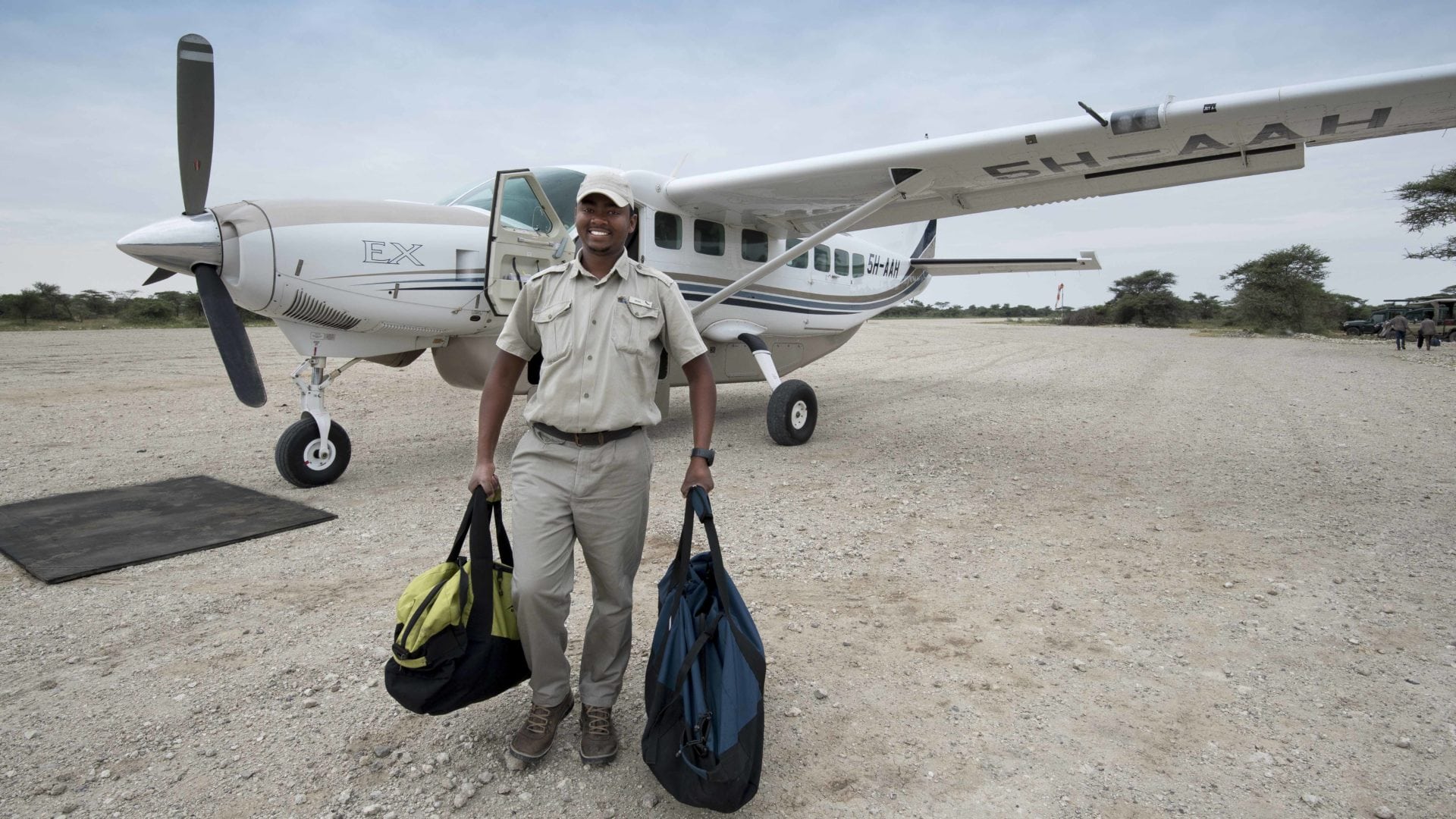
Soft-sided duffel bags — specifically the collapsible, frameless duffel or holdall format rather than hard-shell suitcases or semi-rigid rolling luggage — are the mandated bag type for virtually all light aircraft bush transfers in Africa because they can be compressed to fit the aircraft’s irregular cargo hold spaces, stacked on top of each other without the damage risk that hard-shell cases create when stacked, and carried by a single porter across the rough terrain between aircraft and accommodation without requiring the rolling wheels that are useless on grass airstrips. The most popular safari duffel formats are bags in the 35 to 45 liter capacity range — large enough to hold five days of safari clothing for one person with space for toiletries and incidentals, small enough to weigh under 15 kilograms when fully packed with dense items, and compact enough to fit under the seat of a Cessna Caravan on the internal safari transfer. Osprey, Eagle Creek, and North Face all make well-regarded collapsible duffels in this range; the specific features to prioritize are a top-loading main compartment for easy organization, a separate external pocket for frequently accessed items like sunscreen and insect repellent, and a padded shoulder strap for comfort on the short carries that safari bags routinely make between vehicles and accommodation.
The carry-on day pack — a separate smaller bag of 15 to 25 liters that stays with you on every game drive and functions as your daily field bag — is as important as the main duffel and requires equally thoughtful selection. This is the bag in which you carry your camera and spare lenses, binoculars, the day’s water supply, sunscreen, insect repellent, your field guides and sighting notebook, a light fleece for the cold morning drive, and any medications you take during the day. It needs to be accessible while seated in a game drive vehicle, which means a top-flap access or full front-panel zip rather than a drawstring top, and padded camera compartments or removable padded inserts if you are carrying significant camera equipment that would be damaged by the vehicle’s constant vibration over rough bush tracks. A carry-on day pack that is well organized and always ready for the morning departure saves the frantic searching through an unstructured bag during predawn kit preparation that is one of the most reliably stressful small experiences of a safari morning.
The Seven-Day Safari Wardrobe in a Single Duffel
A functional seven-day safari wardrobe that fits within a 15-kilogram luggage allowance requires three to four pairs of convertible zip-off trousers or lightweight technical pants in neutral earth tones, four to five long-sleeved safari shirts in khaki and olive that can be worn two or three times between washes in the dry bush air without becoming unpleasant, one warm midlayer fleece in a neutral color for the cold morning drives, one lightweight down or synthetic gilet that compresses into its own pocket for additional warmth without bulk, two to three pairs of lightweight merino wool socks that manage temperature across the full range from cold morning to warm afternoon, and two to three pairs of technical underwear in moisture-wicking fabric that handles both comfort and rapid drying from lodge laundry service. This represents six to seven items of clothing for a seven-day safari — deliberately fewer outfits than most travelers initially consider adequate — but it functions well because of two factors: the repetitive nature of the safari day’s structure, where you wear the same game drive outfit for each morning and afternoon drive and change into casual lodge wear for the afternoon rest and evening, and the laundry service that all quality safari lodges provide, usually turning around next-day clean clothing that allows you to repeat the same outfit rotation across a longer trip without accumulating dirty laundry.
The temptation to include items for “just in case” scenarios should be actively resisted when packing for safari, because the just-in-case scenario almost never materializes and the weight it adds to the bag is constant throughout the trip. The specific items that most experienced safari packers identify as the most common unnecessary additions — a second pair of good shoes for evening lodge dinners that turn out to be completely acceptable in trail runners, a formal shirt for a smart casual dinner that proves to require nothing more formal than a clean technical shirt, a heavy towel when lodges universally provide excellent bath towels, and a hair dryer that camp electricity supplies struggle to power and camp humidity makes largely pointless in the bush — collectively represent several kilograms of unnecessary weight that would have been immediately identified as redundant if the packer had known before departure what they discovered on arrival. Reading specific packing reports from travelers who have been to the specific destinations on your itinerary — on travel forums, in specialist operator packing guides, and from direct conversation with your booking consultant — provides the destination-specific intelligence that eliminates just-in-case packing decisions with genuine knowledge about what is actually needed.
Camera Equipment and High-Value Items
Managing Photography Gear on Light Aircraft
Camera Bag Strategy for Bush Flights
Camera equipment represents the greatest packing challenge for safari travelers who bring serious photography gear, because the combination of a camera body, two or three lenses, a teleconverter, spare batteries, memory cards, a cleaning kit, and a portable charging system can easily exceed five kilograms on its own — a meaningful portion of the 15-kilogram total luggage allowance before any clothing, toiletries, or personal medication is included. The strategic solution that experienced safari photographers use is to carry camera equipment in the day pack that accompanies them on every game drive rather than in the checked duffel, because airlines and bush aircraft operators almost universally allow one carry-on bag in addition to the checked main bag, and the carry-on allowance is not subject to the weight restrictions that apply to checked baggage in the hold. This strategy moves the heaviest item category — camera gear — out of the weight-restricted checked bag and into a carry-on that is weighed and handled differently, effectively giving the photographer an additional 7 to 10 kilograms of capacity for camera equipment without exceeding the checked baggage limit.
The specific lens selection for a safari photography carry-on should be determined by the destinations and wildlife on the itinerary rather than by the desire to cover every possible focal length in case an unusual opportunity arises. A 100-400mm or 150-600mm zoom telephoto lens covers the majority of wildlife photography situations from a game drive vehicle and eliminates the need for multiple prime telephoto lenses that collectively weigh more and offer less shooting versatility than a single modern zoom. A second general-purpose zoom in the 16-70mm or 24-105mm range handles landscape, lodge, and human interest photography that the telephoto cannot. These two lenses cover the practical photography requirements of the large majority of safari itineraries and weigh considerably less than a three or four lens combination that attempts to cover every possible focal length. A 1.4x teleconverter adds meaningful reach from the telephoto lens at a weight cost of approximately 200 grams — an excellent value addition that multiplies the useful range of a quality telephoto significantly without the weight penalty of a dedicated supertelephoto prime lens that costs many times more and weighs several times as much.
Plan Your Safari
African Wild Trekkers provides every guest with a detailed, destination-specific packing list that identifies exactly what is needed for their specific itinerary and what should be left at home, including specific guidance on luggage allowances for each bush flight on their route, the laundry service schedule at each lodge, and the specific camera equipment considerations for the wildlife they are most likely to encounter. Our packing guides are built from accumulated guest experience rather than generic travel advice and reflect the specific conditions, lodge facilities, and activity requirements of each destination.
For guests who find the pack-light requirement anxiety-inducing, we offer a pre-departure packing consultation during which our team reviews the specific contents of a proposed packing list and advises on substitutions, omissions, and additions based on their knowledge of each destination’s actual conditions. This consultation typically results in a meaningfully lighter bag without any reduction in the functional coverage that the traveler actually needs — the most consistent feedback we receive from guests who use it is that they were surprised by how little they needed and how liberating the light bag made the trip feel from the first airport to the last.
Contact African Wild Trekkers at africanwildtrekkers.com/contact with your planned safari destinations and itinerary duration and we will send your comprehensive safari packing list within 24 hours.
Why Packing Light Is Not Optional on Safari
Light luggage is the single most consistently underestimated preparation challenge that first-time safari travelers face, and the weight restrictions imposed by light aircraft bush flights between camps are the specific logistical reason that transforms packing light from a personal preference into a hard operational requirement. Light aircraft used for safari transfers across East and Southern Africa — Cessna Caravans, Cessna 208s, Pilatus PC-12s, and various twin-engine charter types — operate with strict per-passenger luggage allowances of typically 15 kilograms in soft-sided bags, and these restrictions are enforced with a seriousness that international airline baggage allowances rarely match. The weight limits exist because small aircraft weight and balance calculations are critical to flight safety, and the pilot’s ability to take off within the available runway length at high-altitude bush airstrips — many of which are grass strips at elevations where air density is meaningfully reduced — depends directly on the total weight carried. Overweight bags are left at the departure point until a subsequent aircraft can accommodate them, which in remote safari circuits may mean your camera equipment does not arrive until day three of a five-day stay.
Beyond the operational necessity, packing light dramatically improves the quality of the safari experience in ways that go beyond mere logistical convenience. Every bag you eliminate from your safari wardrobe is a decision about which items you are genuinely dependent on versus which you carry out of urban habit. The process of packing for a safari with a strict weight constraint forces exactly the right kind of decision-making about what actually matters in a bush environment where the priorities are functional clothing, effective sun and insect protection, adequate camera equipment, and the personal medication and toiletries that cannot be sourced locally — and where none of the ordinary wardrobe concerns of urban travel apply, because nobody at a six-guest bush camp is evaluating your outfit variation from one game drive to the next. The liberation of arriving at a remote camp with a single bag that contains exactly what you need and nothing more is something that experienced safari travelers describe with consistent enthusiasm as one of their most significant practical learnings from early overpacking experiences.
The Carry-On Only Safari Packing System
Bag Choice and Core Clothing System
Choosing the Right Safari Bag
Soft-sided duffel bags — specifically the collapsible, frameless duffel or holdall format rather than hard-shell suitcases or semi-rigid rolling luggage — are the mandated bag type for virtually all light aircraft bush transfers in Africa because they can be compressed to fit the aircraft’s irregular cargo hold spaces, stacked on top of each other without the damage risk that hard-shell cases create when stacked, and carried by a single porter across the rough terrain between aircraft and accommodation without requiring the rolling wheels that are useless on grass airstrips. The most popular safari duffel formats are bags in the 35 to 45 liter capacity range — large enough to hold five days of safari clothing for one person with space for toiletries and incidentals, small enough to weigh under 15 kilograms when fully packed with dense items, and compact enough to fit under the seat of a Cessna Caravan on the internal safari transfer. Osprey, Eagle Creek, and North Face all make well-regarded collapsible duffels in this range; the specific features to prioritize are a top-loading main compartment for easy organization, a separate external pocket for frequently accessed items like sunscreen and insect repellent, and a padded shoulder strap for comfort on the short carries that safari bags routinely make between vehicles and accommodation.
The carry-on day pack — a separate smaller bag of 15 to 25 liters that stays with you on every game drive and functions as your daily field bag — is as important as the main duffel and requires equally thoughtful selection. This is the bag in which you carry your camera and spare lenses, binoculars, the day’s water supply, sunscreen, insect repellent, your field guides and sighting notebook, a light fleece for the cold morning drive, and any medications you take during the day. It needs to be accessible while seated in a game drive vehicle, which means a top-flap access or full front-panel zip rather than a drawstring top, and padded camera compartments or removable padded inserts if you are carrying significant camera equipment that would be damaged by the vehicle’s constant vibration over rough bush tracks. A carry-on day pack that is well organized and always ready for the morning departure saves the frantic searching through an unstructured bag during predawn kit preparation that is one of the most reliably stressful small experiences of a safari morning.
The Seven-Day Safari Wardrobe in a Single Duffel
A functional seven-day safari wardrobe that fits within a 15-kilogram luggage allowance requires three to four pairs of convertible zip-off trousers or lightweight technical pants in neutral earth tones, four to five long-sleeved safari shirts in khaki and olive that can be worn two or three times between washes in the dry bush air without becoming unpleasant, one warm midlayer fleece in a neutral color for the cold morning drives, one lightweight down or synthetic gilet that compresses into its own pocket for additional warmth without bulk, two to three pairs of lightweight merino wool socks that manage temperature across the full range from cold morning to warm afternoon, and two to three pairs of technical underwear in moisture-wicking fabric that handles both comfort and rapid drying from lodge laundry service. This represents six to seven items of clothing for a seven-day safari — deliberately fewer outfits than most travelers initially consider adequate — but it functions well because of two factors: the repetitive nature of the safari day’s structure, where you wear the same game drive outfit for each morning and afternoon drive and change into casual lodge wear for the afternoon rest and evening, and the laundry service that all quality safari lodges provide, usually turning around next-day clean clothing that allows you to repeat the same outfit rotation across a longer trip without accumulating dirty laundry.
The temptation to include items for “just in case” scenarios should be actively resisted when packing for safari, because the just-in-case scenario almost never materializes and the weight it adds to the bag is constant throughout the trip. The specific items that most experienced safari packers identify as the most common unnecessary additions — a second pair of good shoes for evening lodge dinners that turn out to be completely acceptable in trail runners, a formal shirt for a smart casual dinner that proves to require nothing more formal than a clean technical shirt, a heavy towel when lodges universally provide excellent bath towels, and a hair dryer that camp electricity supplies struggle to power and camp humidity makes largely pointless in the bush — collectively represent several kilograms of unnecessary weight that would have been immediately identified as redundant if the packer had known before departure what they discovered on arrival. Reading specific packing reports from travelers who have been to the specific destinations on your itinerary — on travel forums, in specialist operator packing guides, and from direct conversation with your booking consultant — provides the destination-specific intelligence that eliminates just-in-case packing decisions with genuine knowledge about what is actually needed.
Camera Equipment and High-Value Items
Managing Photography Gear on Light Aircraft
Camera Bag Strategy for Bush Flights
Camera equipment represents the greatest packing challenge for safari travelers who bring serious photography gear, because the combination of a camera body, two or three lenses, a teleconverter, spare batteries, memory cards, a cleaning kit, and a portable charging system can easily exceed five kilograms on its own — a meaningful portion of the 15-kilogram total luggage allowance before any clothing, toiletries, or personal medication is included. The strategic solution that experienced safari photographers use is to carry camera equipment in the day pack that accompanies them on every game drive rather than in the checked duffel, because airlines and bush aircraft operators almost universally allow one carry-on bag in addition to the checked main bag, and the carry-on allowance is not subject to the weight restrictions that apply to checked baggage in the hold. This strategy moves the heaviest item category — camera gear — out of the weight-restricted checked bag and into a carry-on that is weighed and handled differently, effectively giving the photographer an additional 7 to 10 kilograms of capacity for camera equipment without exceeding the checked baggage limit.
The specific lens selection for a safari photography carry-on should be determined by the destinations and wildlife on the itinerary rather than by the desire to cover every possible focal length in case an unusual opportunity arises. A 100-400mm or 150-600mm zoom telephoto lens covers the majority of wildlife photography situations from a game drive vehicle and eliminates the need for multiple prime telephoto lenses that collectively weigh more and offer less shooting versatility than a single modern zoom. A second general-purpose zoom in the 16-70mm or 24-105mm range handles landscape, lodge, and human interest photography that the telephoto cannot. These two lenses cover the practical photography requirements of the large majority of safari itineraries and weigh considerably less than a three or four lens combination that attempts to cover every possible focal length. A 1.4x teleconverter adds meaningful reach from the telephoto lens at a weight cost of approximately 200 grams — an excellent value addition that multiplies the useful range of a quality telephoto significantly without the weight penalty of a dedicated supertelephoto prime lens that costs many times more and weighs several times as much.
Plan Your Safari
African Wild Trekkers provides every guest with a detailed, destination-specific packing list that identifies exactly what is needed for their specific itinerary and what should be left at home, including specific guidance on luggage allowances for each bush flight on their route, the laundry service schedule at each lodge, and the specific camera equipment considerations for the wildlife they are most likely to encounter. Our packing guides are built from accumulated guest experience rather than generic travel advice and reflect the specific conditions, lodge facilities, and activity requirements of each destination.
For guests who find the pack-light requirement anxiety-inducing, we offer a pre-departure packing consultation during which our team reviews the specific contents of a proposed packing list and advises on substitutions, omissions, and additions based on their knowledge of each destination’s actual conditions. This consultation typically results in a meaningfully lighter bag without any reduction in the functional coverage that the traveler actually needs — the most consistent feedback we receive from guests who use it is that they were surprised by how little they needed and how liberating the light bag made the trip feel from the first airport to the last.
Contact African Wild Trekkers at africanwildtrekkers.com/contact with your planned safari destinations and itinerary duration and we will send your comprehensive safari packing list within 24 hours.