What to Do Immediately After a Bite
Puff Adders: The Most Dangerous Safari Snake by Incident Volume
The puff adder is responsible for more snakebite fatalities across sub-Saharan Africa than any other species — not because it is the most venomous or the most aggressive, but because of a combination of characteristics that make accidental encounters with people significantly more likely than with any other dangerous African snake. Puff adders rely on camouflage as their primary defense strategy and are reluctant to move away from an approaching threat, instead remaining motionless and trusting that their extraordinarily effective sand-brown and geometric-patterned body renders them invisible against the leaf litter, sandy soil, and dry grass where they bask during daylight hours. This behavioral choice — remaining still rather than retreating — produces the majority of puff adder bite incidents, where a human steps directly onto a puff adder that was invisible against the ground surface and the snake delivers a rapid defensive strike in the instant of contact. The venom is cytotoxic rather than neurotoxic, causing intense local tissue destruction and swelling that is rarely immediately life-threatening but produces severe pain and can result in permanent tissue damage or limb loss if treatment is delayed beyond four to six hours.
The practical field response to the puff adder risk is the same as the general snake safety principle but applied with particular attention to the specific behavior pattern that causes encounters: looking carefully at the ground before each footstep during walking safari activities, never placing your foot into tall grass or low bush cover without first probing the area with a walking stick or the guide’s rifle butt, wearing ankle-height closed-toe boots rather than sandals during all walking activities, and using a flashlight to scan the path ahead whenever moving between accommodation and communal areas at a camp in the hours after dark when puff adders are actively thermoregulating on paths that retain warmth from the day’s sun. Your professional guide on a walking safari will already be applying all of these precautions habitually and unconsciously — it is part of the practiced situational awareness that defines expert bush craft — and observing how they move through the landscape provides a live tutorial in risk-aware walking technique that is more instructive than any written description.
First Response and Snakebite Treatment
What to Do Immediately After a Bite
The Correct Snakebite Response Protocol
The correct immediate response to any snakebite in an African field setting follows a protocol that differs significantly from the folk medicine interventions — cutting and sucking the wound, applying a tourniquet, immersing in cold water — that persist in popular cultural understanding of snakebite treatment despite being definitively contraindicated by current toxicological medicine. The correct response is to immobilize the bitten limb by splinting it at or below the level of the heart, keep the patient as calm and still as possible to minimize the circulation rate that transports venom through the bloodstream, remove any constricting jewelry or clothing from the bitten area to accommodate the inevitable swelling, and begin evacuation to the nearest hospital capable of stocking and administering appropriate polyvalent antivenom immediately. None of these steps requires the bite to be definitively identified to a species before implementation — the immobilization, calming, and evacuation protocol is appropriate for all venomous species and produces no harm for non-venomous species — which removes the dangerous delay that species identification attempts create when applied as a prerequisite to beginning the correct treatment response.
Antivenom is the only treatment that neutralizes venom that has already been absorbed into the body, and it is available only at hospitals and medical facilities with cold-chain storage capability — it cannot be carried in a field first aid kit and should not be self-administered in the field except in the most extreme circumstances where trained medical assistance is genuinely hours away rather than the minutes to hours that properly organized safari evacuation procedures typically deliver. All quality safari lodges and private game reserves maintain current evacuation protocols with their medical assistance partners — typically AMREF Flying Doctors or a regional air ambulance service — and the emergency contact number for this service is the most important number in any guide’s phone and should be written and accessible in every camp’s communications kit. The time between envenomation and antivenom administration is the critical variable that determines outcome for most African snakebite cases, and the efficiency with which the evacuation chain is activated — guide radios camp, camp contacts medical service, medical service dispatches aircraft, patient reaches hospital — is the reason that well-organized safari operations with practiced emergency protocols produce much better snakebite outcomes than incidents that occur outside managed tourism environments where this activation chain is unavailable.
Plan Your Safari
African Wild Trekkers ensures that every guest receives a snake safety briefing from their guide on arrival at each safari destination, covering the specific species most likely to be encountered in that particular environment, the practical behaviors that minimize encounter risk during walking activities, and the emergency response procedure that is in place at each specific lodge or camp for snakebite and other wildlife-related medical events. This briefing is delivered conversationally rather than as a frightening catalogue of dangers, and the consistent response from guests is that it reduces rather than increases their anxiety about the bush by replacing vague fear with specific, actionable knowledge.
Every guide working on African Wild Trekkers itineraries holds current wilderness first aid certification that specifically includes the snakebite response protocol described above, and every camp on our itinerary network maintains active evacuation agreements with medical assistance providers. We review the specific evacuation procedures at each camp before recommending it to guests, and any camp that cannot demonstrate a current, tested, and properly resourced evacuation capability does not appear on our recommended accommodation list regardless of the quality of its wildlife or its accommodation.
Contact African Wild Trekkers at africanwildtrekkers.com/contact with any safety questions about your planned destination and we will provide specific information about the snake species present, the risk management procedures in place, and the emergency response capability at each lodge on your proposed itinerary within 24 hours.

The Black and Green Mamba
The black mamba — Africa’s most feared snake and the subject of more embellished folklore than almost any other organism on the continent — is genuinely one of the most dangerous venomous snakes in the world, combining a highly potent neurotoxic venom, an ability to deliver multiple bites in a single defensive encounter, and a speed of movement that regularly exceeds 12 kilometers per hour over short distances. However, its fearsome reputation is matched by an equal but less famous characteristic: the black mamba is an exceptionally shy, alert, and threat-aware snake that will abandon its retreat route and flee at the first sign of a large animal’s approach, often detecting human presence through ground vibration before visual confirmation and departing the area before an encounter occurs at all. The black mamba encounters that result in envenomation overwhelmingly involve people who have inadvertently cornered the snake — walked between it and its retreat hole, reached into a crevice where one was resting, or attempted to kill one that had entered a building — rather than being attacked by a snake that approached them. Seeing a black mamba in the bush during a safari walk is an extraordinary wildlife sighting of genuine herpetological significance; it is not a life-threatening emergency if the observer stops moving, gives the snake clear retreat space, and watches calmly from a respectful distance.
Green mambas — which are genuinely green rather than the grey-brown of the misnamed black mamba — are arboreal forest snakes found in coastal East African forests, montane forest remnants, and river-fringe vegetation from Kenya’s coast through Tanzania, Mozambique, and South Africa’s KwaZulu-Natal. They are considerably less likely to be encountered on open savanna game drives than black mambas but are a realistic possibility for safari travelers who visit coastal or forested destinations and may encounter one resting in the tree canopy above a lodge walkway or in the dense shrubbery of a forest camp garden. Green mambas are venomous and should be treated with the same respect and retreat space as any dangerous species, but their arboreal lifestyle and relatively timid temperament make accidental provocation significantly less likely than for ground-dwelling species encountered on walking activities. Identifying a green mamba versus an arboreal non-venomous species — Boomslang, vine snakes, and green tree snakes share similar color and habitat — requires herpetological knowledge that most safari tourists do not possess and that makes the “don’t approach any snake in the bush” principle more practically useful than species identification in the moment of encounter.
Puff Adders: The Most Dangerous Safari Snake by Incident Volume
The puff adder is responsible for more snakebite fatalities across sub-Saharan Africa than any other species — not because it is the most venomous or the most aggressive, but because of a combination of characteristics that make accidental encounters with people significantly more likely than with any other dangerous African snake. Puff adders rely on camouflage as their primary defense strategy and are reluctant to move away from an approaching threat, instead remaining motionless and trusting that their extraordinarily effective sand-brown and geometric-patterned body renders them invisible against the leaf litter, sandy soil, and dry grass where they bask during daylight hours. This behavioral choice — remaining still rather than retreating — produces the majority of puff adder bite incidents, where a human steps directly onto a puff adder that was invisible against the ground surface and the snake delivers a rapid defensive strike in the instant of contact. The venom is cytotoxic rather than neurotoxic, causing intense local tissue destruction and swelling that is rarely immediately life-threatening but produces severe pain and can result in permanent tissue damage or limb loss if treatment is delayed beyond four to six hours.
The practical field response to the puff adder risk is the same as the general snake safety principle but applied with particular attention to the specific behavior pattern that causes encounters: looking carefully at the ground before each footstep during walking safari activities, never placing your foot into tall grass or low bush cover without first probing the area with a walking stick or the guide’s rifle butt, wearing ankle-height closed-toe boots rather than sandals during all walking activities, and using a flashlight to scan the path ahead whenever moving between accommodation and communal areas at a camp in the hours after dark when puff adders are actively thermoregulating on paths that retain warmth from the day’s sun. Your professional guide on a walking safari will already be applying all of these precautions habitually and unconsciously — it is part of the practiced situational awareness that defines expert bush craft — and observing how they move through the landscape provides a live tutorial in risk-aware walking technique that is more instructive than any written description.
First Response and Snakebite Treatment
What to Do Immediately After a Bite
The Correct Snakebite Response Protocol
The correct immediate response to any snakebite in an African field setting follows a protocol that differs significantly from the folk medicine interventions — cutting and sucking the wound, applying a tourniquet, immersing in cold water — that persist in popular cultural understanding of snakebite treatment despite being definitively contraindicated by current toxicological medicine. The correct response is to immobilize the bitten limb by splinting it at or below the level of the heart, keep the patient as calm and still as possible to minimize the circulation rate that transports venom through the bloodstream, remove any constricting jewelry or clothing from the bitten area to accommodate the inevitable swelling, and begin evacuation to the nearest hospital capable of stocking and administering appropriate polyvalent antivenom immediately. None of these steps requires the bite to be definitively identified to a species before implementation — the immobilization, calming, and evacuation protocol is appropriate for all venomous species and produces no harm for non-venomous species — which removes the dangerous delay that species identification attempts create when applied as a prerequisite to beginning the correct treatment response.
Antivenom is the only treatment that neutralizes venom that has already been absorbed into the body, and it is available only at hospitals and medical facilities with cold-chain storage capability — it cannot be carried in a field first aid kit and should not be self-administered in the field except in the most extreme circumstances where trained medical assistance is genuinely hours away rather than the minutes to hours that properly organized safari evacuation procedures typically deliver. All quality safari lodges and private game reserves maintain current evacuation protocols with their medical assistance partners — typically AMREF Flying Doctors or a regional air ambulance service — and the emergency contact number for this service is the most important number in any guide’s phone and should be written and accessible in every camp’s communications kit. The time between envenomation and antivenom administration is the critical variable that determines outcome for most African snakebite cases, and the efficiency with which the evacuation chain is activated — guide radios camp, camp contacts medical service, medical service dispatches aircraft, patient reaches hospital — is the reason that well-organized safari operations with practiced emergency protocols produce much better snakebite outcomes than incidents that occur outside managed tourism environments where this activation chain is unavailable.
Plan Your Safari
African Wild Trekkers ensures that every guest receives a snake safety briefing from their guide on arrival at each safari destination, covering the specific species most likely to be encountered in that particular environment, the practical behaviors that minimize encounter risk during walking activities, and the emergency response procedure that is in place at each specific lodge or camp for snakebite and other wildlife-related medical events. This briefing is delivered conversationally rather than as a frightening catalogue of dangers, and the consistent response from guests is that it reduces rather than increases their anxiety about the bush by replacing vague fear with specific, actionable knowledge.
Every guide working on African Wild Trekkers itineraries holds current wilderness first aid certification that specifically includes the snakebite response protocol described above, and every camp on our itinerary network maintains active evacuation agreements with medical assistance providers. We review the specific evacuation procedures at each camp before recommending it to guests, and any camp that cannot demonstrate a current, tested, and properly resourced evacuation capability does not appear on our recommended accommodation list regardless of the quality of its wildlife or its accommodation.
Contact African Wild Trekkers at africanwildtrekkers.com/contact with any safety questions about your planned destination and we will provide specific information about the snake species present, the risk management procedures in place, and the emergency response capability at each lodge on your proposed itinerary within 24 hours.
Understanding Snake Encounters on African Safari
Snakes are among the most consistently misunderstood and irrationally feared elements of the African bush environment, and the disproportion between the terror they inspire in most safari visitors and the actual risk they represent to someone who understands snake behavior and responds appropriately to encounters is one of the most important pieces of field knowledge that a professional African safari guide shares with guests at every opportunity. Africa is home to approximately 1,000 snake species, of which roughly 100 are venomous and a far smaller number — perhaps fifteen to twenty species — are responsible for the great majority of serious snakebite incidents on the continent. The overlap between the habitats of these dangerously venomous species and the specific environments used by safari tourists is real but manageable, and the single most consistent finding from field herpetologists who study human-snake interaction in African game reserves is that virtually every serious snakebite incident involves a human who either stepped on a snake without looking or who attempted to catch, handle, or kill a snake rather than leaving it alone. The snake that bites defensively when stepped on or threatened is behaving with entirely rational self-protective logic; the person who provoked the bite by failing to observe where they were walking or by attempting snake removal has created the incident entirely through their own behavior rather than through any inherent aggression on the snake’s part.
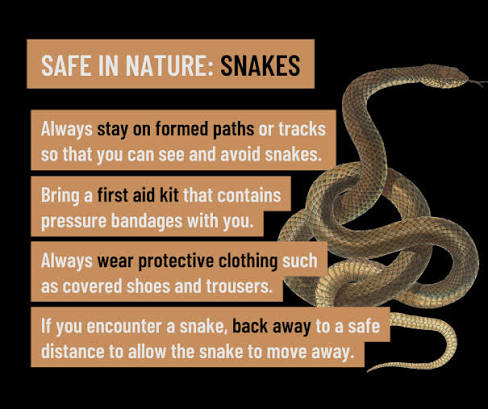
The fundamental principle of snake safety on African safari is simple enough to state in a single sentence but requires some unpacking to apply correctly in the field: if you see a snake, stop moving immediately, observe its position calmly, do not approach it, and wait for it to move away on its own — which the vast majority of snakes will do within sixty seconds if the human observer has stopped advancing toward them. Every elaboration on this principle is a refinement of the same underlying logic: snakes bite because they feel threatened or trapped, and the behaviors that produce a sense of threat or entrapment in a snake — rapid movement toward it, reaching for it, blocking its escape route, loud noise or ground vibration — are all human behaviors rather than snake behaviors. The snake that you see on a walking safari path, at a lodge entrance, or crossing a game drive track is not looking for trouble; it is going about the business of thermoregulating, hunting, or navigating its territory and will reroute away from you the moment it registers that you represent a large, potentially threatening animal, provided you give it the space to do so.
The Most Commonly Encountered Safari Snakes
Species Identification and Risk Assessment
The Black and Green Mamba
The black mamba — Africa’s most feared snake and the subject of more embellished folklore than almost any other organism on the continent — is genuinely one of the most dangerous venomous snakes in the world, combining a highly potent neurotoxic venom, an ability to deliver multiple bites in a single defensive encounter, and a speed of movement that regularly exceeds 12 kilometers per hour over short distances. However, its fearsome reputation is matched by an equal but less famous characteristic: the black mamba is an exceptionally shy, alert, and threat-aware snake that will abandon its retreat route and flee at the first sign of a large animal’s approach, often detecting human presence through ground vibration before visual confirmation and departing the area before an encounter occurs at all. The black mamba encounters that result in envenomation overwhelmingly involve people who have inadvertently cornered the snake — walked between it and its retreat hole, reached into a crevice where one was resting, or attempted to kill one that had entered a building — rather than being attacked by a snake that approached them. Seeing a black mamba in the bush during a safari walk is an extraordinary wildlife sighting of genuine herpetological significance; it is not a life-threatening emergency if the observer stops moving, gives the snake clear retreat space, and watches calmly from a respectful distance.
Green mambas — which are genuinely green rather than the grey-brown of the misnamed black mamba — are arboreal forest snakes found in coastal East African forests, montane forest remnants, and river-fringe vegetation from Kenya’s coast through Tanzania, Mozambique, and South Africa’s KwaZulu-Natal. They are considerably less likely to be encountered on open savanna game drives than black mambas but are a realistic possibility for safari travelers who visit coastal or forested destinations and may encounter one resting in the tree canopy above a lodge walkway or in the dense shrubbery of a forest camp garden. Green mambas are venomous and should be treated with the same respect and retreat space as any dangerous species, but their arboreal lifestyle and relatively timid temperament make accidental provocation significantly less likely than for ground-dwelling species encountered on walking activities. Identifying a green mamba versus an arboreal non-venomous species — Boomslang, vine snakes, and green tree snakes share similar color and habitat — requires herpetological knowledge that most safari tourists do not possess and that makes the “don’t approach any snake in the bush” principle more practically useful than species identification in the moment of encounter.
Puff Adders: The Most Dangerous Safari Snake by Incident Volume
The puff adder is responsible for more snakebite fatalities across sub-Saharan Africa than any other species — not because it is the most venomous or the most aggressive, but because of a combination of characteristics that make accidental encounters with people significantly more likely than with any other dangerous African snake. Puff adders rely on camouflage as their primary defense strategy and are reluctant to move away from an approaching threat, instead remaining motionless and trusting that their extraordinarily effective sand-brown and geometric-patterned body renders them invisible against the leaf litter, sandy soil, and dry grass where they bask during daylight hours. This behavioral choice — remaining still rather than retreating — produces the majority of puff adder bite incidents, where a human steps directly onto a puff adder that was invisible against the ground surface and the snake delivers a rapid defensive strike in the instant of contact. The venom is cytotoxic rather than neurotoxic, causing intense local tissue destruction and swelling that is rarely immediately life-threatening but produces severe pain and can result in permanent tissue damage or limb loss if treatment is delayed beyond four to six hours.
The practical field response to the puff adder risk is the same as the general snake safety principle but applied with particular attention to the specific behavior pattern that causes encounters: looking carefully at the ground before each footstep during walking safari activities, never placing your foot into tall grass or low bush cover without first probing the area with a walking stick or the guide’s rifle butt, wearing ankle-height closed-toe boots rather than sandals during all walking activities, and using a flashlight to scan the path ahead whenever moving between accommodation and communal areas at a camp in the hours after dark when puff adders are actively thermoregulating on paths that retain warmth from the day’s sun. Your professional guide on a walking safari will already be applying all of these precautions habitually and unconsciously — it is part of the practiced situational awareness that defines expert bush craft — and observing how they move through the landscape provides a live tutorial in risk-aware walking technique that is more instructive than any written description.
First Response and Snakebite Treatment
What to Do Immediately After a Bite
The Correct Snakebite Response Protocol
The correct immediate response to any snakebite in an African field setting follows a protocol that differs significantly from the folk medicine interventions — cutting and sucking the wound, applying a tourniquet, immersing in cold water — that persist in popular cultural understanding of snakebite treatment despite being definitively contraindicated by current toxicological medicine. The correct response is to immobilize the bitten limb by splinting it at or below the level of the heart, keep the patient as calm and still as possible to minimize the circulation rate that transports venom through the bloodstream, remove any constricting jewelry or clothing from the bitten area to accommodate the inevitable swelling, and begin evacuation to the nearest hospital capable of stocking and administering appropriate polyvalent antivenom immediately. None of these steps requires the bite to be definitively identified to a species before implementation — the immobilization, calming, and evacuation protocol is appropriate for all venomous species and produces no harm for non-venomous species — which removes the dangerous delay that species identification attempts create when applied as a prerequisite to beginning the correct treatment response.
Antivenom is the only treatment that neutralizes venom that has already been absorbed into the body, and it is available only at hospitals and medical facilities with cold-chain storage capability — it cannot be carried in a field first aid kit and should not be self-administered in the field except in the most extreme circumstances where trained medical assistance is genuinely hours away rather than the minutes to hours that properly organized safari evacuation procedures typically deliver. All quality safari lodges and private game reserves maintain current evacuation protocols with their medical assistance partners — typically AMREF Flying Doctors or a regional air ambulance service — and the emergency contact number for this service is the most important number in any guide’s phone and should be written and accessible in every camp’s communications kit. The time between envenomation and antivenom administration is the critical variable that determines outcome for most African snakebite cases, and the efficiency with which the evacuation chain is activated — guide radios camp, camp contacts medical service, medical service dispatches aircraft, patient reaches hospital — is the reason that well-organized safari operations with practiced emergency protocols produce much better snakebite outcomes than incidents that occur outside managed tourism environments where this activation chain is unavailable.
Plan Your Safari
African Wild Trekkers ensures that every guest receives a snake safety briefing from their guide on arrival at each safari destination, covering the specific species most likely to be encountered in that particular environment, the practical behaviors that minimize encounter risk during walking activities, and the emergency response procedure that is in place at each specific lodge or camp for snakebite and other wildlife-related medical events. This briefing is delivered conversationally rather than as a frightening catalogue of dangers, and the consistent response from guests is that it reduces rather than increases their anxiety about the bush by replacing vague fear with specific, actionable knowledge.
Every guide working on African Wild Trekkers itineraries holds current wilderness first aid certification that specifically includes the snakebite response protocol described above, and every camp on our itinerary network maintains active evacuation agreements with medical assistance providers. We review the specific evacuation procedures at each camp before recommending it to guests, and any camp that cannot demonstrate a current, tested, and properly resourced evacuation capability does not appear on our recommended accommodation list regardless of the quality of its wildlife or its accommodation.
Contact African Wild Trekkers at africanwildtrekkers.com/contact with any safety questions about your planned destination and we will provide specific information about the snake species present, the risk management procedures in place, and the emergency response capability at each lodge on your proposed itinerary within 24 hours.