Kilimanjaro Summit Night: What Really Happens on the Midnight Push
Kilimanjaro Summit Night: An Honest Account of the Midnight Push to Uhuru
Kilimanjaro summit night is the part of the climb that most people think about most before they go and remember most vividly afterward. Everything from the preceding days of acclimatization, trail walking, and early camp life converges on a single night that begins at midnight in temperatures well below freezing. For those who make it, it ends on the roof of Africa at sunrise. Understanding what actually happens during the summit push, in honest and practical terms, is more useful preparation than any amount of inspirational summit narrative. The midnight push is hard, cold, slow, and altitude-affected in ways that no amount of sea-level training fully prepares you for. It is also, for the overwhelming majority of climbers who complete it, one of the most significant experiences of their lives.
The Hours Before Departure
Summit night does not begin at midnight. It begins in the early afternoon of the day before, when the reality of what is coming starts to become concrete in ways that the preceding days of trekking have not quite delivered.
The Final Camp Day
Most Kilimanjaro routes arrive at the final camp. Barafu, School Hut, or Kosovo Camp depending on the route—in early to mid-afternoon. The remainder of the day goes to resting, eating, and sleeping as much as possible before the midnight departure. The altitude at these camps is between 4,600 and 4,800 meters. Most climbers feel the effects: a mild headache, reduced appetite, and disturbed sleep. And a general sense of physical heaviness distinct from ordinary tiredness. These are normal altitude symptoms at this elevation and do not indicate a problem unless they are severe or worsening significantly.
The camp meals before summit night are important even when appetite is suppressed. Guides consistently urge climbers to eat as much as possible at the afternoon meal and again at the midnight departure meal, even if food feels unappealing. Altitude reduces appetite while simultaneously increasing caloric demand. Climbers who start the summit push poorly fueled invariably perform worse than those who have forced adequate nutrition despite feeling full or nauseous. Hot soup, pasta, and simple carbohydrates are the most common pre-summit foods and the easiest to consume when appetite is limited.
Getting Up at Midnight
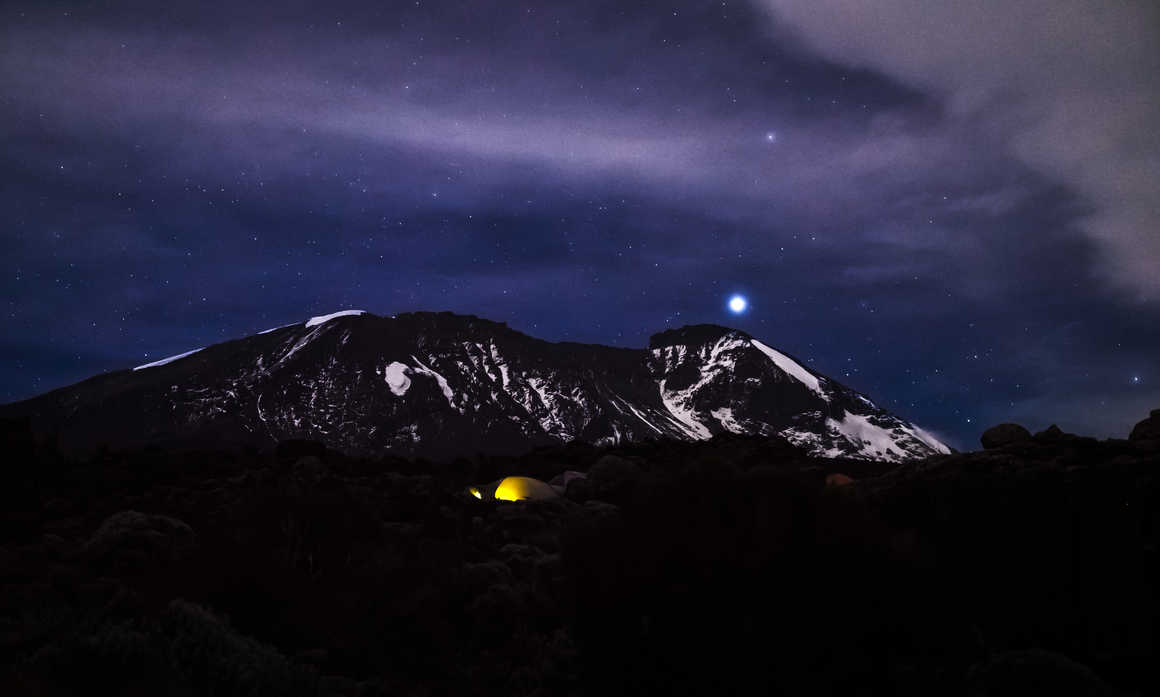
Waking at 11 or 11:30 pm for a midnight departure involves getting up from a sleeping bag in which you probably have not slept more than two or three hours. The tent is somewhere between cool and freezing depending on the night. You must assemble all your summit layers and equipment in the dark with cold fingers and altitude-fogged concentration. Many climbers describe this preparation period as harder than parts of the actual climb. The cold, darkness, and extreme altitude combine with the knowledge of what lies ahead to create a psychological challenge that precedes any physical one. Guides at the camp provide hot drinks and a light snack. The process of getting moving—headtorch on, poles in hand, guide ahead—converts anxiety into action relatively quickly.
Temperature at the final camp at midnight can range from minus five degrees Celsius to minus 15 degrees or colder depending on the season and conditions. Wind chill on the exposed upper mountain can reduce the apparent temperature significantly below the ambient reading. Proper layering—thermal base layers, insulating mid-layer, down jacket, waterproof outer jacket, warm hat, balaclava, neck gaiter, and warm gloves over liner gloves—is essential. Ensure you test and pack your layering system before leaving for the mountain. Climbers who arrive at midnight departure without adequate layering cannot borrow what they need and will suffer severely in the cold during the summit push.
The Ascent: What Midnight to Dawn Feels Like
The climb from the final camp to the crater rim takes between five and seven hours depending on route, individual pace, and conditions. Understanding the psychological and physical arc of this period helps climbers manage their expectations and energy appropriately.
The Scree Climb in Darkness
The first two to three hours of the summit push involve climbing steep scree and volcanic gravel in complete darkness, illuminated only by headtorches. The guide’s footsteps serve as the primary navigation reference. The pace is extremely slow. Far slower than any previous day’s trekking — and this slowness is deliberate and essential. The Swahili phrase “pole pole” (slowly, slowly) becomes meaningful on summit night in a way that polite instruction during the lower mountain days has not conveyed. At 5,000 meters and above, the body can only sustain a pace that allows adequate oxygenation at each step. Guides who push the pace to match a climber’s early enthusiasm do their clients a disservice. This typically results in premature exhaustion or worsening altitude symptoms in the final stages.
The darkness during this phase creates a psychological tunnel that is both manageable and at times difficult. The summit is invisible and feels impossibly far. The altitude produces varying degrees of headache, dizziness, and nausea in most climbers. The combination of these symptoms with cold, darkness, exhaustion, and the sheer relentlessness of the upward scree creates a sustained mental challenge. This determines whether a climber turns back or continues more than any specific physical limitation. Experienced Kilimanjaro guides monitor their climbers carefully during this section. They communicate honestly about turnaround recommendations when altitude symptoms cross from normal discomfort to genuine risk.
Reaching the Crater Rim
The moment of reaching Stella Point or Gilman’s Point on the crater rim is one of the most emotionally charged moments in any Kilimanjaro climb. After hours of upward effort in darkness, the ground levels, the wind intensifies. And the first light of dawn begins to reveal the enormous volcanic crater below. The final stretch to Uhuru Peak lies along the crater rim above. Most climbers experience a surge of emotion at this point. Relief, triumph, gratitude, physical exhaustion. That overrides the altitude symptoms temporarily and provides the energy for the final 45 minutes to the summit.
The walk from Stella Point to Uhuru Peak covers 200 meters of additional elevation gain along the crater rim. This section is the most demanding of the entire climb relative to the distance covered. The altitude of 5,700 to 5,895 meters reduces available oxygen to approximately 50 percent of sea-level concentration. Each step requires conscious effort and recovery, and the pace is the slowest of the entire night. The glaciers of the ice field are visible on the left. The crater drops away on the right. Uhuru Peak’s famous wooden summit sign appears in the distance as dawn light grows across the southern sky. The last few hundred meters take an unreasonably long time. They are worth every step.
The Summit and Descent
Uhuru Peak at sunrise delivers one of the great views available anywhere on earth. The summit sign, the glaciers, the vast African sky, and the shadow of the mountain stretching west across the clouds. All of it arrives simultaneously with the physical and emotional release of having completed the push. Most climbers spend 15 to 30 minutes at the summit. This is enough time for photographs, the full sensory experience. And the conscious acknowledgment of what you have accomplished before altitude and cold recommend the descent.
Descent from Uhuru is paradoxically harder for many climbers than the ascent. The knee and quadriceps demands of the steep scree descent arrive at a point of extreme fatigue. The volcanic gravel descent technique. Planting poles, leaning slightly back, and using the scree as a cushioned slide downward. Is counterintuitive initially but efficient and kind to the joints once you learn it. The descent to Barafu takes two to three hours. Most climbers then descend immediately to the lower camp where food and rest are. And the emotional processing of what has just happened can finally begin.
Plan Your Safari
Kilimanjaro summit night begins months before you leave home, in the training sessions and the gear purchases. And the mental preparation that determines how you perform in the cold and altitude when it matters. Every component of the preparation phase contributes to the summit night outcome. The climbers who arrive most prepared for the physical and psychological demands of the midnight push are invariably the ones who stand at Uhuru Peak at dawn.
African Wild Trekkers prepares climbers thoroughly for summit night with detailed pre-climb briefings, experienced guides who monitor altitude carefully throughout the mountain, and quality cold-weather tent and sleeping equipment. And comprehensive route preparation that puts every climber in the best possible position to succeed on the summit push.
Contact African Wild Trekkers at africanwildtrekkers.com/contact with your preferred Kilimanjaro dates, and we will provide everything you need to prepare for summit night and reach Uhuru Peak within 24 hours.