Grey-cheeked Mangabey Facts: The Loud Forest Monkey of Uganda’s Kibale Canopy
The grey-cheeked mangabey announces itself before it appears. A whooping, gobbling call among the loudest vocalisations produced by any African forest primate echoes through Kibale Forest from distances of several hundred metres. Experienced guides identify the call immediately and move toward it. The mangabey troop eventually comes into view in the mid-to-upper canopy: large, dark-bodied, active, and completely unconcerned by observers below. Watching a mangabey crack open a hard-shelled seed between its jaws using large, powerful molar teeth that no other Kibale primate can match is one of the forest’s most remarkable feeding demonstrations.
What Is a Grey-cheeked Mangabey?
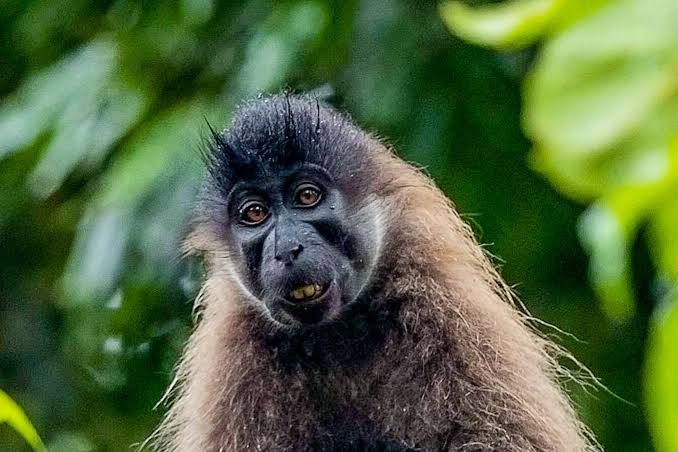
The grey-cheeked mangabey, Lophocebus albigena, is a large Old World monkey belonging to the teamPapionini the same team as baboons and geladas. Adults weigh between 6 and 11 kilograms. Body length reaches 45 to 67 centimetres with a very long tail of 70 to 100 centimetres, carried arched over the back while the animal moves through the canopy. The coat is dark grey-brown to blackish on the body with grey cheek patches that give the species its name. The face is dark grey with heavy brow ridges. A shaggy crest of longer hairs on the crown gives the head a distinctly tufted profile. The eyelids are white — a brief flash of colour visible when the animal blinks.
The Whoop Call and Long-distance Communication
Adult male grey-cheeked mangabeys produce a distinctive loud whoop-gobble call that carries through dense forest for 500 to 800 metres. This call announces the group’s location to neighbouring troops, challenges rival males, and maintains contact between dispersed troop members across the large forest territories that mangabey groups occupy. Playback experiments show that mangabey troops respond to recorded male calls by moving toward or away from the sound depending on their current territorial confidence. The call’s carrying power through dense canopy makes it one of the most effective long-distance communication systems in Uganda’s forest primate community.
Seed Predation: The Hard-Fruit Specialist
Grey-cheeked mangabeys process hard-shelled seeds that other primates cannot open. Their molar teeth are large, thickly enamelled, and capable of generating bite forces that crack seeds other forest monkeys abandon. This dietary specialisation gives mangabeys access to a food resource hard-shelled oil-rich seeds that chimpanzees, red-tailed monkeys, and blue monkeys cannot fully exploit. The mangabey’s role as a seed predator differs from the seed disperser role of fruit-eating primates mangabeys destroy the seed rather than transporting it, extracting the lipid-rich endosperm directly.
Fruit, fungus, arthropods, and leaves supplement the diet when hard seeds are scarce. Mangabeys descend to the forest floor more readily than most canopy primates, foraging among fallen logs and leaf litter for fungi and invertebrates.
Social Structure
Grey-cheeked mangabey troops contain 15 to 40 individuals multiple adult males and multiple adult females with offspring. The multi-male troop structure differs from the single-male groups of blue and red-tailed monkeys sharing the same forest. Male rank within the troop determines access to oestrus females. Rank competition involves aggressive interactions, alliance formation, and the production of dominance vocalisations. Female rank is matrilineally inherited. The large troop size provides predator detection benefits and competitive advantages at productive food trees.
Range in Uganda
Grey-cheeked mangabeys occur in Uganda’s main forest parks Kibale, Bwindi, and Budongo. Kibale holds the largest and most studied population in East Africa. The species also occurs in western Kenya’s Kakamega Forest and in Democratic Republic of Congo’s forest zone. Closed-canopy rainforest and mature riverine forest are the habitat requirements.
Plan Your Safari
Uganda’s Kibale National Park provides the finest grey-cheeked mangabey viewing in East Africa. The Kanyanchu sector’s chimpanzee tracking trails pass through areas of high mangabey density, and troops appear on nearly every forest walk. The whoop call guides observers toward the troop’s position before visual contact. Watching mangabeys work through a fruiting tree alongside chimpanzees competing for access to the same canopy food resource produces one of Kibale’s most compelling multi-species observations.
African Wild Trekkers designs Uganda forest safari itineraries combining chimpanzee tracking, gorilla trekking in Bwindi, and full primate diversity walks in Kibale. Contact us to plan a Uganda primate circuit that captures the country’s extraordinary forest wildlife.