Bat-eared Fox Facts: The Insect-Hunting Canid of East Africa’s Open Plains
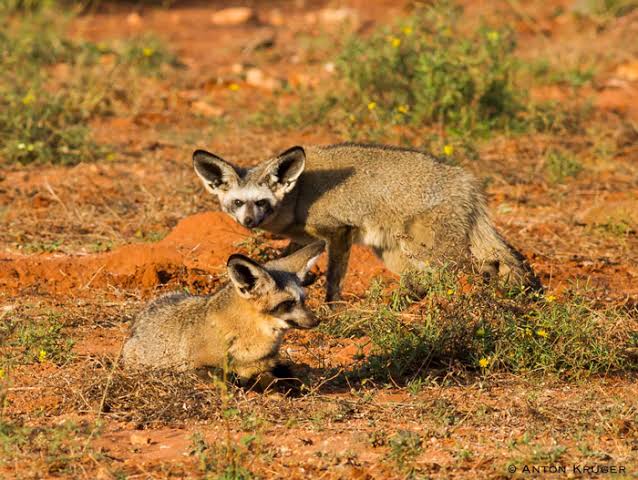
The bat-eared fox carries ears up to 13 centimetres long on a body weighing less than 5 kilograms. Those ears are precision instruments for detecting underground insect movement. A bat-eared fox trots across open grassland with its head lowered and ears angled forward, pausing frequently to press one ear to the ground. The pause lasts one to three seconds before the fox either moves on or begins digging with rapid forepaw strokes. What it digs for harvester termites, dung beetle larvae, and other soil-dwelling insects forms 80 percent of its diet. Forget what you know about foxes and carnivory. The bat-eared fox is essentially a small, dog-shaped, aerially-navigated insectivore with extraordinary hearing.
What Is a Bat-eared Fox?
The bat-eared fox, Otocyon megalotis, is the only member of its genus. Adults weigh between 2.2 and 5.3 kilograms. Body length reaches 46 to 66 centimetres with a bushy tail of 23 to 34 centimetres. The coat is pale sandy-grey on the back with black legs, face mask, and tail tip. The face carries a black-and-white patterned muzzle and the enormous black-tipped ears that name the species. The molar teeth are small and numerous 46 to 50 teeth in adults, more than any other non-marsupial land mammal in Africa. This unusual tooth count reflects the insectivore diet small, numerous crushing teeth process insects more efficiently than the fewer, larger carnassial teeth of typical canids.
Hunting by Ear: How Termite Detection Works
Bat-eared foxes detect prey entirely through sound before any digging begins. The large ears capture the faint acoustic signals of termites moving through soil galleries and dung beetle larvae chewing plant matter underground. The fox stops, cocks one ear toward the ground, and listens for two to five seconds. A positive detection triggers immediate digging at the exact sound source location the fox’s snout strikes soil within centimetres of the actual prey position. This acoustic precision reduces wasted digging effort to a minimum and makes foraging highly efficient even when prey density is low.
Harvester termites Hodotermes species are the dietary staple in East Africa’s open grassland. These termites forage above ground in large columns during the day, making them accessible to a surface forager. Dung beetles and their buried larvae supplement the diet. Scorpions, millipedes, wild fruit, and occasionally small vertebrates round out the intake. The fox’s extremely catholic diet is an adaptation to the seasonal fluctuations in East Africa’s insect prey availability.
Social Life: Pairs and Family Groups
Bat-eared foxes form monogamous pair bonds and raise pups cooperatively. Litters of two to six pups are born in a burrow after a gestation of 60 to 75 days. Unusually among canids, males provide substantially more direct pup care than females grooming, guarding, and playing with pups while the female forages. Both parents bring food to older pups. Adult pups from previous litters sometimes remain as helpers. The family occupies a territory of 0.3 to 3.5 square kilometres, marked with urine at boundary points and actively defended against neighbouring pairs.
Range in East Africa
Bat-eared foxes occur across East Africa’s short-grass open savanna and semi-arid country. The Maasai Mara, Amboseli, Serengeti, and Ngorongoro all hold resident populations. Short open grass with abundant termite activity is the critical habitat requirement. Overgrazed areas and actively managed short-grass plains produce the highest bat-eared fox densities because bare ground and short cover make termite columns visible and accessible.
Plan Your Safari
The Maasai Mara and Tanzania’s Ngorongoro Crater floor produce the most reliable bat-eared fox sightings in East Africa. Dawn and late afternoon drives in open short-grass areas are the key the foxes are most active in the cooler parts of the day when termite columns are above ground. Families with pups, visible from September to December, produce particularly engaging encounters near their den. A fox pressing its ear to the ground before digging at exactly the right spot gives an immediate, vivid demonstration of the acoustic hunting system that defines the species.
African Wild Trekkers designs Kenya and Tanzania safari itineraries that capture the open-country small carnivore community alongside the major wildlife. Contact us to plan a safari exploring East Africa’s complete predator and insectivore diversity.