Why Ruaha Is Tanzania’s Best Kept Safari Secret
Ruaha: The Park That Experienced Travellers Whisper About
Ask any experienced Tanzania safari guide which park they would choose for their own personal safari. Many will say Ruaha. Not the Serengeti, which is magnificent, or Ngorongoro, which is spectacular—it’s Ruaha. Tanzania’s largest national park receives a fraction of the Serengeti’s visitor numbers despite holding comparable lion populations, larger buffalo herds, and wildlife encounters of a rawness and intensity that visitors consistently describe as beyond anything they experienced elsewhere in East Africa.
Safari professionals know Ruaha very well. But operators under-promote it relative to its quality because it requires more effort to reach and lacks the Serengeti’s global name recognition.
This guide explains in specific terms why Ruaha deserves more recognition than it currently receives. Travelers who are ready for their second or third Tanzania safari—or who are sophisticated enough to prioritize quality over brand recognition on their first—consistently rank the Ruaha experience among the finest wildlife encounters of their lives.
The park’s character is not for every traveller, and being honest about who will love it and who might prefer to start with the northern circuit is part of this explanation.
The Wildlife Case for Ruaha
Why the Numbers and the Drama Both Surpass Expectations
Tanzania’s Largest Lion Population Outside the Serengeti
Ruaha National Park holds a lion population estimated at 10 percent of Africa’s remaining total — an extraordinary figure for a single protected area. This translates directly into game drive encounter rates that consistently surprise visitors. The African Lion Research Institute and Frankfurt Zoological Society have studied the Ruaha lion population for decades. Researchers have documented the prides’ home ranges, pride composition, and behavior patterns in detail. Guides draw on this knowledge to provide interpretively rich encounters at every sighting.
These are not just lions—they are known individuals with names, histories, and behavioral profiles that experienced Ruaha guides articulate with the same depth that Serengeti lion researchers bring to their studied prides.
Ruaha’s lions also behave in ways that are distinctly more dramatic than in many other parks. Unlike the Serengeti, where wildebeest and zebra provide relatively easy prey, Ruaha lions regularly hunt buffalo and—remarkably—adult elephants, including large breeding females and occasionally bulls. Researchers document lion-elephant interactions at Ruaha regularly. Camp guests witness these events with noteworthy frequency.
The physical scale and intensity of these encounters—prides of twenty or more lions coordinating to bring down prey that outweighs them by twenty times—produce wildlife observation of a kind that is genuinely difficult to describe without experiencing.
Wild Dogs and the Complete Southern Tanzania Predator Guild
Ruaha is one of Tanzania’s most reliable locations for African wild dog sightings — arguably more consistent than anywhere on the northern circuit. Wild dogs require large home ranges and avoid areas of heavy human activity. Ruaha’s vast, low-visitor landscape provides ideal habitat. Pack structures in Ruaha run large relative to most East African populations.
Open game drive circuits in the Mwagusi and Great Ruaha River areas allow vehicles to follow packs on their morning hunts. A wild dog hunt in Ruaha—the chaotic, high-speed chase through bush and open ground; the catch; and the extraordinary sound of a pack feeding—ranks among the most viscerally exciting wildlife encounters available in Tanzania.
The complete predator guild operating in Ruaha — lions, leopards, cheetahs, wild dogs, spotted hyenas, striped hyenas, and a full complement of smaller predators — creates conditions for predator interaction that specialists specifically seek. Multi-predator interactions at kills, where wild dogs lose a carcass to hyenas who then yield to lions while leopards watch from trees above, represent complex ecological drama that Ruaha’s high predator density makes possible. Less predator-rich parks simply cannot provide these scenes.
The Landscape: Why Ruaha Looks Unlike Any Other Tanzania Park
Baobabs, Escarpments, and the Great Ruaha River
A Visual Environment of Extraordinary Character
Ruaha’s landscape is unlike anything in northern Tanzania. The park sits on the edge of Tanzania’s central plateau, combining rocky granite kopjes, steep escarpments falling away to the river valley, ancient baobab trees of enormous girth, and the winding Great Ruaha River. During the dry season from June through October, river levels drop and sandbanks emerge where crocodiles bask in dozens. The riverine vegetation on the banks produces the densest wildlife concentration in the entire park. Game drives along the river during July and August encounter scenes of wildlife abundance concentrated around dwindling water that rank among the most dramatic in Tanzania.
The baobab trees deserve specific mention. Ruaha contains some of the oldest and most impressive specimens in Tanzania—trees of ten to twenty meters in circumference whose hollow trunks the Hehe people of the southern highlands historically used as water storage. The visual combination of massive baobabs, kopje outcrops, and the blue line of the Great Ruaha River creates a landscape character specific to this part of Tanzania that exists nowhere in the northern parks.
Photographers who visit Ruaha consistently describe it as more visually interesting and compositionally varied than the Serengeti’s open plains. Environmental wildlife portraits—a lion in front of an ancient baobab at dawn and an elephant crossing a sand river bend against rocky escarpments—are specific to Ruaha and impossible to replicate elsewhere.
The Ruaha Experience: What Staying Here Is Like
Camps, Guides, and the Character of the Visit
Small Camps and Exclusive Wilderness
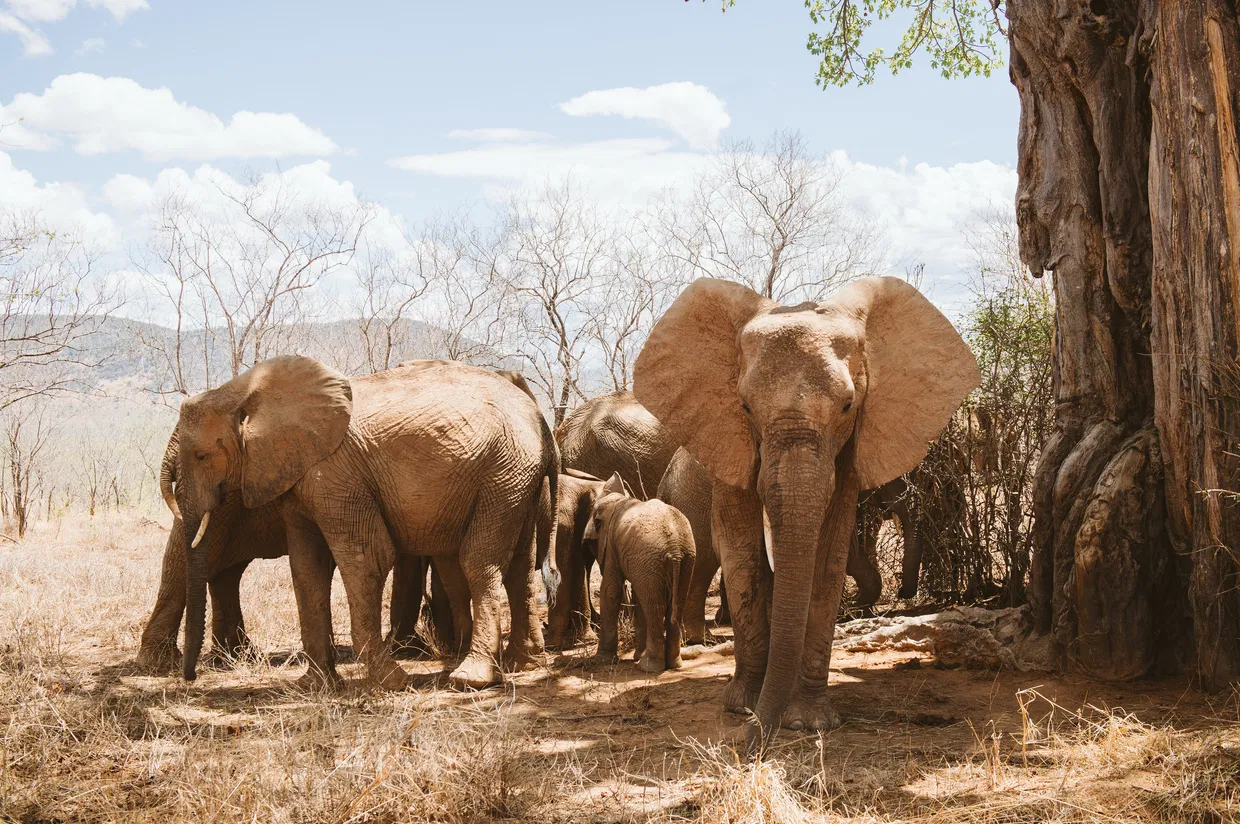
The accommodation network in Ruaha is intentionally small — a handful of permanent camps spread across a park the size of Switzerland, each operating at a maximum of twelve to twenty beds. This structural limitation reflects a deliberate conservation choice that maintains the wilderness character of the park and keeps visitor numbers low enough that wildlife behavior remains essentially undisturbed by human presence. Game drives in Ruaha rarely encounter other vehicles. When significant wildlife events occur—a wild dog hunt, a lion ambush, an elephant confrontation—they often happen in the presence of a single vehicle. The vehicle concentrations that follow major sightings in the Serengeti simply do not happen here.
The guides at Ruaha’s established camps rank among Tanzania’s most knowledgeable and passionate wildlife professionals. Low visitor numbers attract guides who come for the wildlife rather than the volume of tourism income. The complexity and variety of Ruaha’s wildlife also demand genuine expertise to interpret. A Ruaha guide explains lion predation ecology on large prey, discusses the fire management practices that shape the park’s vegetation, identifies the dry-country antelope species absent from the north, and reads the landscape in ways that go significantly beyond standard game drive narration. The combination of small camp exclusivity, expert guiding, and extraordinary wildlife creates an experience that guests consistently describe as transformative.
Walking Safaris in Ruaha’s Rugged Terrain
Most established Ruaha camps offer walking safaris with armed guides. These walks provide access to the park at a scale and sensory depth that vehicle-based game drives cannot approach. Walking in Ruaha involves moving through terrain ranging from open riverbed to rocky kopje to dense bush corridor—reading animal tracks in the dust, identifying spoor and scat, observing small fauna that the vehicle covers too quickly to register, and experiencing the ecosystem at the pace at which most animals within it live.
The guided walk in Ruaha is not a gentle stroll. The terrain is rugged, temperatures are high by 9:00 a.m., and the guide’s route choices follow animal activity and wind direction rather than any fixed path.
Walking safely in Ruaha requires a guide who has trained for and passed the required walking safari qualifications and who knows the local terrain and animal home ranges with genuine intimacy. All established Ruaha camps use qualified walking guides. The safety record of guided walking safaris in Ruaha is excellent—the combination of guide expertise, animal behavior knowledge, and appropriate group management makes these walks challenging and exciting without being reckless. Guests who have done extensive vehicle-based safaris and have never walked in Africa almost universally describe the Ruaha walking experience as one of the most significant additions to their understanding of what African wilderness means.
Who Should Go to Ruaha
The Right Traveller for This Experience
Ruaha Is Not for Every Traveller — and That Is Fine
Ruaha is not the right choice for a first Tanzania safari where the priority is reliable access to the broadest range of species, a comfortable lodge environment, and predictable logistics. It is also not ideal for visitors with significant mobility limitations, young children who need managed activities between game drives, or travelers who measure safari quality primarily by hotel comfort and room quality. Ruaha’s camps, while excellent in their field, are functional safari operations in a remote environment rather than luxury resorts with expansive facilities. The park’s distance from Arusha and the requirement for internal charter flights add cost and logistical commitment that not every itinerary can accommodate.
Ruaha is the right choice for repeat Tanzania visitors who want something genuinely different from the northern circuit. It suits experienced Africa travelers who prioritize wildlife quality and exclusivity over brand recognition; photographers seeking a landscape and wildlife environment that differs from the open Serengeti; predator specialists and wild dog enthusiasts; walkers who want guided foot safaris in complex terrain; and any traveler whose primary goal is the most raw and unmediated African wilderness experience available within Tanzania. For these travelers, Ruaha is not just a good safari destination—it is one of the best wildlife experiences on the continent, full stop.
Plan Your Safari
Ruaha is best visited from June through October when the Great Ruaha River wildlife concentrations peak and game viewing conditions are clearest. The park is accessible by charter flight from Dar es Salaam or Arusha (via Dar) to Msembe airstrip. Book internal flights simultaneously with camp accommodation—aviation and camp operators coordinate availability and scheduling together. A minimum stay of three nights allows two full days of game drives and one half-day walking safari. Four nights provide the most satisfying pace for a Ruaha introduction.
African Wild Trekkers designs southern Tanzania safari itineraries incorporating Ruaha as both a standalone destination and as part of combined Ruaha and Selous circuits. We work with all established Ruaha camp operators and manage all charter flight logistics from Tanzania’s main airports to Msembe airstrip and back.
Contact African Wild Trekkers at africanwildtrekkers.com/contact with your Tanzania travel dates. We will design your Ruaha itinerary and confirm all camp and flight availability within 24 hours.