Kilimanjaro Training Plan: 12 Weeks to Summit-Ready Fitness
Training for Kilimanjaro: A 12-Week Programme to Summit Fitness
Kilimanjaro is not a technical mountain climb, but it demands a level of aerobic fitness and endurance that unprepared travelers consistently underestimate. The summit night push to 5,895 meters involves walking continuously for seven to nine hours at extreme altitude with minimal oxygen. This follows six or seven previous days of four to eight hours of trekking each day. Inadequate physical preparation is the most common reason for incomplete summits that have nothing to do with altitude sickness. A structured 12-week training program gives your body the cardiovascular foundation it needs to sustain the effort that reaching Uhuru Peak requires.
The Foundation: What Kilimanjaro Demands Physically
Understanding the specific physical demands of Kilimanjaro helps you build a training program that addresses the right systems rather than general fitness that may not transfer to mountain performance.
Sustained Aerobic Endurance
The primary physical requirement for Kilimanjaro is sustained aerobic endurance: the ability to walk at a steady pace for many hours on multiple consecutive days. This differs from the short, intense aerobic fitness that running fast or circuit training develops. It requires training that builds the oxidative capacity of slow-twitch muscle fibers and trains the cardiovascular system to operate efficiently at low intensity for extended periods. Long walks, easy hikes, and low-intensity cycling are more relevant to Kilimanjaro preparation than gym-based high-intensity sessions, even though the latter may feel more demanding in training.
A useful practical test for Kilimanjaro readiness is the ability to walk briskly for five hours on rolling terrain without significant fatigue. If you complete this test comfortably, you have the aerobic base for Kilimanjaro’s daily trekking demands. If five hours of continuous walking feels very challenging, begin the 12-week program with shorter sessions and build progressively toward this target before increasing either duration or elevation gain.
Leg Strength and Descending Capacity
Kilimanjaro’s descent from the summit to the lower camps involves several thousand meters of elevation loss on loose scree and volcanic gravel. This places significant eccentric loading on the quadriceps. Many climbers find the descent more physically painful than the ascent. Unprepared quadriceps develop severe delayed-onset muscle soreness after the steep downhill sections. Train specifically for descent—through downhill walking, step-downs, and eccentric squat exercises—to prepare the leg muscles for this loading pattern. This reduces the post-summit muscle damage that makes the final day’s walk to the gate an ordeal for underprepared climbers.
Calf strength and ankle stability are secondary but important considerations, particularly for scrambling sections like the Barranco Wall on the Lemosho Route. Single-leg balance exercises, calf raises, and walking on uneven terrain all contribute to the ankle stability that makes technical scrambling sections safer and less energy-consuming. Wear your trekking boots throughout training and ensure you fully break them in and test them before leaving for the mountain. Attempting to break in new boots during the climb itself reliably produces blisters that compound the altitude experience unnecessarily.
The 12-Week Programme Structure
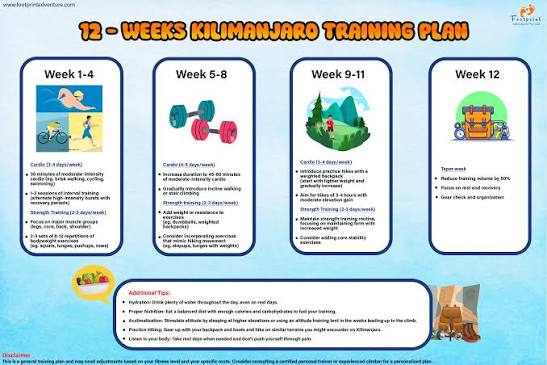
The following 12-week structure progresses from aerobic base building to mountain-specific endurance training with a deliberate taper in the final two weeks before the climb begins.
Weeks 1 Through 4: Aerobic Base Building
The first four weeks establish the aerobic foundation through consistent moderate-intensity exercise five days per week. The primary sessions are long walks or easy hikes of 60 to 90 minutes on flat or gently rolling terrain, building to two hours by the end of week four. Add one longer session of two to three hours per week from week three. Secondary sessions can use cycling, swimming, or elliptical training as cross-training that maintains aerobic conditioning without the repetitive impact loading of daily walking. Strength training two to three times per week should focus on squat variations, lunges, step-ups, and calf raises. And core exercises that support upright posture during long carrying loads.
Week four should include the first back-to-back training day: two consecutive days of three-hour walks with moderate elevation change. This session pattern simulates the consecutive daily trekking of the mountain and begins to train the body’s recovery capacity alongside its raw aerobic fitness. Back-to-back training days are more transferable to Kilimanjaro conditions than any single long session. They stress recovery in the way that seven consecutive trekking days will.
Weeks 5 Through 9: Endurance Development
Weeks five through nine increase training volume and elevation gain progressively. Weekly long sessions should extend to four to five hours with deliberate elevation gain. Ideally on actual hills. But stair climbing or treadmill incline can substitute where terrain is unavailable. By week nine, aim to complete a single-day hike of five to six hours with 800 to 1,000 meters of elevation gain and descent without significant fatigue the following day. This standard approximates a typical Kilimanjaro trekking day and provides a reliable benchmark for summit readiness.
Back-to-back training weekends should become a regular feature from week six onward: two consecutive days of three to four hours each, with the second day emphasizing descending terrain to train the eccentric leg strength needed for Kilimanjaro’s descent. Wear a daypack with five to eight kilograms during these sessions to simulate the load you carry during the climb. Strength training continues two days per week but shifts toward higher repetitions at lower loads to develop muscular endurance rather than maximum strength.
Weeks 10 Through 12: Taper and Preparation
The final two to three weeks before the climb reduce training volume while maintaining intensity. This allows the body to recover from the accumulated training load and arrive at the mountain fresh rather than fatigued. The taper should reduce total weekly training time by 30 to 40 percent while keeping at least two moderate sessions per week to maintain cardiovascular fitness without adding new fatigue. Complete one final back-to-back weekend in week ten as the last significant training block before travel. After that, shift into active recovery mode.
Use the two weeks before climbing Kilimanjaro for gear preparation and final medical consultations, including altitude medication discussions with a doctor. Ensure you fully break in and test your trekking boots and all clothing. Mental preparation is also relevant. Understanding the summit night process and preparing for the cold and darkness of the midnight departure. And setting realistic expectations for how altitude will feel at 5,000 meters above sea level all contribute to better summit performance. They reduce the anxiety and uncertainty that consume energy on the mountain.
Plan Your Safari
Confirm your Kilimanjaro booking at the start of your 12-week training program so that the summit date becomes a fixed target that motivates consistent training adherence. Many climbers find that having the mountain booked and paid for transforms training from optional to essential. This significantly improves training consistency over the preparation period.
African Wild Trekkers provides pre-climb guidance on training, gear, and acclimatization strategies as part of every Kilimanjaro package. The team answers questions about physical preparation, altitude medication, and what to expect at each stage of the climb so you arrive at Londorossi Gate or Marangu Gate fully prepared for the mountain ahead.
Contact African Wild Trekkers at africanwildtrekkers.com/contact with your preferred climb dates and current fitness level, and we will advise on the right route, training approach, and full preparation plan within 24 hours.