Lake Nakuru National Park Kenya: Flamingos, Rhinos and Complete Wildlife Guide
Lake Nakuru National Park delivers one of Africa’s most visually dramatic wildlife experiences within a compact protected 188-square-kilometer area.The park centers on a shallow alkaline lake historically famous for hosting some of the world’s largest flamingo concentrations.Lake algae productivity fluctuates with rainfall and water levels, directly influencing flamingo population size across seasons and different years.Flamingo numbers have ranged from a few thousand to nearly two million individuals depending on environmental conditions over time.
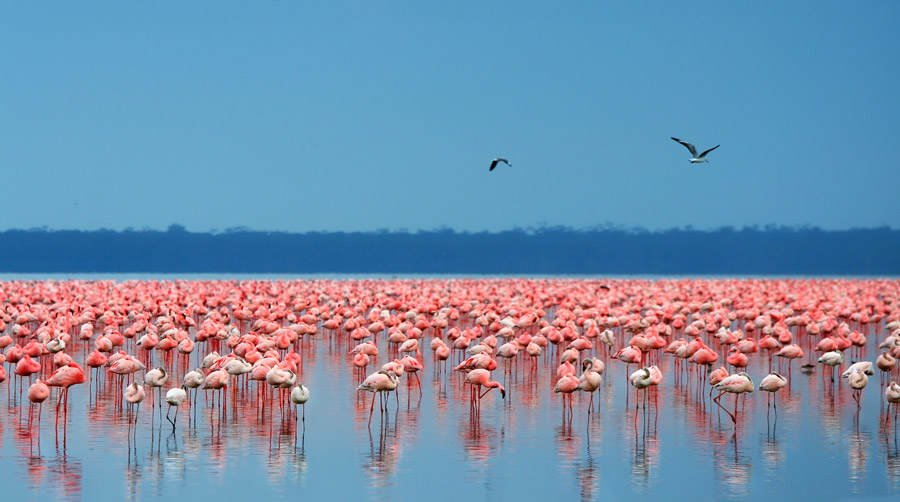
During optimal conditions, the shoreline becomes uniformly pink, creating a spectacular natural display visible from very long distances away.Beyond flamingos, the park functions as a fenced sanctuary protecting black rhinos, white rhinos, lions, leopards, and buffalo herds.It is located approximately three hours from Nairobi, making it ideal for short safari itineraries within Kenya.African Wild Trekkers includes Lake Nakuru in Kenya safari circuits as a compact park with very high wildlife density per game drive hour.The park is especially valuable for travelers seeking reliable rhino encounters without traveling farther to Laikipia or Ol Pejeta Conservancy.
Flamingo Spectacle
Lake Nakuru hosts both lesser flamingos and greater flamingos, which feed on algae and invertebrates within shallow alkaline waters.Lesser flamingos dominate because spirulina algae provides abundant seasonal food supporting large and highly concentrated feeding flocks.The lake’s alkaline chemistry limits other organisms, reducing competition and allowing efficient feeding across wide shallow zones.Flamingo numbers peak after long rains between April and June, when algae blooms reach maximum productivity levels.
During peak periods, the shoreline becomes densely covered in flamingos, creating an extensive pink landscape across the entire lake.Photographs from Baboon Cliff capture the whole lake during peak density conditions, especially under soft early morning light.Dawn lighting enhances pink reflections across the water, attracting wildlife photographers from many countries every single year.
However, flamingo numbers vary greatly depending on rainfall patterns and changing water chemistry conditions throughout different years.After droughts or wet extremes, flamingos often move to other Rift Valley lakes such as Lake Bogoria and Lake Magadi.During such periods, Nakuru may host only tens of thousands of flamingos instead of historic peak aggregations.Rising water levels since the early 2000s have reduced shallow feeding zones where flamingos typically concentrate heavily.
This sometimes lowers visible density even when overall ecological conditions remain productive and relatively stable overall.African Wild Trekkers monitors flamingo conditions using visitor reports and satellite data for accurate safari planning decisions.Safari schedules are adjusted based on current lake conditions to match expected flamingo presence during each client visit.
Nauru Wildlife Experience
When flamingo numbers are low, Lake Nakuru still offers a complete safari experience without relying on lake spectacle alone.The fenced rhino sanctuary ensures both black and white rhinos are reliably present throughout the year inside the park.Excellent road access and small park size allow guides to locate rhinos efficiently compared to larger unfenced reserves.Large buffalo herds provide major prey populations alongside zebra and waterbuck distributed across diverse park habitats.
Leopards inhabit forested lake edges and rocky escarpments, making Nakuru relatively reliable for sightings in Kenya overall.Experienced guides track known individuals and movement corridors to improve leopard encounter success during game drives.Waterbuck are especially abundant along grassy lake margins and form a highly visible part of daily safari viewing.Rothschild’s giraffe, an endangered subspecies with fewer than 3,000 individuals globally, has been successfully reintroduced into the park.
Its population continues growing due to fenced protection and structured conservation translocation and monitoring programs ongoing.The same fencing that protects rhinos also provides a secure environment for Rothschild’s giraffe recovery and survival.Seeing Rothschild’s giraffe alongside rhinos in one game drive offers a strong conservation-focused safari experience overall.These species together highlight the park’s role in protecting multiple threatened large mammals within one ecosystem.
Safari Planning
Lake Nakuru works best as a one-night addition to Kenya itineraries including the Maasai Mara or Amboseli regions.Its proximity to Nairobi makes it an efficient stop rather than a long standalone safari destination.African Wild Trekkers positions Nakuru as a Rift Valley lake and rhino experience within broader Kenya safari circuits.Visits are timed using current flamingo condition updates to align expectations with real-time ecological conditions at the lake.Packages include park fees, accommodation, guided game drives, and transfers connecting to wider Kenya safari routes.Clients receive updated flamingo reports before departure to ensure accurate expectations during their Lake Nakuru experience.
Contact African Wild Trekkers at africanwildtrekkers.com/contact with your Kenya dates and we will design a complete Rift Valley and safari circuit around your priorities. We respond within 24 hours.