The Samburu Five: Kenya’s Most Exclusive Wildlife Lineup
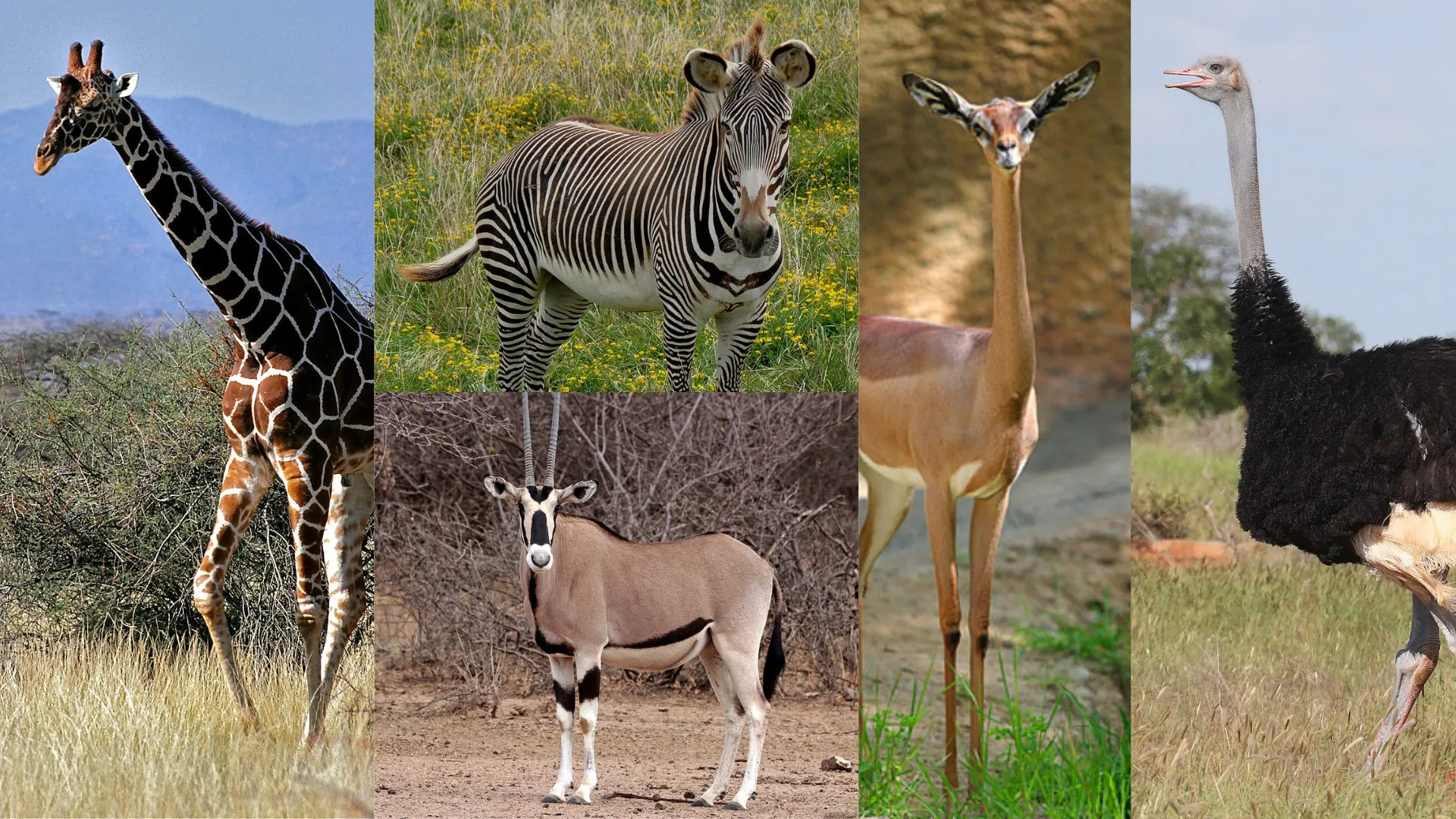
The Samburu Five Kenya describes the five wildlife species endemic to Kenya’s northern arid zone that occur in Samburu National Reserve and its surrounding conservancies but are absent from every major park south of the equator. Gerenuk, Grevy’s zebra, reticulated giraffe, Beisa oryx, and Somali ostrich each evolved specifically for the semi-arid Somali-Maasai biome that covers northern Kenya, Somalia, and Ethiopia, and their presence in Samburu creates a wildlife experience entirely distinct from anything available in the Maasai Mara, Amboseli, or Tsavo. Travelers who have completed multiple Kenya safaris focusing on the southern parks consistently describe their first Samburu visit as a revelation — the same commitment of time and travel budget produces a completely different set of wildlife encounters rather than repeating the species already seen elsewhere. African Wild Trekkers includes Samburu in northern Kenya circuits specifically for this wildlife diversity argument and designs drives that maximize Samburu Five encounters within the standard two-night park visit duration.
Gerenuk: The Standing Antelope
Anatomy and Feeding Behavior
The gerenuk’s body represents one of Africa’s most specialized evolutionary adaptations — a neck proportionally longer than any other antelope relative to body size, hindquarters capable of fully supporting the animal’s weight in a bipedal standing posture, and forelimbs evolved to provide stable balance against acacia trunks while the animal browses at heights inaccessible to competing antelope species. The bipedal feeding stance is not a learned trick but a hardwired behavioral pattern observed from early age, and juveniles begin standing to browse within months of birth, practicing the posture on lower branches before their necks and legs grow long enough to reach the upper foliage that adult gerenuks access. The long neck serves both feeding and predator-scanning functions — a standing gerenuk surveys the surrounding scrubland from a height advantage that provides early warning of approaching lion and cheetah while simultaneously allowing access to the most nutritious unfragmented acacia foliage in the canopy layer below the doum palm fronds that giraffes monopolize.
The gerenuk’s complete water independence from surface sources sets it apart ecologically from every other browsing antelope in Samburu, because the succulent acacia foliage and wild fruits it consumes provide sufficient moisture to maintain hydration across the dry season without the daily riverside drinking ritual that most Samburu species perform. This independence allows gerenuks to penetrate the driest sections of the reserve interior where permanent water is absent and dry-season competition from other species is minimal — a niche that reduces both predation pressure and feeding competition simultaneously. Photographers targeting gerenuks should position the vehicle between the animal and the sun to backlight the elongated neck and translucent ears in a rim-light effect that emphasizes the species’ distinctive silhouette, and the late afternoon light in Samburu’s acacia scrubland creates the warm background that makes gerenuk photographs immediately recognizable as northern Kenya rather than any other East African destination.
Grevy’s Zebra: The Endangered Giant
Identifying Grevy’s from Plains Zebra
Grevy’s zebra is larger than plains zebra by a meaningful margin — a fully grown Grevy’s stallion stands 150 centimeters at the shoulder and weighs 450 kilograms compared to the plains zebra’s 130-centimeter height and 350-kilogram maximum weight — and this size difference becomes obvious when both species appear in the same field of view. The coat pattern differences are equally striking: Grevy’s stripes are extremely narrow and densely packed across the entire body including the belly, while plains zebra stripes are broader with a plain white belly and often a shadow stripe between the main black stripes. The ears of Grevy’s zebra are large, rounded, and mule-like in contrast to the more upright, pointed ears of plains zebra, and this ear shape difference provides a reliable identification feature visible at the distances typical of Samburu game drive encounters. The Grevy’s neck and head are more massively proportioned than the plains zebra’s, giving the species a heavier, more stallion-like appearance that contrasts with the lighter, more uniform build of the common zebra grazing nearby.
Grevy’s zebra social structure produces a completely different behavioral landscape than the plains zebra herds common in southern Kenya. Males hold large exclusive territories of five to ten square kilometers and advertise their boundaries through dung middens and loud braying calls that carry considerable distances across the open scrubland. Females are non-territorial and move freely between male territories based on forage and water availability, so the groups you observe in Samburu are typically a territorial male with a small number of temporarily associated females rather than the stable family herds of plains zebra. This social fluidity means Grevy’s groups you see in the morning may have entirely different compositions by the afternoon as females move between territories, and the same open patch of grassland that held six Grevy’s at dawn may contain different individuals by the evening game drive without any apparent change in the habitat that would explain the turnover. Understanding this behavioral context explains why Grevy’s sightings in Samburu feel different from plains zebra encounters — the animals have a more independent, less cohesive quality that reflects their fundamentally individualistic social organization.
Reticulated Giraffe: The Most Ornate Subspecies
Coat Pattern and Physical Characteristics
The reticulated giraffe’s coat pattern is geometrically the most precise and visually striking of all giraffe subspecies — large, sharply defined chestnut-brown polygonal patches separated by brilliant white borders create a mosaic of extraordinary regularity compared to the irregular, less distinctly bordered blotching of Maasai or southern African giraffe subspecies. No two reticulated giraffes have identical patterns, and the variations in patch size, shape, and color intensity allow researchers to identify individuals from photographs with the same reliability as fingerprint analysis. The white borders between patches are not merely blank skin — they contain a dense network of blood vessels that serve as a thermoregulation system, radiating excess body heat in the hot semi-arid environment where reticulated giraffes have spent millions of years evolving. This vascular network is visible under the white skin as a faint tracery when the giraffe stands in bright light, and close-range photography of a reticulated giraffe in Samburu’s morning light reveals this anatomical detail in a way that increases rather than diminishes appreciation for the coat’s functional elegance.
Reticulated giraffes in Samburu use the doum palm and acacia riverine forest along the Ewaso Ng’iro for shade and high-foliage feeding during midday heat, and their presence at the river creates opportunities for game drive vehicles to observe close-range drinking behavior — a biomechanically demanding process during which the giraffe must splay its forelegs widely to lower its head to the water, a vulnerable posture that the animal monitors carefully for predator approach before committing to. The Samburu giraffe population includes individuals that research teams have monitored for over a decade, and the reticulated giraffe’s relatively smaller range compared to Maasai giraffe makes the Samburu population more observable as a community over repeated visits than the more nomadic southern giraffe populations.
Beisa Oryx and Somali Ostrich
Beisa Oryx: The Arid Zone Survivor
The Beisa oryx has evolved a physiological heat tolerance system so efficient that it can allow its body temperature to rise to 45 degrees Celsius — a temperature that would cause fatal brain damage in most mammals — by temporarily storing heat in its body mass during the hottest hours rather than using energy-expensive sweating to maintain a constant lower temperature. This heat storage strategy is only possible because the oryx’s nasal blood vessel network cools the blood supply to the brain independently of body temperature, protecting the brain while allowing the rest of the body to function as a thermal buffer. This extraordinary adaptation allows Beisa oryx to remain active in the midday heat of Samburu’s summer temperatures that force other species into deep shade, and midday drives in the reserve’s open grassland areas encounter oryx feeding when lions, zebras, and wildebeest have all retreated to riverine cover. The long straight horns that both male and female oryx carry serve as formidable defensive weapons — lions preying on Beisa oryx receive horn wounds that occasionally prove fatal, and adult oryx in good condition successfully defend themselves against single lion attacks in ways that few other prey species manage.
Oryx herds in Samburu range in size from six to 30 individuals and move across the driest sections of the reserve with a purposeful efficiency that reflects the energetic constraints of life in an arid environment where every movement represents a caloric expenditure that must be offset by food intake. The herd’s travel patterns follow seasonal forage availability rather than fixed routes, and their willingness to range far from permanent water into areas where surface water disappears entirely for months at a time allows them to exploit pasture that water-dependent species abandon. Watching an oryx herd traverse the open Samburu scrubland in the early morning — their straight-backed posture, precise synchronized movement, and the parallel alignment of their horns against the sky — produces a visual experience with a formal elegance distinct from the energetic chaos of wildebeest or the casual ambling of elephant family groups.
Somali Ostrich: The Blue-Legged Giant
The Somali ostrich male displays conspicuous blue neck and leg skin during the breeding season that immediately separates him from the pink-necked common ostrich familiar from southern Kenya and Tanzania, and this coloration difference is visible at considerable game drive distances in the open habitat where ostriches consistently occur. Female Somali ostriches are brownish-grey like common ostrich females, making female identification require attention to subtle differences in body size and proportions rather than the dramatic male coloration difference. The Somali ostrich is slightly smaller overall than the common ostrich but maintains the same fundamental biology — the world’s largest bird, incapable of flight but capable of sustained running at 70 kilometers per hour for distances that outpace most predators over open terrain. The species’ preference for the most open, flat terrain in Samburu means sightings cluster in the western and northern sections of the reserve away from the riverine forest, and drives that specifically target these areas rather than staying exclusively on the river circuit produce more consistent Somali ostrich encounters.
Breeding behavior in Somali ostriches during nesting season between April and September produces fascinating displays where the dominant male performs wing-flapping and swaying dances toward females, inflating his neck skin to an intense blue that signals hormonal readiness. The nest site is a simple ground scrape shared between the dominant female and several subordinate females, with the dominant female’s eggs positioned at the center where incubation success is highest. Chicks from multiple females are raised together as a single crèche supervised by both parents, and seeing a Somali ostrich family group with 10 to 20 chicks of varying sizes running behind both parents creates a wildlife scene that visitors from non-ostrich habitats find simultaneously absurd and charming in equal measure.
Plan Your Safari
Seeing all five Samburu Five species in a single visit requires two full days in the reserve with a guide who routes morning drives to cover both the interior scrubland habitat where gerenuk, Grevy’s zebra, and Beisa oryx concentrate and the riverine corridor where reticulated giraffe and Somali ostrich appear alongside the general wildlife. African Wild Trekkers briefs your Samburu guide on your Samburu Five priority list before arrival so the first morning drive is strategically planned rather than a general exploration.
Your Samburu package includes park entry fees, specialist guide, all game drives covering interior and riverine circuits, full-board accommodation on the Ewaso Ng’iro, and transfers from Nairobi or Wilson Airport. We pair Samburu with Laikipia or the Maasai Mara to build a complete Kenya safari that covers northern and southern ecosystems in a single trip.
Contact African Wild Trekkers at africanwildtrekkers.com/contact with your travel dates and we will confirm Samburu availability and send a full Kenya safari itinerary within 24 hours.