Maasai Culture Kenya: Understanding and Visiting Maasai Communities
Maasai culture Kenya travelers encounter on safari is one of East Africa’s most visually distinctive and historically significant cultural traditions. The Maasai maintain a cattle-herding identity, warrior tradition, and ceremonial practices across centuries of colonial pressure, national park boundary creation, and modern economic change. Their presence in the Maasai Mara landscape — the red shukas, ochre-smeared warriors, and low acacia-wood boma enclosures — is inseparable from the Kenya safari visual identity. Understanding Maasai culture before visiting a community creates a more meaningful exchange for both traveler and host. African Wild Trekkers integrates Maasai cultural visits into Kenya safari itineraries through community partnerships that direct visit fees to the community and ensure the exchange is dignified for both parties.
Maasai Society and Traditions
The Maasai Age-Grade System
Maasai society organizes its male members through a formalized age-grade system moving men from junior warrior (moran) through senior warrior to junior and senior elder. Each transition carries specific ceremonies, behavioral requirements, and community responsibilities. The moran — young men between 15 and 30 — occupy the most visually iconic role, wearing long ochre-dyed shukas and carrying herding staffs. Historically, lion hunting marked the transition to full warrior status. Community conservation agreements now redirect that warrior energy toward anti-poaching patrol and wildlife protection roles. Elders govern community decisions through consensus at the enkiama council gathering — a system that manages land, water rights, and inter-community relations without written law or centralized government.
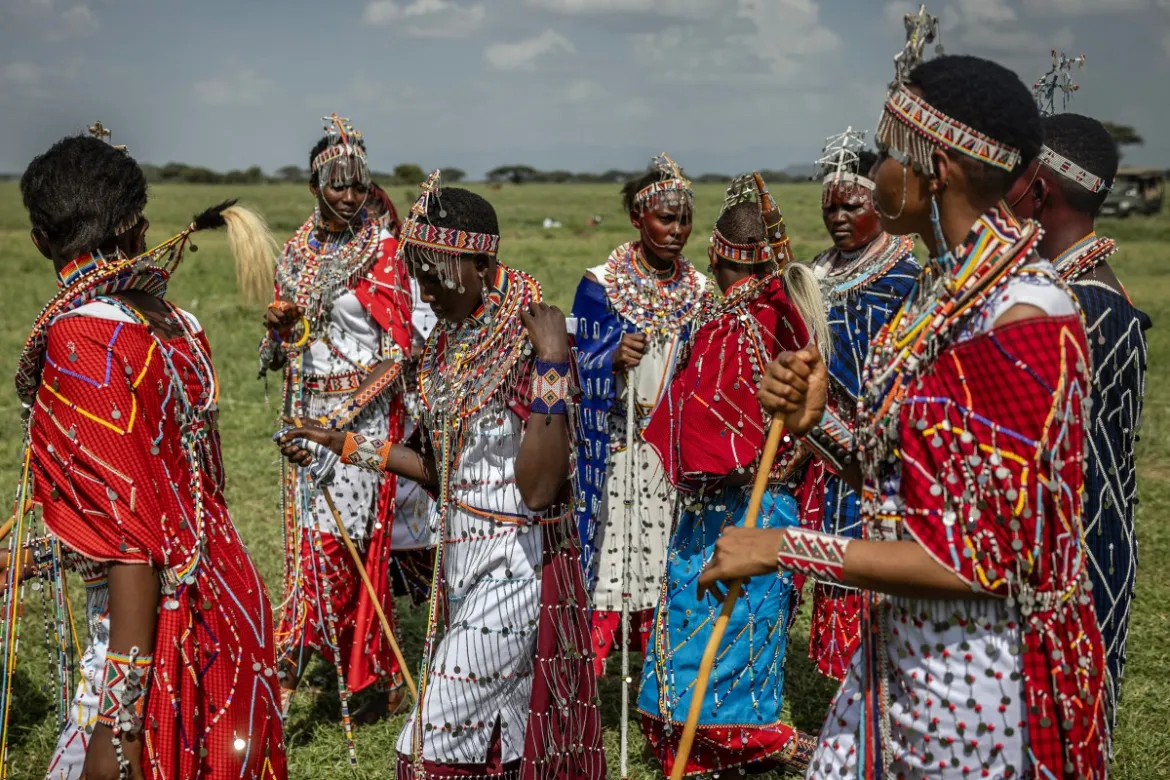
Female social organization centers on age cohorts corresponding to the male age-grade system. Women carry primary responsibility for building the enkaji family home, gathering water and firewood, milking cattle, and managing household food distribution and child-rearing. Maasai beadwork — elaborate color-coded necklaces, ear ornaments, and bracelets — encodes the maker’s clan, age grade, marital status, and region of origin in a sophisticated physical language. A wedding ceremony’s beadwork differs completely from a young woman’s unmarried beadwork, which differs again from the large flat disc necklaces that married elder women wear. Asking a Maasai guide to explain specific beadwork patterns during a village visit transforms the observation from aesthetic appreciation to cultural literacy.
Maasai Cattle Culture and Land
Cattle represent the central economic, spiritual, and social currency of Maasai life. A man’s wealth is measured in cattle, bride price is paid in cattle, and ceremonies mark themselves with cattle sacrifice. The Maasai spiritual worldview holds that God created cattle specifically for the Maasai people, making all cattle rightfully theirs in cosmological terms. This cattle-centered identity creates a land use pattern that conflicts directly with the national park system, since the Maasai require large seasonal grazing ranges that national parks enclose as permanent wildlife habitat. The creation of the Maasai Mara National Reserve in the 1960s and 1970s removed traditional grazing areas from community access. The conservation-versus-pastoralist tension that resulted has shaped Mara ecosystem management politics for decades.
The private conservancy model surrounding the main reserve — where Maasai landowners lease land to safari operators while retaining grazing rights outside core game areas — represents the most successful resolution of this tension. Conservancy lease payments of $40–$80 per acre per year provide reliable income that cattle alone cannot match in years of drought or market price collapse. This financial dependence on conservation-compatible land use aligns Maasai community interests with wildlife protection. Community members who receive lease income from conservancies on their land become the most consistent advocates for anti-poaching enforcement and wildlife-friendly land management. Understanding this economic ecology of the conservancy model is one of the most important frameworks a traveler can bring to a Maasai village visit.
How to Visit a Maasai Village Respectfully
Choosing the Right Village Visit Format
Maasai village visits range from highly performative tourist stage shows — warriors in full ceremonial dress performing the adumu jumping dance repeatedly for multiple daily visitor groups — to genuine community engagement visits through ethical tourism partnerships. The difference between these extremes is often invisible at the point of booking. A performative stage show visit displays real cultural practices in an artificial context — the adumu performed for twelve tourist groups per day is the same dance performed at ceremonies, but the absence of ceremonial context transforms it from a meaningful cultural act into a performance. A genuine community visit arranged through a conservancy community liaison visits a family home in the context of actual daily life, with the interaction shaped by the community members’ own preferences and pace.
Ask your safari camp manager specifically which community the village visit connects to, how the entrance fee is distributed, and whether the visit follows a fixed performance format or an open interaction model. Camps in private conservancies with genuine community partnerships typically visit specific families whose land the conservancy leases — the relationship between camp staff (many of whom are Maasai community members themselves) and the families visited creates a natural ambassador dynamic where the guide explains cultural context rather than simply facilitating observation. The entrance fee — typically $15–$30 per person — should flow entirely to the community rather than being split between a tour operator and the community. Asking this question directly reflects a respectful traveler orientation that community liaison officers consistently appreciate.
Cultural Etiquette
Dress modestly for a Maasai village visit — long trousers rather than shorts, covered shoulders, and footwear you do not mind getting dirty on the boma’s unpaved ground. Photography is generally welcome by community members who participate in organized village programs, but always ask permission before photographing an individual and accept a refusal gracefully. Some elder women and individuals not participating in the formal visitor program prefer not to be documented — a good village liaison indicates in advance who is available for photography. Children at the boma may approach visitors for photographs enthusiastically. Show children the photograph on the camera screen immediately — this generates genuine delight that makes the interaction mutual rather than extractive.
Purchasing crafts and beadwork at the village market is a genuinely supportive economic act when the item is made by the seller. Maasai beadwork purchased directly from the maker funds the specific woman who created it rather than intermediary resellers. Negotiate respectfully and accept the seller’s final price without aggressive bargaining — a Maasai elder woman’s beaded necklace is priced at what it costs to make and what it represents culturally. Do not distribute sweets, money, or other items directly to children regardless of how persistently they are requested — community members consistently report that this practice damages children’s educational motivation and social dynamics in ways that the brief visitor satisfaction of a child’s smile does not justify. African Wild Trekkers guides brief clients on these etiquette points before every community visit.
Maasai Cultural Experiences Beyond the Village Visit
Maasai Warriors as Safari Guides
Some of the Maasai Mara’s most exceptional wildlife guides are Maasai community members who grew up in the ecosystem and learned animal behavior, plant identification, and tracking from childhood cattle herding before conservation training built professional knowledge around that empirical foundation. A Maasai guide’s ability to read animal signs, understand seasonal movement patterns, and interpret the ecosystem’s daily rhythms draws on a depth of landscape knowledge that a formally trained but non-local guide simply does not accumulate without decades of immersion in the specific terrain. Walking safaris led by Maasai warriors carry an additional layer of authenticity — the warrior’s traditional role as community protector from predators creates a situational awareness and bush fearlessness that transfers directly to the walking safari format.
The Maasai Mara’s private conservancies increasingly employ Maasai community members as wildlife researchers, anti-poaching patrol rangers, and conservation monitors — roles that leverage traditional ecological knowledge in institutional conservation programs and provide career paths for educated young Maasai who want professional development alongside continued connection to their ancestral landscape. Travelers who engage with these conservancy staff members during bush walks or evening talks encounter the living synthesis of traditional pastoralist knowledge and contemporary conservation science that the Mara’s community conservation model produces at its most successful. African Wild Trekkers camps in Mara North and Naboisho arrange evening conservation presentations by Maasai research monitors as a standard itinerary feature.
Plan Your Safari
Maasai culture Kenya community visits work best when arranged in advance through the safari camp rather than organized independently at roadside bomas. Pre-arranged visits connect to communities with established visitor programs, transparent fee structures, and guided interpretation that spontaneous visits cannot provide. African Wild Trekkers builds Maasai community visits into Maasai Mara itineraries through conservancy community partnerships at no additional operator cost beyond the community entrance fee.
Your Maasai Mara safari package includes a private conservancy camp with Maasai staff guides, game drives in a vehicle limit conservancy, full-board accommodation, Wilson Airport domestic flight, park and conservancy fees, and a Maasai community visit arranged through the camp’s established community partnership program.
Contact African Wild Trekkers at africanwildtrekkers.com/contact with your travel dates and we will confirm Maasai Mara availability and send a complete Kenya safari itinerary within 24 hours.