Mountain Gorilla Facts 2026: Population, Diet, Behavior & Conservation
The Mountain Gorilla in 2026
The mountain gorilla is one of conservation’s most celebrated success stories and one of the world’s most sought-after wildlife encounters. In 1981, the global mountain gorilla population fell to an estimated 254 individuals. A number small enough that several leading researchers predicted extinction within decades. Today, the combined population across the Virunga Massif (shared by Rwanda, Uganda. And the DRC), Uganda’s Bwindi Impenetrable Forest stands at approximately 1,063 individuals, and the trend is upward. This recovery was achieved through decades of dedicated research, intensive ranger protection, and community benefit programs. And the development of gorilla ecotourism as a conservation funding mechanism. It represents one of the most successful recoveries of any critically endangered large mammal in history.
Mountain gorillas are a subspecies of the eastern gorilla and are confined to a remarkably small geographic range: the volcanic Virunga Mountains straddling Rwanda and Uganda. And the DRC. And the separate Bwindi ecosystem in southwestern Uganda. The two populations are genetically distinct. Bwindi gorillas and Virunga gorillas differ measurably in DNA and physical characteristics. And conservation programs manage them as separate units. Despite this small range, mountain gorillas have defied the extinctions that most biologists predicted for a critically small, geographically confined population. They demonstrate what intensive protection combined with ecotourism revenue can achieve when governments and conservation organizations. And local communities align around a common objective.
Mountain Gorilla Biology
Physical Characteristics and Diet
Size and Physical Adaptations
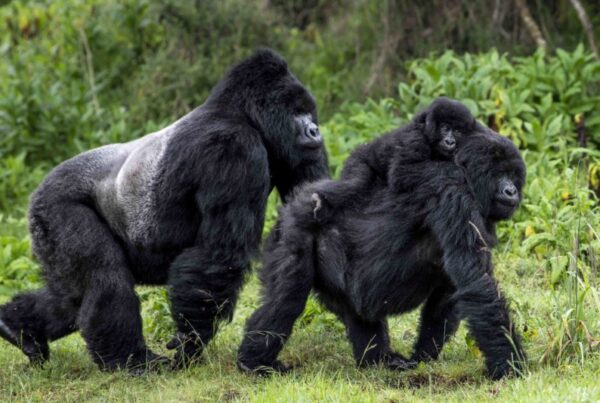
Mountain gorillas are the largest of the four gorilla subspecies. Adult male silverbacks—males that have developed the silver saddle of grey hair marking full maturity, typically around 12 to 15 years of age—weigh 140 to 200 kilograms and stand up to 1.8 meters when upright. Their arm span extends to 2.5 meters, and their muscular upper body adapts for both locomotion through dense mountain forest and the displays and combat that characterize male-male competition. Mountain gorillas knuckle-walk, moving most efficiently on all fours with the dorsal surface of the fingers bearing weight rather than the palms. Their broad, heavily muscled shoulders and chest suit this locomotion pattern as well as the branch-tearing and tree-beating displays that silverbacks use to assert dominance.
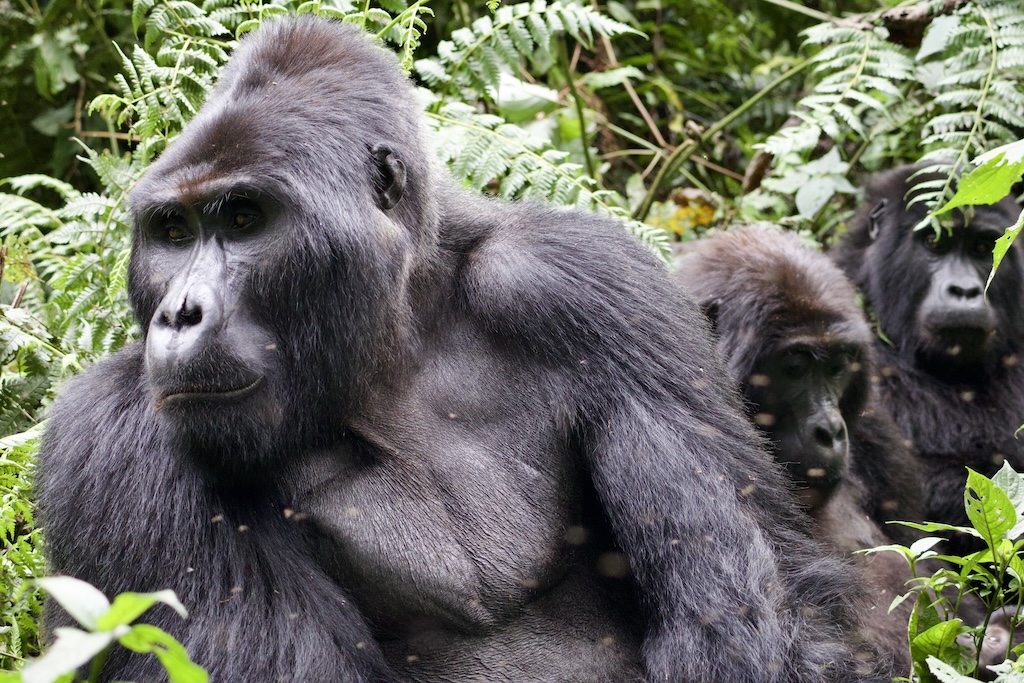
Compared to lowland gorilla subspecies, mountain gorillas have several physical adaptations to the cold, high-altitude environment. The Virunga volcanoes typically sit at 2,200 to 4,300 meters above sea level. And Bwindi’s montane forest ranges from 1,190 to 2,607 meters. Their hair is longer and denser than that of lowland gorillas, providing insulation against overnight temperatures that frequently drop below 10 degrees Celsius. Their body mass relative to height is higher, reducing surface area to volume ratio and conserving body heat. These cold-climate adaptations make mountain gorillas the most visually distinctive of the four gorilla subspecies. The thick, shaggy black coat that safari travelers see when sitting meters from a feeding family is an evolutionary response to the specific climatic conditions of the high Afromontane forests where the subspecies lives.
Diet and Daily Activity
Mountain gorillas eat primarily leaves, stems, roots, bark, and occasionally flowers and fruit, spending 30 to 40 percent of each day feeding. Unlike lowland gorilla subspecies that depend heavily on fruit, mountain gorillas in the Virungas consume very little fruit because the high-altitude forest produces limited fruit crops year-round. This dietary difference—abundant foliage versus limited fruit—shapes the daily ranging patterns of mountain versus lowland gorillas. Lowland gorillas travel farther each day in search of fruit patches. Mountain gorillas move relatively short distances between dense vegetation stands, consuming high-fiber, low-calorie food in large quantities throughout the day. An adult gorilla eats 18 to 22 kilograms of vegetation daily.
The daily activity pattern of a mountain gorilla family features extended feeding periods in the morning and afternoon and a midday rest period when adults sleep and groom. And play. And a late afternoon foraging push before nest-building at dusk. Each gorilla builds a new nest each night. Either in trees or on the ground depending on the individual and the terrain. By bending and folding vegetation into a platform. Nest-building takes only a few minutes and produces the circular depressions in vegetation that researchers use to count groups, determine ages from nest size, and track family movements across the forest. The habit of building a new nest each night rather than returning to a fixed sleeping site likely reduces parasite loads and predator habituation. Predation pressure on mountain gorillas is minimal given their size and the collective defense capacity of even a small family group.
Family Structure and Silverback Behavior
Families, Silverbacks, and Social Life
The Silverback’s Role
Mountain gorilla families center on a dominant silverback who serves as protector, conflict mediator, and decision-maker for the group. Most families contain a single silverback, though multi-male families exist. With two or more adult males. Exist and tend to be larger and more stable than single-male groups. The silverback makes all travel decisions, determines the family’s ranging route, and intervenes in conflicts between other group members. His physical presence alone deters most threats. An 180-kilogram silverback’s charge display. Involving a sequence of chest-beating, roaring, ground-slapping. And vegetation-tearing culminating in a short charge and sudden stop. Is one of the most intense wildlife experiences in Africa, even when clearly a display rather than a serious attack.
Female mountain gorillas choose their group and their ability to transfer between groups. Taking their infants with them. Gives them a degree of social agency that challenges simple dominance-based models of gorilla society. Females that lose their silverback to death or defeat by a rival may follow the victorious male, transfer to an entirely different group, or, rarely, attempt to form a new group with their offspring. The silverback’s reproductive interests require retaining females, so silverbacks actively protect the females and young under their care against infanticide attempts by rival males. A silverback that allows his females and infants to be killed by rivals loses reproductive potential. One that defends them successfully maintains it.
Gorilla Infant Development
Female mountain gorillas give birth to a single infant after an eight-and-a-half-month gestation period—similar to the human gestation period. The infant is born at approximately 2 kilograms, helpless, and entirely dependent on the mother. Infants cling to their mother’s chest for the first months of life, then transition to riding on her back as they develop the strength and coordination to hold on independently. Weaning occurs between three and four years of age and the interbirth interval. The time between successive births. Is typically four to six years, one of the longest of any non-human primate. This slow reproductive rate means that mountain gorilla population recovery is inherently gradual. A female gorilla that lives to 40 may produce only six to eight surviving offspring across her lifetime.
Infant play is one of the most engaging behaviors observable during a gorilla trekking hour. Young gorillas play with considerable energy—wrestling, chasing, tumbling, and swinging from branches. Interactions between infants from different family members produce some of the most photogenic and anthropomorphically striking images in wildlife photography. The occasional approach of a juvenile gorilla toward the human trekking group. Touching a boot, examining a camera bag, retreating rapidly at an adult’s rumble. Is one of the most frequently reported highlights of any gorilla trekking experience. It is one of the moments that most powerfully conveys the closeness of the evolutionary relationship between humans and gorillas.
Where to Trek Mountain Gorillas
Rwanda’s Volcanoes National Park is the most accessible and polished gorilla trekking destination, offering high-end lodge infrastructure in Musanze and well-maintained trails. And 12 habituated gorilla families available for daily visits. The Rwanda Development Board issues permits at USD 1,500 per person, and advance booking is essential. Rwanda’s proximity to Kigali International Airport. 2.5 hours by road. And the development of Musanze’s hospitality infrastructure make it the easiest gorilla trekking destination for travelers combining a Rwanda gorilla trip with East Africa game drives in Kenya or Tanzania.
Uganda’s Bwindi Impenetrable Forest hosts more habituated gorilla families than any other single location. Over 20 families across four sectors of the forest. And offers significantly lower permit prices at USD 700 per person. The Bwindi experience is more adventurous and less polished than Rwanda’s: the forest is genuinely impenetrable in places, and the terrain can be steep and muddy. And the experience of arriving at a gorilla family after a long forest trek through the mist has a rawness that Rwanda’s more manicured approach lacks. For many experienced safari travelers, this roughness is the point. Uganda’s lower cost, greater gorilla family diversity, and the ability to combine gorilla trekking with chimpanzee tracking in Kibale and savanna game drives in Queen Elizabeth make it the more complete African primate destination.
Plan Your Safari
Mountain gorilla permits in Rwanda sell out twelve months ahead for peak season visits in July and August. And Uganda’s Bwindi permits are increasingly booked out months in advance as the destination’s reputation grows. The logistics of combining gorilla trekking with other African safari activities. Particularly the Kenya or Tanzania game drive circuits. Require careful sequencing that an experienced operator handles from the permit stage forward.
African Wild Trekkers secures gorilla permits in both Rwanda and Uganda and designs combination itineraries that pair gorilla trekking with chimpanzee tracking and game drives across multiple countries. And manages all transfers, lodge bookings. And park entry logistics so that every element of the great ape circuit connects seamlessly.
Contact African Wild Trekkers at africanwildtrekkers.com/contact with your travel dates and gorilla trekking goals, and we will begin securing your permits and designing an itinerary around both Rwanda and Uganda options within 24 hours.