Safari on a Budget: See Africa Wildlife for Under $100 a Day
Budget Safari Is Real and It Works
The idea that an African safari requires weeks of budget and only the wealthy can access Africa’s wildlife is one of the most persistent and most damaging misconceptions in travel. It keeps potential first-time visitors from planning trips they can genuinely afford. It misrepresents the actual structure of the Africa safari market. Which ranges from $50-a-night public campsite experiences inside major national parks to $3,000-a-night exclusive private camps with butlers and helicopter transfers. The middle of that range — and the lower-budget end — contains genuinely excellent wildlife experiences. These deliver Big Five encounters, skilled local guides, and close-range game viewing at a fraction of the prices that luxury safari marketing presents as the norm. Understanding where in the market to look, and which specific destinations and formats offer the best wildlife quality per dollar spent, is the key to building a budget Africa safari that over-delivers on every expectation.
The $100 per day figure in this guide’s title represents a realistic floor for a genuine multi-day safari experience. It includes accommodation, park fees, and game drives. Not a single activity or a day trip. But the sustained bush experience of waking up in the game reserve, going on multiple game drives daily, and spending genuine time immersed in the wildlife environment. Below $100 per day becomes possible in specific circumstances. Camping, self-drive, East Africa’s most affordable public parks. But requires accepting comfort limitations that most travelers find manageable for the duration of a short trip. The guide below is structured around the most practical budget safari formats and the specific destinations that offer the best wildlife at each price level.
Best Budget Safari Destinations
East Africa and Southern Africa Options
Kenya’s Public National Parks: Tsavo, Amboseli, and Aberdares
Kenya’s public national parks offer some of Africa’s best wildlife in a budget-accessible format. Kenya Wildlife Service (KWS) campsites inside Tsavo East, Tsavo West, Amboseli. And Lake Nakuru charge between $30 and $60 per person per night at public campsites. Basic bandas — simple wooden huts — are available at KWS facilities within several parks for slightly more. The park entry fee structure in Kenya distinguishes between citizens, East Africa residents, and international visitors. International visitors pay between $40 and $80 per person per day in park fees depending on the specific park. Amboseli sits at the higher end; the Tsavo complex sits at the lower. Self-drive is available in most Kenyan national parks. Travelers with a 4WD vehicle. Available for hire in Nairobi from around $70 to $100 per day with basic equipment. Can cover extensive game drive circuits independently without hiring a guide. The absence of a guide eliminates much of the wildlife interpretation that makes a guided safari exceptional. But it also eliminates the most significant cost driver beyond accommodation and park fees in the Kenya safari market.
Tanzania’s public park system offers similar budget access in its northern circuit parks. However, the USD-denominated entry fees are among the highest in Africa. Serengeti National Park charges $82 per adult per day. Ngorongoro Crater’s conservation area fees add a further $300 per vehicle per crater descent. This fee structure makes Tanzania’s most famous parks expensive for budget travelers in a way that Kenya, South Africa, and Namibia are not. Public campsite options within the Serengeti provide affordable accommodation. Around $40 per person per night at special campsites, $30 at public campsites. But they do not reduce the park entry cost. The most budget-conscious Tanzania approach combines Arusha’s nearby Arusha National Park. With the lowest entry fees at $45 per person per day. With a single strategic Ngorongoro entry. This obtains the crater’s extraordinary wildlife density without a multi-day Ngorongoro commitment at full daily fees.
South Africa’s Self-Drive Parks: Kruger and Beyond
South Africa’s public national park system, managed by SANParks, offers the best budget safari infrastructure in Africa. It combines affordable online entry fees, a range of accommodation from full-facility restcamps to wilderness backcountry campsites. And a self-drive game viewing system in Kruger National Park. Kruger’s 350-kilometer north-south extent can be covered at the traveler’s own pace and budget. Kruger’s SANParks restcamp accommodation ranges from basic camping at $15 per person per night through fully equipped chalets at $80 to $120 per chalet per night sleeping two to four. Park entry is charged at $17 per person per day for international visitors. The lowest international visitor fee of any major African safari park. The result is that a couple spending four days in Kruger with their own vehicle, staying in a basic restcamp chalet. And paying their own park entry fees can achieve the complete Kruger safari experience for approximately $80 to $100 per person per day before vehicle fuel and food costs. This is genuinely within budget safari territory by any African safari standard.
Namibia’s public park system provides similar self-drive budget access to its extraordinary desert and wildlife experiences. NamibRand, Etosha, and the Caprivi Strip’s Bwabwata National Park are all accessible for self-drive travelers. Affordable SANParks-equivalent camping and chalet facilities are run by Namibia Wildlife Resorts (NWR). The Etosha restcamps at Okaukuejo, Namutoni, and Halali are genuinely comfortable. Each has its own waterhole that produces extraordinary overnight wildlife viewing from floodlit viewing decks. Per-person accommodation costs at basic campsites and self-catering bungalows come in well under $100 per person per day. Namibia’s low population density and the fact that most self-drive travelers need a 4WD or high-clearance vehicle for remote routes adds vehicle hire to the per-day cost. But the visual spectacle and wildlife quality of Etosha make it one of Africa’s outstanding budget safari destinations at any price level.
Budget Safari Formats and Tips
Group Tours, Camping Safaris, and Self-Drive
Group Camping Safaris: Best Value Per Day
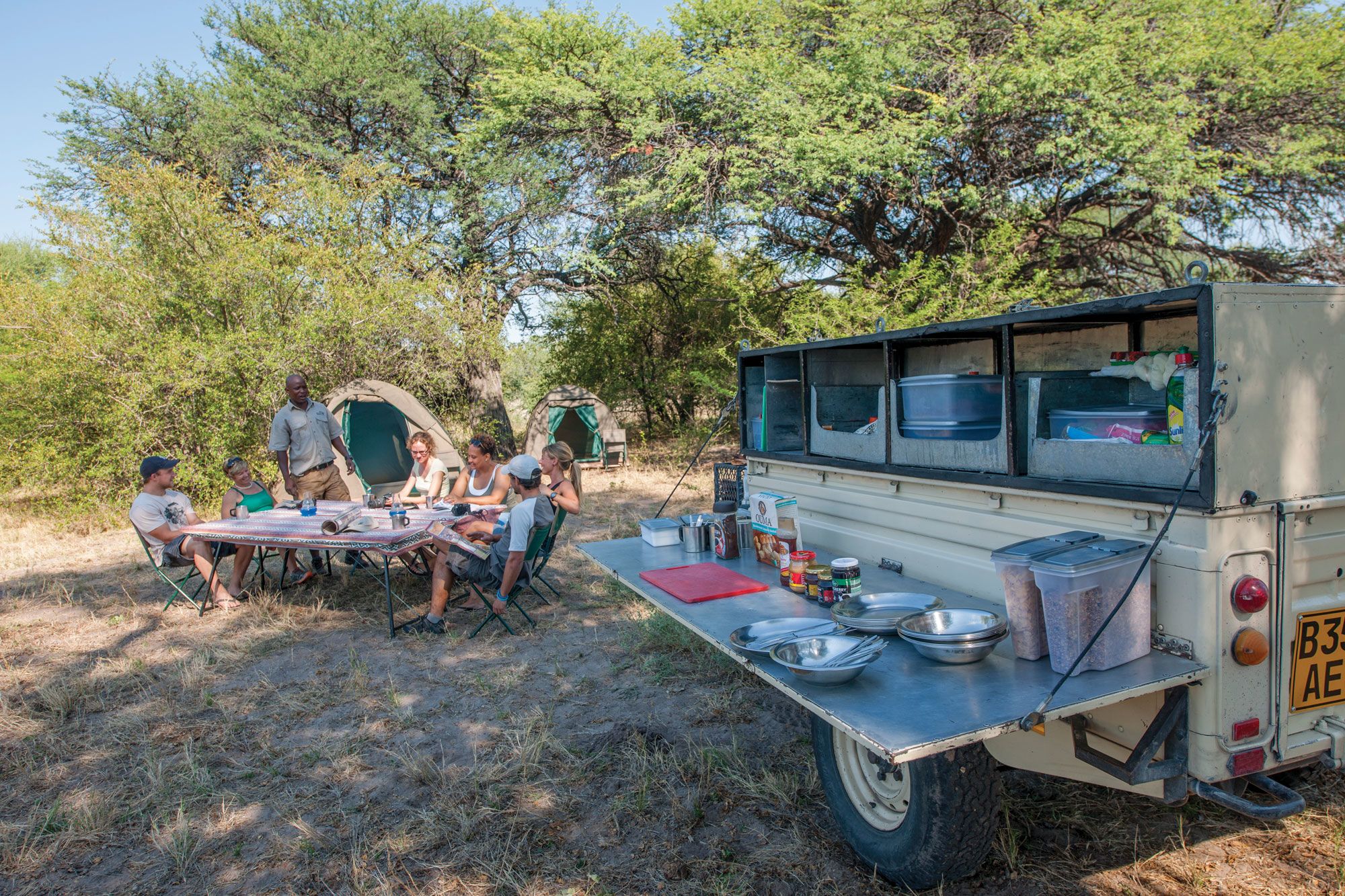
Scheduled group camping safaris provide the lowest cost per day access to guided safari experiences in East and Southern Africa. Operators include Intrepid Travel, G Adventures, Exodus Travels, and Africa specialists including Tracks and Trails. Groups of 8 to 16 travelers share the cost of a guide, vehicle. And camping equipment across itineraries that run five to fourteen days. Prices for these scheduled camping safaris typically run $100 to $200 per person per day all-inclusive. This is significantly below the per-person cost of a private guided safari. Because fixed vehicle costs and shared camping infrastructure spread across multiple travelers produce per-person cost efficiencies that solo or couple travelers cannot achieve. The trade-off is flexibility. Scheduled group itineraries depart on fixed dates at the group’s pace. This produces excellent wildlife encounters but eliminates the ability to spend an extra hour at a lion kill or take a detour to investigate interesting tracks. A private guide would build around guest interest in those situations.
Self-drive safari is the absolute budget ceiling-remover for travelers comfortable with independent travel. It requires willingness to research routes, navigation, and wildlife identification independently. A self-drive safari combining Kruger National Park, Chobe National Park. And Victoria Falls achieves the full range of Big Five encounters, river safari wildlife, and one of the world’s natural wonders. All three have excellent self-drive infrastructure and affordable campsite booking systems. The total trip cost can come in under $2,500 per person for a two-week trip. Including flights, vehicle hire, accommodation. And park fees. When planned carefully and booked in advance. The self-drive format demands research investment before departure. But it rewards that investment with complete flexibility to follow wildlife encounters, stay at favored locations. And adapt the itinerary to what the bush is actually producing on any given day.
What Budget Safari Cannot Always Deliver
Honest budget safari guidance requires acknowledging what the budget format does not deliver. The walking safaris, night drives, and off-road game vehicle privileges that are standard in private game reserves are generally not available in public national parks. Road rules and guide certification requirements apply uniformly in public parks. Night drives in Kruger are restricted to the camps’ own organized drives. Walking safaris require certified armed guides not always available through public park bookings. The extraordinary habituation of wildlife in private concessions. Where elephant eat from trees above your breakfast table and lion sleep 10 meters from your tent deck. Reflects the low vehicle pressure and total absence of mass public tourism. Budget park safaris necessarily share the landscape with hundreds of other vehicles in peak season. Budget safari delivers genuine wildlife encounters at excellent value. It does not deliver the exclusivity, intimacy, or specialist activity access that private concession safari provides. And that is worth every cent of its premium for travelers who specifically seek those qualities.
Plan Your Safari
African Wild Trekkers designs itineraries across the full budget spectrum. From self-drive Kruger planning with recommended routes and campsite bookings to mid-range lodge safaris that access quality wildlife without paying for the exclusive private concession premium. We believe that the wildlife of Africa should be accessible at every level of the budget spectrum. We help clients at every price point build itineraries that deliver the best wildlife experience their budget can achieve.
Contact us with your per-day budget, travel dates, and destination interests and we will design a safari that maximizes your wildlife experience within your specific financial parameters. No pressure, no upsell, just the best safari your budget actually allows.
Contact African Wild Trekkers at africanwildtrekkers.com/contact with your budget and travel dates and we will design a safari itinerary within 24 hours.