Suni Antelope Africa: The Tiny Forest Antelope of East Africa’s Coastal Thicket
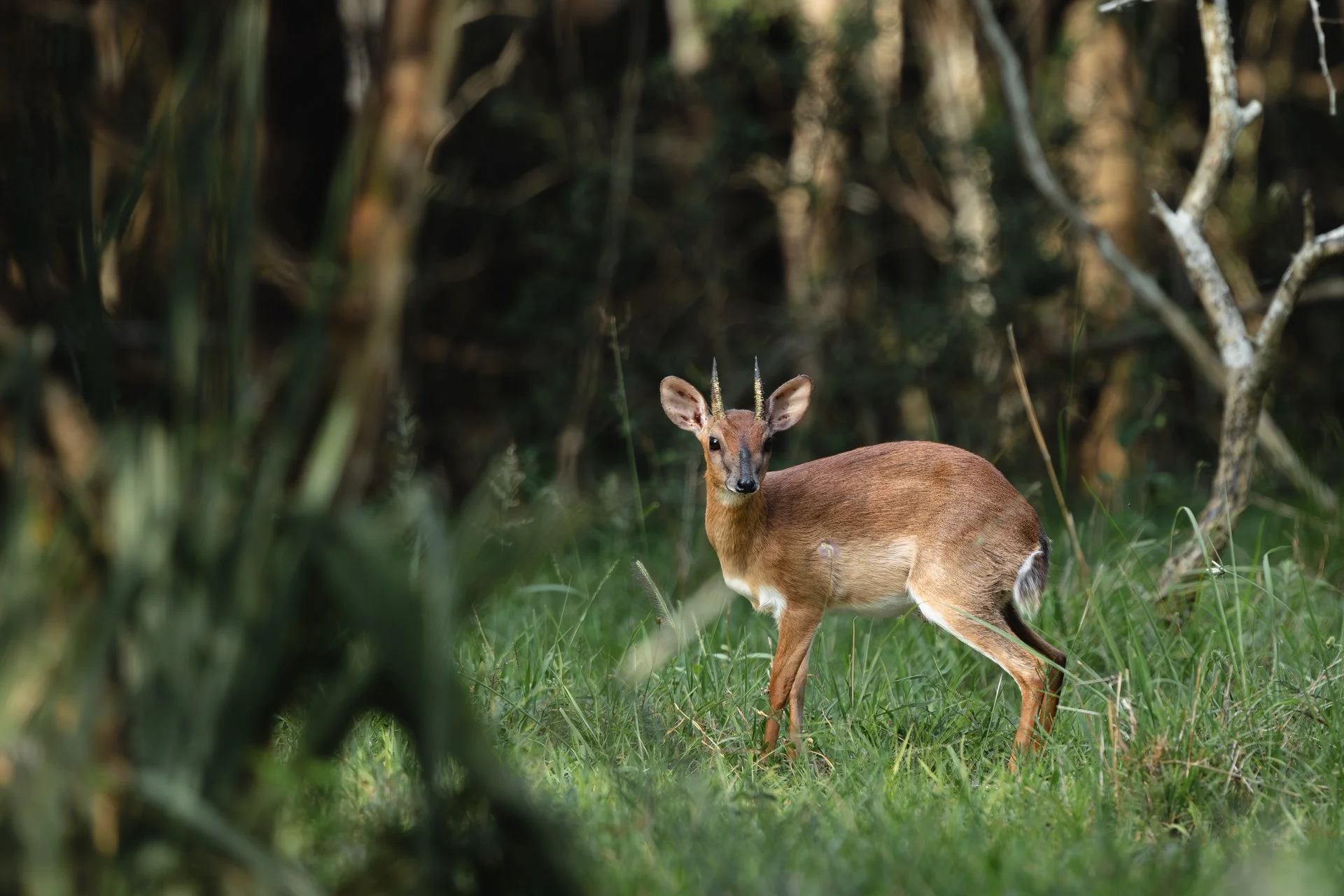
The suni is one of East Africa’s smallest antelopes. Standing 30 to 37 centimeters at the shoulder and weighing 4 to 6 kilograms, it lives entirely within dense coastal thicket, forest understory, and riverine bush where visibility rarely exceeds 5 meters. Its existence on most safari itineraries is almost entirely unknown—it appears on no open-country game drive circuit and requires deliberate forest-edge or coastal thicket walking to encounter. Yet the suni occupies the coastal and forest-margin zones of Kenya and Tanzania at relatively high densities, and a guided walk through suitable habitat almost always produces evidence of its presence, even when the animal itself remains invisible.
What Is a Suni?
The suni, Neotragus moschatus, belongs to the dwarf antelope group alongside the dik-dik and steenbok. Adults weigh between 4 and 6 kilograms. Shoulder height reaches 30 to 37 centimeters. Only males carry horns—short, straight, and ridged, reaching 8 to 13 centimeters, angled slightly forward. The coat is rich rufous-chestnut on the back and sides with white underparts. The face carries a prominent preorbital gland—a large dark tear track below each eye that produces the sticky secretion used for territory marking. The musk gland on the back, between the shoulder blades, produces a strong musky scent used in social signaling. This musk is strong enough to detect by smell in areas of heavy sunny activity.
Territory Marking and Pair Behaviour
Male sunis hold territories of 3 to 7 hectares in dense thickets. A female occupies an area overlapping with one or two male territories. The male marks the territory perimeter with preorbital gland secretions deposited on low twigs and stems at intervals of a meter or less throughout the territory boundary. This dense marking network creates a strong scent barrier visible and smellable to any suni entering the area. The male also deposits dung at fixed latrine sites at territory boundaries. When two males meet at a boundary, they display through broadside posturing and sometimes horn-locked wrestling, though serious fights are infrequent.
Dense Thicket Lifestyle
Sunis move through extremely dense vegetation using established tunnel-like pathways through the thicket. These tunnelsworn smooth by repeated passage are a reliable field sign of Suni presence in coastal thicket areas. The animal uses the tunnel network to move between feeding areas and escape routes with minimal exposure to the open. A suni alarmed in thick bush does not bolt into the openit dives deeper into the thicket along a known escape tunnel. This behavior makes pursuit by terrestrial predators extremely difficult in dense vegetation.
Sunis feed on leaves, fallen fruit, fungi, and seedpods within the thicket. A small home range provides sufficient food in the forest understory and thicket margin zones they occupy. Water independence, achieved through moisture from the food they eat, allows occupation of dry coastal thicket areas without surface water access.
Range in East Africa
Sunis occupy Kenya’s coastal forest and thicket zones Arabuko Sokoke Forest, Shimba Hills, and the dense coastal thicket between Mombasa and Malindi. Tanzania’s Saadani National Park and coastal thicket zones carry populations. Inland riverine forests along major rivers also hold sunis where the vegetation density meets their requirements.
Plan Your Safari
Kenya’s Arabuko Sokoke Forest near Malindi provides the most accessible suni encounters in East Africa. Guided forest walks in the early morning produce evidence of suni activity fresh tracks in dust paths, preorbital gland marks on twigs, and the musky scent of recent passage. Actual sightings require patience, slow movement, and quiet walking along the forest tunnel paths.
Tanzania’s Saadani National Park’s coastal forest adds suni to its unusual savanna-and-coast-wildlife combination. These encounters reward visitors who extend their East Africa itinerary beyond the standard open-country circuit.
African Wild Trekkers designs Kenya coastal safari itineraries combining Arabuko Sokoke’s forest wildlife with marine experiences and the northern safari circuit. Contact us to plan a Kenya safari that explores the full range of the country’s extraordinary wildlife habitats.