Mountain Nyala Facts: Ethiopia’s High-Altitude Endemic Antelope
The mountain nyala exists only in Ethiopia. No other country holds a wild population. This complete endemism makes the mountain nyala one of Africa’s most geographically restricted large mammals — and one of the most compelling reasons to include Ethiopia in an East Africa safari circuit. The Bale Mountains National Park holds the core population. A bull mountain nyala standing at 3,500 metres on the Sanetti Plateau — spiral horns above a powerful grey-brown body, misty highland grassland stretching behind him — is one of the continent’s most singular wildlife encounters.
What Is a Mountain Nyala?
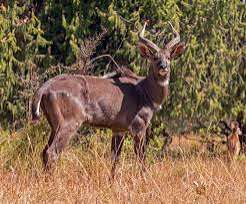
The mountain nyala, Tragelaphus buxtoni, belongs to the spiral-horned antelope family alongside the greater kudu, sitatunga, and eland. Adult males weigh between 150 and 300 kilograms. Females weigh 100 to 150 kilograms. Shoulder height in males reaches 1.2 to 1.35 metres. Only males carry horns — open spirals with a single twist, reaching 60 to 118 centimetres along the outer curve. The coat is greyish-brown with a white chevron between the eyes and white spots and stripes on the flanks — the typical spiral-horn antelope pattern. A shaggy mane runs along the throat and chest in adult males. The ears are large and rounded.
At first glance the mountain nyala resembles the greater kudu — the spiral horn form and the white stripe patterning on the body create a superficial similarity. Closer inspection reveals a shorter, straighter horn configuration, a heavier body, and the distinctive highland coat with slightly longer, denser fur adapted to the cold altitude conditions of the Ethiopian highlands.
Highland Habitat
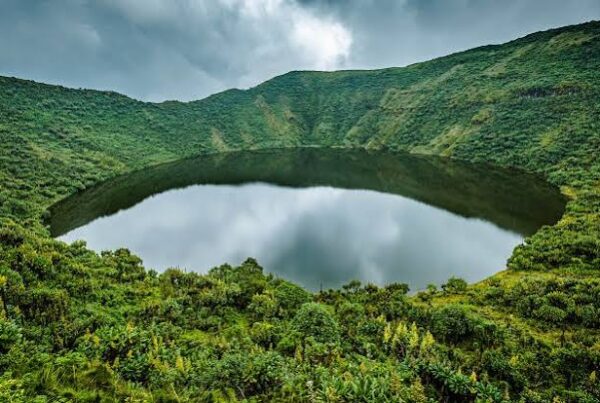
Mountain nyalas occupy afroalpine and montane woodland habitats between 3,000 and 4,200 metres above sea level in the Bale Mountains and the Arsi Mountains of central Ethiopia. Hagenia woodland, giant heather, and high-altitude grassland the vegetation zones of the Ethiopian highlands define their range. Cold nights, cool days, and seasonal mist characterise the habitat. Grazing in the afroalpine grassland and browsing in the Hagenia woodland both feature in the diet.
The Bale Mountains hold approximately 80 percent of the global mountain nyala population. A second, smaller population occupies the Arsi Mountains to the north. Outside these highland areas, the species does not exist anywhere on earth.
Behaviour and Social Structure
Mountain nyalas are predominantly crepuscular most active at dawn and dusk. They retreat to dense Hagenia woodland during the middle of the day. Social groups are small two to six individuals, usually a female with offspring or a small bachelor male group. Large male aggregations of 10 to 15 bulls occur occasionally on the Sanetti Plateau’s open grassland. The dominant male displays through broadside posturing and slow parallel walks when rival males approach females. Direct fights are infrequent but can be intense when evenly matched large bulls compete for access to a female group.
Conservation Status
The mountain nyala is classified as Endangered with an estimated population of 2,500 to 4,500 individuals. Habitat loss through agricultural encroachment at the lower forest margins, livestock grazing competition within the national park, and historic hunting pressure have reduced numbers from levels that exceeded 7,000 in the mid-20th century. The Bale Mountains National Park provides the core protection area but faces ongoing pressure from surrounding land use.
Plan Your Safari
Ethiopia’s Bale Mountains National Park is the only reliable mountain nyala destination on earth. The Sanetti Plateau — Africa’s largest afroalpine plateau — produces daily mountain nyala sightings from vehicles driving the plateau road. Dawn drives produce bull groups in the open grassland before they retreat to Hagenia woodland. The plateau also holds the Ethiopian wolf — the world’s rarest canid — making Bale the finest destination on earth for two highly endemic and endangered mammals on a single morning drive.
African Wild Trekkers designs Ethiopia safari itineraries combining the Bale Mountains’ unique highland wildlife with the Omo Valley and Simien Mountains. Contact us to plan an Ethiopia itinerary built around the country’s extraordinary endemic wildlife.