Tanzania Botswana Victoria Falls: Southern Africa Add-On From Dar
Both form an extraordinary trio of Southern and East African experiences that together cover the full range of what this part of the continent offers its most committed wildlife and adventure travelers. Tanzania delivers the Serengeti scale and East African savanna experience. Botswana provides a completely different African wilderness character: the Okavango Delta’s water-based ecosystem, the Kalahari’s ancient desert landscapes, and the Chobe River’s famous elephant concentrations—all accessed through some of the most exclusive and intimate safari camps in Africa. Victoria Falls on the Zimbabwe-Zambia border adds a natural spectacle of a different order entirely: the world’s largest waterfall, supplemented by white-water rafting on the Zambezi, bungee jumping, and the energetic adventure tourism culture that surrounds one of Africa’s most famous landmarks. Together these three elements create a Southern and East African itinerary of extraordinary variety and depth.
This guide outlines how to structure a Tanzania-Botswana-Victoria Falls combination, what each component delivers distinctly, and the practical logistics of moving between three countries across this geographic range. The itinerary is ambitious—it requires a minimum of 16 days and ideally three weeks—but each component is self-contained, and the combination can be configured for different lengths and priorities depending on your available time and budget.
Tanzania: The East Africa Foundation
Serengeti, Zanzibar, and Northern Circuit
What the Tanzanian Leg Provides
Tanzania is the anchor of the East Africa end of this combination, providing the Serengeti’s migration spectacle, Ngorongoro’s enclosed Big Five ecosystem, and — if the itinerary includes it — a Zanzibar beach component that provides rest and contrast before the Botswana leg. The Tanzania leg for this combination works well at 7 to 10 days, covering the essential northern circuit parks with internal charter flights and ending in Dar es Salaam or Kilimanjaro Airport for the onward connection to Botswana. Zanzibar can be included as a 3-night addition before Botswana if beach recovery time is wanted, though some travellers prefer to keep the combination focused on wildlife and move directly from Tanzania to Botswana without a beach interlude.
The Tanzania leg establishes the frame of reference against which Botswana’s different character will be measured, and this sequencing works well because Tanzania’s open savannah scale impresses first before Botswana’s more intimate, water-influenced environment provides its counterpoint. Experienced Africa travelers who have already done Tanzania sometimes reverse the order—Botswana first, then Tanzania—but for first-time visitors to the region, the Tanzania opening makes narrative sense as the larger, more accessible, and less expensive introduction to the multi-country journey.
Botswana: The Okavango Experience
Delta, Chobe, and Linyanti — A Different Africa
Why Botswana Safari Is Unlike Tanzania
Botswana’s safari character is defined by exclusivity, intimacy, and the unique ecosystems the Okavango Delta and the great rivers of the north create. The Okavango Delta—a UNESCO World Heritage Site—is the world’s largest inland delta, created by the Okavango River flooding into the Kalahari Desert each year and creating a temporary water world of papyrus channels, palm islands, and flooded grasslands that hosts one of Africa’s most extraordinary concentrations of wildlife.
Mokoro canoe safaris through the channels, motorboat explorations of the deeper floodwaters, and walking safaris on the dry islands provide methods of wildlife encounter impossible in Tanzania’s landlocked national parks. Elephants and hippos seen from a canoe at eye level in clear water, or buffalo herds crossing a flooded plain with only their backs visible above the surface — these are images specific to the Okavango that cannot exist elsewhere.
Botswana also imposes a deliberate low-volume, high-value tourism model that keeps safari camps extremely small, visitor numbers per area minimal, and the resulting quality of the wildlife experience among the most exclusive in Africa. Camp sizes of six to twelve beds are typical across the Okavango and Linyanti regions, and daily vehicle and boat numbers in any given area are fractions of what occurs in the Serengeti.
For travellers who have experienced the Serengeti at peak season with its inevitable vehicle concentrations at major sightings, Botswana’s complete absence of crowds at equally spectacular wildlife events feels like a different paradigm. The cost of this exclusivity is significantly higher per-night lodge rates than most Tanzanian equivalents, but the experiential quality is commensurate.
Chobe National Park: Elephant Superabundance
Chobe National Park in northern Botswana, bordering Zimbabwe on the Chobe River, holds the world’s highest concentration of African elephants—an estimated 130,000 animals in the broader Chobe ecosystem. Afternoon boat safaris on the Chobe River produce elephant encounters of extraordinary intimacy: herds of hundreds of animals drinking and bathing at the river, bulls in musth splashing in chest-deep water, and elephant calves learning to swim while their mothers guide them across the current—all observed from a silent boat at close range.
Combined with exceptional lion, leopard, and wild dog populations in the park’s dry woodland, Chobe rounds out a Botswana itinerary that addresses wildlife variety and quantity on a scale that justifies the extension from Tanzania.
Chobe also serves as a natural geographic stepping stone between Botswana and Victoria Falls—the town of Kasane at Chobe’s entrance is approximately 80 kilometers from Victoria Falls, and the ferry crossing from Botswana into Zambia at Kazungula is a short drive from the falls. This geographic proximity makes the Chobe-to-Victoria Falls transition the smoothest connection in the entire combination itinerary, and most operators include a morning game drive in Chobe before the afternoon transfer to Victoria Falls as a final Botswana wildlife experience before the journey concludes at the falls.
Victoria Falls: The Grand Finale
The World’s Largest Waterfall and Adventure Capital
Victoria Falls: What to Expect and Do
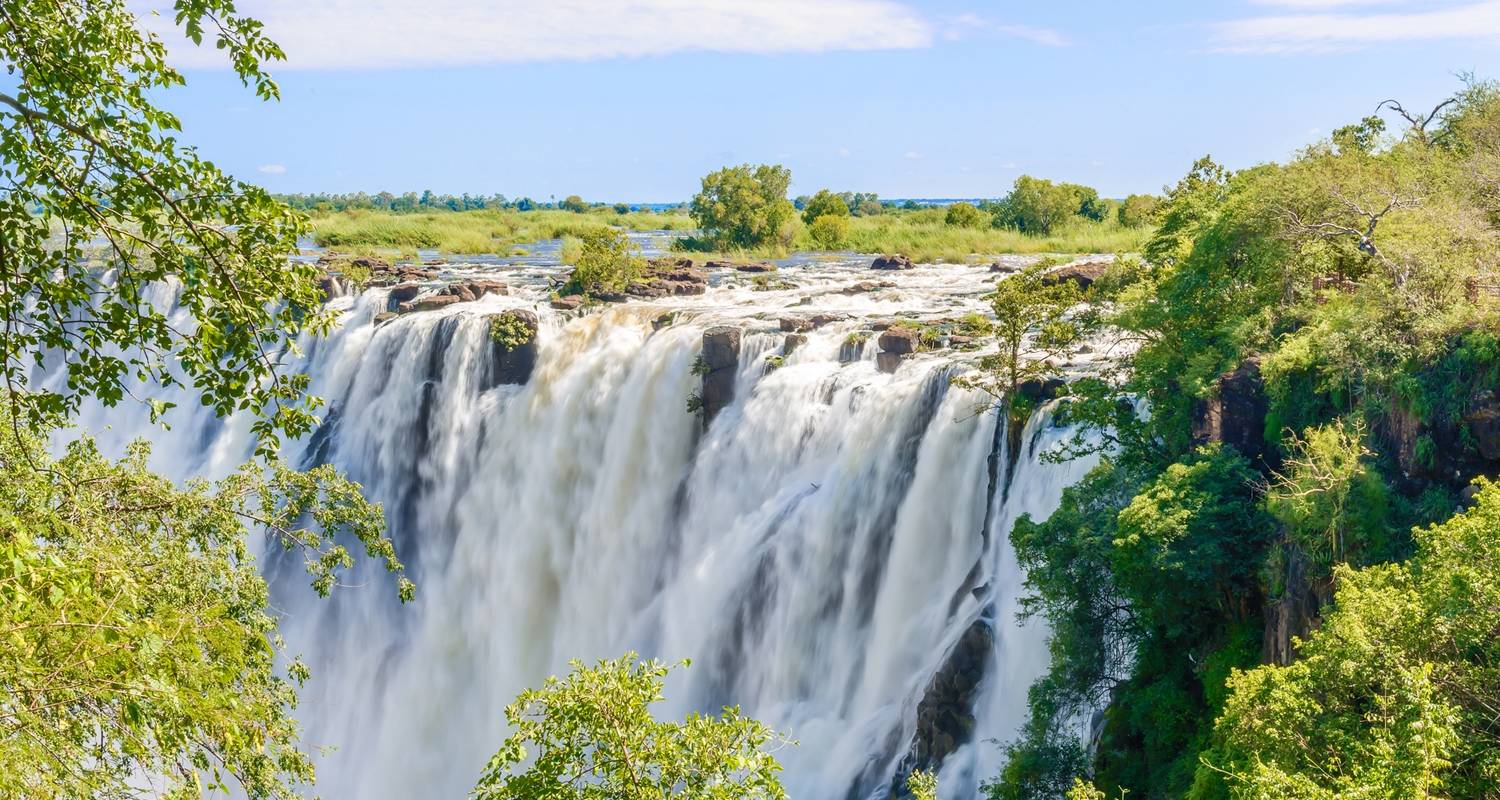
Victoria Falls—known locally as Mosi-oa-Tunya, “the smoke that thunders”—spans 1,708 meters across the Zambezi River and drops 108 meters at its highest point, creating a wall of mist visible from 50 kilometers away and a thundering roar that is experienced as much as heard. In full flood from February through May, the falls are a curtain of white water and spray so dense that photography inside the viewpoints requires waterproof covers on camera equipment. In the dry season from September through November, the water levels drop enough to reveal the individual curtains of fall and the basalt gorge below with complete clarity. Both seasons present the falls magnificently but in completely different aesthetic contexts—the choice between them comes down to whether you prefer overwhelming spectacle or clear visibility, and both are valid.
Beyond the falls themselves, Victoria Falls town (on the Zimbabwe side) and Livingstone (on the Zambia side) have developed extensive adventure tourism infrastructure around the gorge. White-water rafting on the Zambezi below the falls offers some of the most technically demanding commercially rafted rapids in the world, suitable for intermediate paddlers looking for serious water rather than gentle float trips. Bungee jumping from the Victoria Falls Bridge spanning the gorge is a 111-meter drop above the Zambezi that is one of Africa’s most iconic adrenaline experiences.
Helicopter flights over the full span of the falls provide the only viewpoint from which the complete cascade is visible without the spray and mist that obscure ground-level viewpoints. Two to three nights at Victoria Falls—two in Zimbabwe for viewing and adventure, one on the Zambian side for the sunset cruise on the Zambezi—gives adequate time without overstaying the experience.
Connecting the Three Countries
Flight Logistics Across Tanzania, Botswana, and Victoria Falls
Regional Flight Network and Practical Connection Points
The regional aviation network connecting Tanzania, Botswana, and Victoria Falls routes primarily through Johannesburg, South Africa, which serves as the Southern African hub for most airlines operating in this region. From Tanzania, flights to Johannesburg connect onward to Maun (gateway to the Okavango Delta) or Kasane (gateway to Chobe). From Chobe, the road transfer to Victoria Falls via the Kasungula ferry or Livingstone Bridge takes under two hours. Return flights from the Victoria Falls route through Johannesburg and then onward to international destinations, making this a logical end point for the entire journey
Some travelers fly directly from Dar es Salaam to Johannesburg, then onward to Maun, without backtracking to Arusha—confirming the optimal Tanzania exit point and Botswana entry based on your final itinerary structure is important in the planning phase.
Visas for Botswana and Zimbabwe (or Zambia for the Livingstone side of Victoria Falls) require advance research, as requirements vary by nationality. Botswana grants visa-free entry for most Western passport holders for stays under 90 days. Zimbabwe requires a visa either in advance or on arrival depending on nationality, and the KAZA UniVisa available at Victoria Falls covers both Zimbabwe and Zambia in a single document for most eligible nationalities.
Confirming current requirements through your operator or official embassy sources before booking is essential, as these arrangements can change.
Plan Your Safari
A Tanzania, Botswana, and Victoria Falls combination requires three to four weeks minimum to do justice to all components, with ten days in Tanzania, eight days in Botswana (four in the Okavango Delta plus four in Chobe), and two to three days in Victoria Falls, representing a practical and balanced structure. The combination is most efficiently managed through a single operator with active partnerships in all three countries, handling flights, camp bookings, and cross-border transfers as an integrated package.
Budget planning should account for the higher per-night lodge costs of Botswana’s exclusive camps, which are significantly more expensive than most Tanzanian safari accommodations at equivalent or lower lodge standards.
African Wild Trekkers designs Tanzania-anchored multi-country Southern and East Africa safari itineraries in partnership with established Botswana and Victoria Falls operators. The team coordinates all flights, lodge bookings, and border transfers across the full combination, providing a single itinerary document and contact point for the entire journey from Arusha through Maun, Chobe, and Victoria Falls. All reservations are confirmed in writing before any deposit is requested.
Contact African Wild Trekkers at africanwildtrekkers.com/contact with your preferred travel dates and we will design your Tanzania, Botswana, and Victoria Falls itinerary and confirm all availability within 24 hours.