White Pelican Africa: The Cooperative Fisherman of East Africa’s Rift Valley Lakes
The great white pelican is one of East Africa’s largest and most visually impressive waterbirds. It stands over 1.5 metres tall with a wingspan reaching 3.6 metres. The species is most abundant on the alkaline lakes of East Africa’s Rift Valley, where vast numbers — sometimes exceeding 10,000 individuals — gather at the most productive fishing sites. The sight of a large white pelican flock cooperatively herding fish in the shallows of a Rift Valley lake is one of the most spectacular large waterbird displays available anywhere in the world.
The great white pelican’s cooperative fishing strategy is one of the most sophisticated group hunting behaviours documented in any bird species. Groups of up to 100 individuals coordinate their movements to herd fish into shallow water before plunging their bills simultaneously to maximise catch efficiency in a coordinated group strike.
Identification
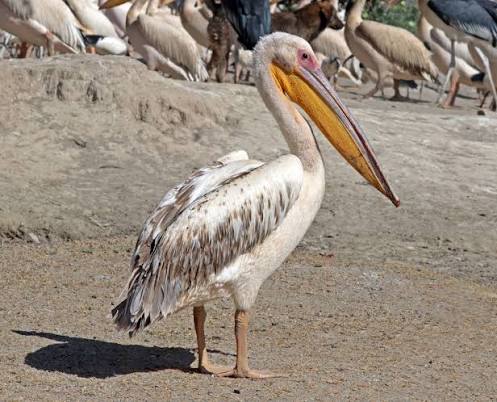
The adult great white pelican is a massive, predominantly white bird with black primary flight feathers visible in the wing. The bill is long — up to 47 centimetres — with a large, expandable throat pouch used to scoop fish from the water. The bare facial skin is yellow. The pouch turns vivid orange-yellow during the breeding season.
In flight, the great white pelican shows a distinctive profile with the large head, long bill, and the pouched throat creating an unmistakable large-billed silhouette. Groups of pelicans in flight form V-formations or long lines that undulate as each bird benefits from the updraft of the bird ahead. These formation flights are visible from considerable distances across the flat landscape of East Africa’s Rift Valley floor.
The pink-backed pelican, a smaller species, shares the great white pelican’s habitat at some East African sites. The great white pelican is noticeably larger, shows white rather than pink-grey body plumage, and lacks the scalloped feather pattern on the pink-backed pelican’s back that gives the smaller species its name.
Cooperative Fishing
Great white pelicans fish cooperatively in organised groups. The hunt begins when a group of birds assembles in a loose line across a shallow bay or lake margin. The birds then advance together, driving fish toward the shore in a coordinated movement. When the fish are concentrated in shallow water ahead of the advancing line, the entire group plunges their bills simultaneously, each bird lifting a pouch full of water and fish from which the water is drained before the fish are swallowed.
The coordination required for successful cooperative fishing develops through experience within established groups. Young pelicans learning to participate in the group hunt initially disrupt the cooperative movement before gradually synchronising their behaviour with the experienced group members.
Individual pelicans can also fish alone when cooperative groups are not assembled. Solo fishing involves swimming slowly with the bill submerged and scooping fish detected beneath the surface. This solo technique is less efficient than cooperative fishing and produces lower catch rates per unit of energy expended.
Where to See Great White Pelicans in East Africa
Kenya’s Lake Naivasha, Lake Nakuru, and Lake Elementaita all carry great white pelican populations. Lake Nakuru in particular has historically carried one of the largest freshwater pelican concentrations in Africa, with thousands of birds visible on the lake simultaneously during peak presence periods.
Uganda’s Lake Victoria and the alkaline lakes of the Edward-George system in Queen Elizabeth National Park carry breeding and non-breeding pelican populations. Tanzania’s Lake Manyara and Lake Eyasi both carry great white pelicans in numbers visible from the lake shore drive within the established Tanzania circuit.
The Ngorongoro Crater’s central lake, Lake Magadi, carries a permanent great white pelican population visible from the crater rim descent road and from the crater floor drive.
Plan Your Birding Safari
Great white pelican sightings are most spectacular at Kenya’s Rift Valley lakes where large flocks gather. Lake Nakuru provides the most reliably productive pelican watching within the standard Kenya safari circuit, combining large pelican flocks with flamingo concentrations and the lake’s extraordinary waterbird diversity in a single compact park.
Tanzania’s Ngorongoro Crater adds a dramatic setting — watching a cooperative pelican fishing sequence on the crater floor with the crater walls rising 600 metres on all sides is one of East Africa’s most memorable wildlife moments.
African Wild Trekkers designs Kenya and Tanzania safari itineraries that include the Rift Valley lake circuit where great white pelican spectacles are a highlight of the waterbird experience. Contact us to plan a safari that captures East Africa’s most dramatic pelican gatherings.