Wildebeest Facts: Everything You Need to Know About the Migration Animal
The Animal That Defines the Great Migration
The wildebeest — also called the gnu — is the animal at the center of one of the most spectacular ecological events on Earth: the Great Migration of the Serengeti-Mara ecosystem. Approximately 1.5 million wildebeest move in a roughly circular annual circuit through Tanzania and Kenya, following the rainfall patterns that determine where the short, nutritious grasses they depend on are available in each season. The migration is one of the most filmed, most photographed, and most traveled-for wildlife events in the world. Yet most travelers who witness it know relatively little about the animal itself. Its biology, its decision-making. And the remarkable physiological and behavioral adaptations that allow it to sustain a population of 1.5 million through a year of continuous movement, constant predator pressure. And the physiological demands of breeding in the midst of migration.
The wildebeest’s reputation does it no favors with casual observers. Ungainly in appearance, perpetually seeming on the verge of some mild panic, wildebeest lack the visual authority of elephants, the dramatic appeal of lions and cheetahs, or the recognizability of giraffes. But the wildebeest is an extraordinarily successful animal. 1.5 million individuals thriving in an ecosystem that includes Africa’s densest predator concentration. The reasons for that success are encoded in every aspect of its biology and behavior. The wildebeest is, on close examination, a masterpiece of evolutionary adaptation to the specific conditions of the East African savanna.
Wildebeest Biology and Adaptations
Physical Characteristics and Behavior
Anatomy and Senses
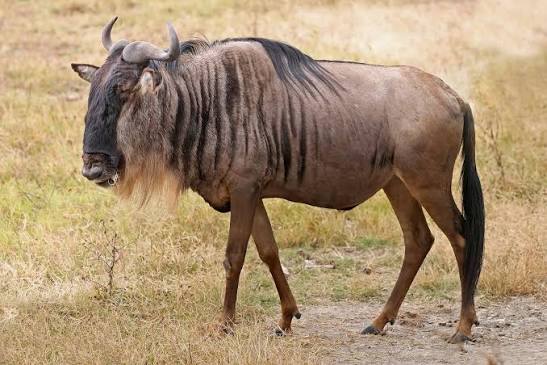
The wildebeest is a large antelope. Adult males weigh 250 to 290 kilograms and stand 1.4 metres at the shoulder. With a distinctive appearance that combines bovine features (broad muzzle, heavy shoulders, sloping hindquarters) with the light build and long legs of a fast runner. The combination is functional rather than elegant: the heavy head and shoulders house the powerful jaw musculature required for intensive grass processing. The long legs give the animal a stride length that sustains migration covering 800 to 1,000 kilometres annually without the physiological stress that would break down a less athletically built animal. Wildebeest can sprint at 80 kilometres per hour when they need to. But their most important locomotor adaptation is the stamina to travel continuously at moderate speed across vast distances while feeding.
Wildebeest have acute hearing and smell that are critical for predator detection in tall grass and under nighttime conditions when most predation attempts occur. Their vision is not exceptional for an antelope. The wide-set eyes give a panoramic view that detects movement but resolves detail poorly. But the combination of multiple sensory inputs and the safety-in-numbers effect of moving in very large herds means that any single animal’s predation risk in the center of a large herd is extremely low. The alarm behavior of one wildebeest. Snorting, stiffening, and staring in the direction of a threat. Propagates rapidly through surrounding animals. The collective response of thousands of wildebeest to a single alarm signal produces the dramatic “wildebeest explosion” that photographers target at crossing points: the sudden mass movement of a herd that had appeared calm a moment before.
What Triggers the Migration
The Great Migration is fundamentally driven by the growth of short grass following rainfall. And the wildebeest track this rainfall-grass growth cycle around the Serengeti-Mara ecosystem with a precision that researchers are still working to fully understand. The conventional explanation — that wildebeest simply follow the rain — is accurate but incomplete. Wildebeest appear to detect rainfall and the grass growth that follows it through both visual cues and possibly by sensing the electrical activity associated with distant thunderstorms. The decision to move is a collective, emergent property of the herd — no individual wildebeest leads the migration. Rather, the movement arises from each individual’s response to the same environmental signals and the social pressure of surrounding animals that are also moving in response to those signals. The result is a coherent directional movement of 1.5 million animals that appears organized but emerges from decentralized individual decisions.
The migration’s annual circuit is broadly predictable: the wildebeest calve on the short-grass southern Serengeti plains between January and March, move northwest toward the Grumeti and Mara rivers in May through July, cross into the Masai Mara between July and October depending on rainfall. And return south through the Serengeti in November and December. But the timing varies by weeks or even months from year to year depending on when and where rainfall occurs. The herd does not follow a fixed route — it responds to current conditions rather than following a learned path. This variability is what makes planning a trip to see the river crossings so dependent on real-time information from guides in the field rather than simple calendar-based planning.
Calving Season and Predator Dynamics
Birth, Survival, and Predation
Synchronized Calving
Wildebeest employ one of the most effective anti-predator reproduction strategies in the animal kingdom: synchronized mass calving. Approximately 300,000 to 500,000 wildebeest calves are born within a window of two to three weeks in January and February on the southern Serengeti plains near Ndutu. This extreme synchrony overwhelms the capacity of the resident predator population to kill calves faster than they are produced. There are simply more calves available than all the lions, cheetahs, wild dogs. And leopards in the area can consume, even hunting at maximum capacity. The calves that survive the immediate post-birth vulnerability window become robust juveniles within weeks. The predation rate drops as the initial glut of vulnerable newborns passes and the herd’s movement patterns begin to reduce the predictability that predators exploit.
Wildebeest calves stand within minutes of birth and can run with the herd within hours. One of the most rapid post-natal development timelines of any ungulate. This rapid mobility is essential because the open Serengeti plains where calving occurs offer no cover from predators. A calf that cannot keep up with the herd dies. Calves are born with a tawny brown coat. Temporarily different from the grey-brown adult coloration. That may provide some camouflage in dry grass before the calves are mobile enough to receive protection through herd movement. The bond between mother and calf forms within the first minutes of birth through smell and is strong enough to drive mothers to extraordinary defensive efforts against predators targeting their young. Wildebeest females have been observed chasing cheetahs and leopards away from calves with persistent aggression that predators clearly respect.
The River Crossing Spectacle
The Mara and Grumeti river crossings are the dramatic centerpiece of Great Migration safari coverage, and with good reason. Thousands of wildebeest crowd a crossing point before committing to the water, then surge across in a wave while Nile crocodiles surge from below and the current pushes weaker animals downstream. It is a genuinely spectacular and intense wildlife event that nothing else in Africa quite matches in scale and drama. The psychological dynamics of the crossing itself are fascinating: the herd’s collective decision to enter the water is an emergent social phenomenon. Individual animals’ hesitation and individual animals’ commitment interact until a tipping point is reached and the entire herd commits in a matter of seconds. Once the first animal enters at a committed pace, the rest follow within moments. A behavioral cascade that can carry thousands of animals across in less than a minute.
The costs of the migration are enormous. Approximately 250,000 wildebeest die each year through predation, drowning, exhaustion, and starvation — roughly 17 percent of the total population. This death rate is sustainable only because the population’s reproductive rate is high enough to replace the losses annually. The migration’s success as a strategy depends on this balance between mortality and reproduction holding across years. The bodies of drowned wildebeest are ecologically significant: the tons of organic matter they deliver to the Mara River annually feed the crocodiles, hippos, and fish of the river system. The nutrients released as the carcasses decompose fertilize the riparian vegetation that sustains the broader ecosystem. The wildebeest migration is not just a wildlife spectacle. It is the nutrient circulation engine of one of Africa’s most productive ecosystems.
Best Places to See Wildebeest
The southern Serengeti and the Ndutu area of Tanzania in January through March deliver the calving season spectacle. Hundreds of thousands of newborn calves on the open plains, surrounded by predators, in one of the most dramatic wildlife concentrations anywhere in Africa. The western Serengeti in June and July sees the herds crossing the Grumeti River under the eyes of the resident crocodile population, less dramatic than the Mara crossings but with fewer tourist vehicles and a more intimate quality. The northern Serengeti and Masai Mara between July and October is the peak season for the famous Mara River crossings. And the months of August and September typically produce the most frequent crossing events as the herds build up on the Kenya side and the pressure to move builds daily.
South Africa’s Kruger National Park, Namibia, Botswana, and Zimbabwe have blue wildebeest. A southern subspecies. In substantial numbers across their main safari parks. This provides wildebeest viewing for travelers who are not visiting East Africa during the migration window. The blue wildebeest of Southern Africa does not undertake long-range migration in the same way as the Serengeti population. Instead, it makes more localized movements in response to rainfall and seasonal grazing availability. Wildebeest sightings in these parks are consistent and reliable year-round, making them one of the standard large-mammal encounters on any Southern Africa game drive even without the dramatic migration spectacle that defines the East Africa experience.
Plan Your Safari
The Great Migration’s timing varies significantly year to year depending on rainfall. And planning a safari specifically around the river crossings requires real-time guidance from operators with contacts in the field who can advise on current herd positions in the weeks before departure. Getting this information right is the difference between watching thousands of wildebeest cross and arriving at an empty crossing point.
African Wild Trekkers monitors migration movements throughout the year and adjusts itinerary recommendations based on current conditions, positioning guests in the right location. Southern Serengeti for calving, northern Serengeti or Masai Mara for crossings. At the times when the specific wildlife event they want to witness is actually occurring.
Contact African Wild Trekkers at africanwildtrekkers.com/contact with your preferred travel months and we will design a Great Migration safari itinerary that positions you at the right place at the right time within 24 hours.