The Wildebeest Migration Timeline in Kenya
When the Herds Cross into the Mara
The Journey North From the Serengeti
The wildebeest migration’s northern movement into Kenya’s Maasai Mara follows a predictable seasonal pattern. Grass growth and rainfall timing in Tanzania’s Serengeti ecosystem drive it, though exact dates shift by several weeks from year to year depending on conditions. The migration begins leaving the Serengeti’s northern corridor — the area between the Grumeti and Mara Rivers within Tanzania — from late June onward. The vanguard of the herd typically reaches the Mara River’s Tanzanian bank between late June and mid-July in most years. Initial crossing attempts begin when lead animals reach the bank and the population pressure of hundreds of thousands of animals behind them creates a condition that eventually overcomes individual hesitation. This process can take hours or days at any specific crossing point before it resolves into actual water entry.
The timing of the first Kenya crossing varies annually by two to four weeks in either direction from a notional average of mid-July. In years of heavy early-season rain in the Serengeti’s northern corridor, abundant grass holds the herd longer in Tanzania and delays the Kenya crossing to late July or early August. In dry years when Serengeti grass depletes quickly, the herd pushes north faster, and first crossings have occurred as early as late June. Following specific social media accounts and guide networks in the Mara during June and early July provides real-time tracking of the herd’s northward progress that allows reasonably accurate prediction of first crossing windows two to three weeks in advance — a lead time sufficient to adjust camp bookings if a visit falls just before or after the predicted arrival window.
Month-by-Month Migration Calendar for the Mara
July in the Maasai Mara marks the migration’s arrival window, beginning with the first crossing attempts in the second or third week of the month and building through the final week as more of the herd moves north. Early July before the migration arrives still offers excellent resident wildlife viewing. The Mara’s permanent lion prides, resident cheetah families, and high buffalo and elephant populations produce strong game drive results without the herd, while anticipation of the migration’s imminent arrival adds excitement to every southward sighting. The first crossings of the season attract limited vehicles compared to August, and guests who time their visit to the migration’s arrival rather than its peak experience an exhilarating freshness that peak-season familiarity does not replicate.
August delivers the migration’s peak in most years — the maximum number of wildebeest in Kenya, the highest frequency of Mara River crossings, and the most concentrated predator activity around the herds. The Mara River crossing points in the Triangle sector see multiple crossings per week during August, with some days producing two or three separate events at different crossing locations along the river’s length. Peak period also brings the highest camp occupancy, maximum vehicle numbers at crossings, and peak-season pricing across all Mara properties. September maintains high herd density and crossing frequency while vehicle numbers ease as the first wave of peak-season visitors departs and replacement bookings run slightly lighter.
What Triggers and Ends the Kenya Migration
Factors That Drive Crossing Behaviour
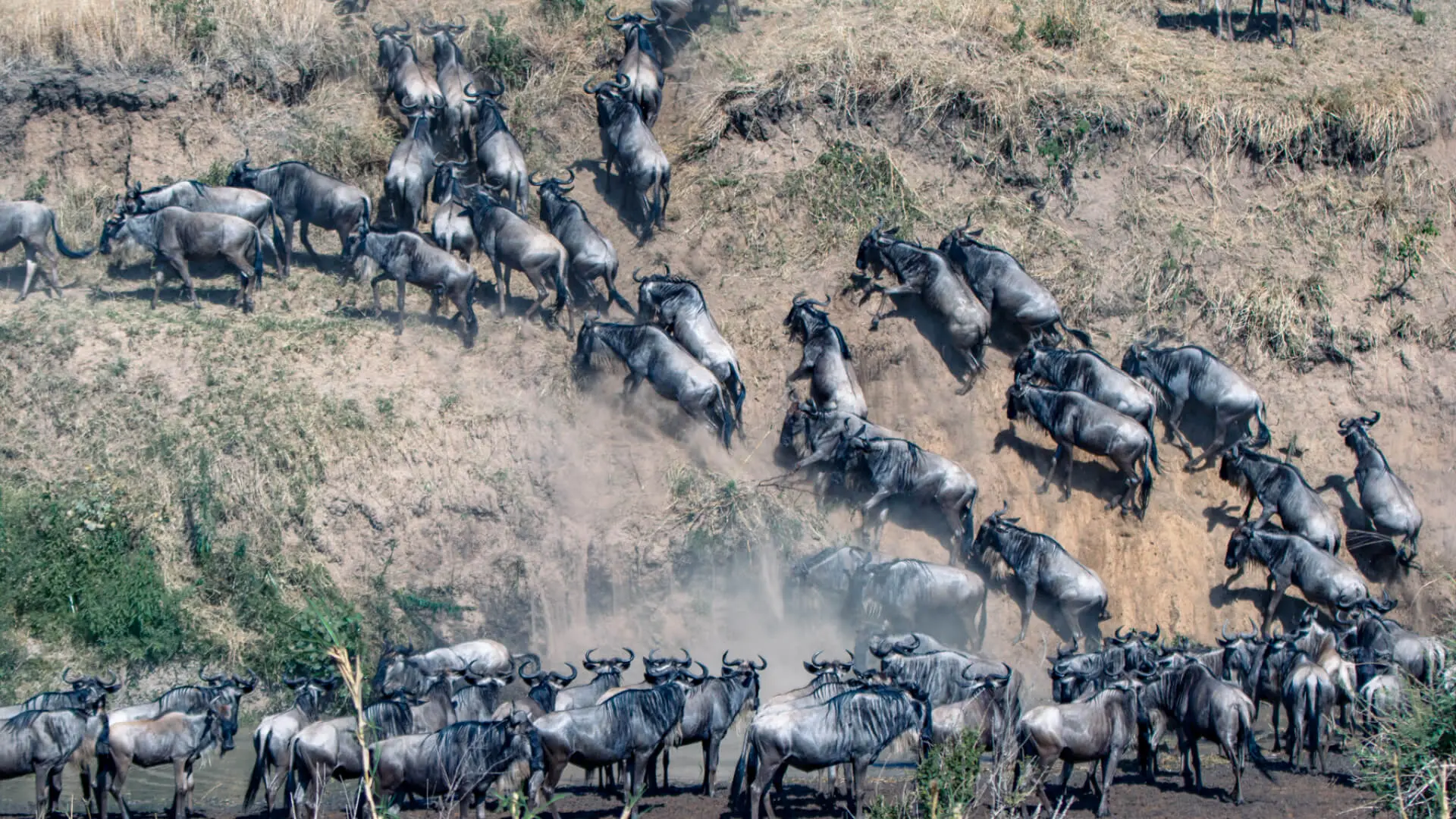
Individual wildebeest crossing decisions emerge from the interaction between two competing instincts — the drive to follow the herd toward better grazing and fear of the crocodiles and deep water that any Mara River crossing involves. The lead animal at a crossing point may stand at the water’s edge for minutes or hours while animals massing behind it intensify the social pressure to move. A single animal that breaks from the group and enters the water typically triggers an immediate cascade response where hundreds or thousands follow within seconds, overriding individual calculation with the crowd dynamic that gives the crossing its dramatic character. River level, crossing point steepness, crocodile visibility, and the noise and smell of the far bank’s grass all influence when the first animal enters. Experienced guides read these factors and position vehicles before the crossing begins rather than reacting after it starts.
Failed crossings — where lead animals enter the water and then retreat when crocodiles attack or the bank proves unscalable — occur regularly throughout crossing season and can extend the build-up at a specific point by another hour or day before the attempt succeeds. These failed crossings are not disappointments but part of the crossing drama. A retreat by five hundred wildebeest from a Nile crocodile attack creates visual and audio chaos equal to any successful crossing, and the survival of individual animals from crocodile strikes at close range produces the kind of raw predator-prey narrative that drives wildlife documentary audiences. Guides who have spent multiple migration seasons at the same crossing points know when a specific location has high or low failure rates and can advise on which points to target for specific crossing outcomes.
When the Migration Leaves Kenya
The wildebeest migration’s departure from Kenya begins as the short rains arrive in late October and early November. The greening of Tanzania’s short-grass Serengeti plains pulls the herd southward along the same route it came. The southward Mara River crossings in October and November move in the same direction as the river flow during the rainier period and produce crossings of a different character from the northward push. Animals move with more urgency and less hesitation in the southward direction. Crocodile activity remains intense even as visitor numbers begin to drop from September’s levels. Late October Mara visits combine departing herds with the first green flush of the short rains, producing a landscape that looks distinctly different from dry-season August and September while maintaining high wildlife density from both the departing herd and the Mara’s permanent resident population.
November in the Mara after the migration’s departure surprises first-time visitors who expect a depleted destination. The Mara’s resident wildlife — lions, leopards, cheetahs, elephants, and plains animals — stays in place regardless of the migration’s presence or absence. November’s lower visitor numbers produce solitude at sightings that peak-season migration viewers never experience. Conservancy camps that filled at peak-season rates from July through October drop significantly in price for November visits while delivering the same guiding quality, off-road access, and night drive experiences at a fraction of the cost. This November window represents the Mara’s best value proposition of the year for travellers whose priority is wildlife quality over migration spectacle specifically.
Practical Advice for Migration Timing
How to Book Around the Migration
The Risk of Fixed Dates and How to Manage It
Booking a Maasai Mara migration safari around a fixed date window carries irreducible uncertainty. Rainfall and grass growth in Tanzania — not guest booking calendars — determine when the migration crosses into Kenya. Operators who promise specific crossing dates or guarantee river crossings during a specific week oversimplify the ecological reality, and guests who book on the basis of such guarantees and then witness a pre-crossing or post-peak experience feel justifiably misled. The honest approach is to book a flexible two-week window that covers the statistical range of likely crossing activity for the target period, combined with camp guides’ real-time monitoring that allows itinerary adjustment if the herd’s movement differs significantly from the expected pattern.
Camps that provide honest pre-arrival updates on herd position and current crossing frequency allow guests to make informed adjustments to their arrival dates before travel begins. A camp manager who reports in early July that the herd has not yet crossed and is still two weeks away from the main reserve boundary gives a guest with flexible travel dates the information to act on — extending the start date by a week or shifting from early to late July without financial penalty at camps that offer this flexibility. Building date flexibility into migration-season bookings from the beginning of the planning process costs very little in terms of higher flight fares or camp deposits but potentially delivers the difference between catching peak crossing activity and arriving slightly outside the window.
Plan Your Safari
Migration timing decisions benefit from current intelligence that can only come from guides and camp managers with eyes on the ecosystem in real time. African Wild Trekkers maintains active communication with Mara guide networks throughout the June to October season and provides guests with updated herd position reports three weeks before departure so that final timing decisions incorporate the best available information rather than relying on calendar generalisations.
The package covers migration-season accommodation in conservancy camps positioned for both crossing access and resident wildlife viewing, internal flights to the appropriate Mara airstrip, park and conservancy fees, and daily guide briefings on herd movement and likely crossing timing. Pre-departure updates on current migration position are provided automatically without requiring the guest to research conditions independently.
Contact African Wild Trekkers at africanwildtrekkers.com/contact with your preferred migration dates and we will advise on the best timing window and confirm camp availability within 24 hours.