Banded Mongoose Behavior: Teamwork, Communication and Life in a Pack
A banded mongoose pack moves through the bush like a small army on patrol, and they trot in formation. They vocalize constantly. They face threats as a mob, and they raise each other’s young. The banded mongoose has evolved one of the most sophisticated social systems in African carnivore biology.
What Is the Banded Mongoose?
The banded mongoose, Mungos mungo, is a medium-sized mongoose native to sub-Saharan Africa. It is one of the most social carnivores in the world. It lives in permanent packs of 10 to 40 individuals. The pack shares a home range, forages together, defends territory collectively, and raises cubs cooperatively.
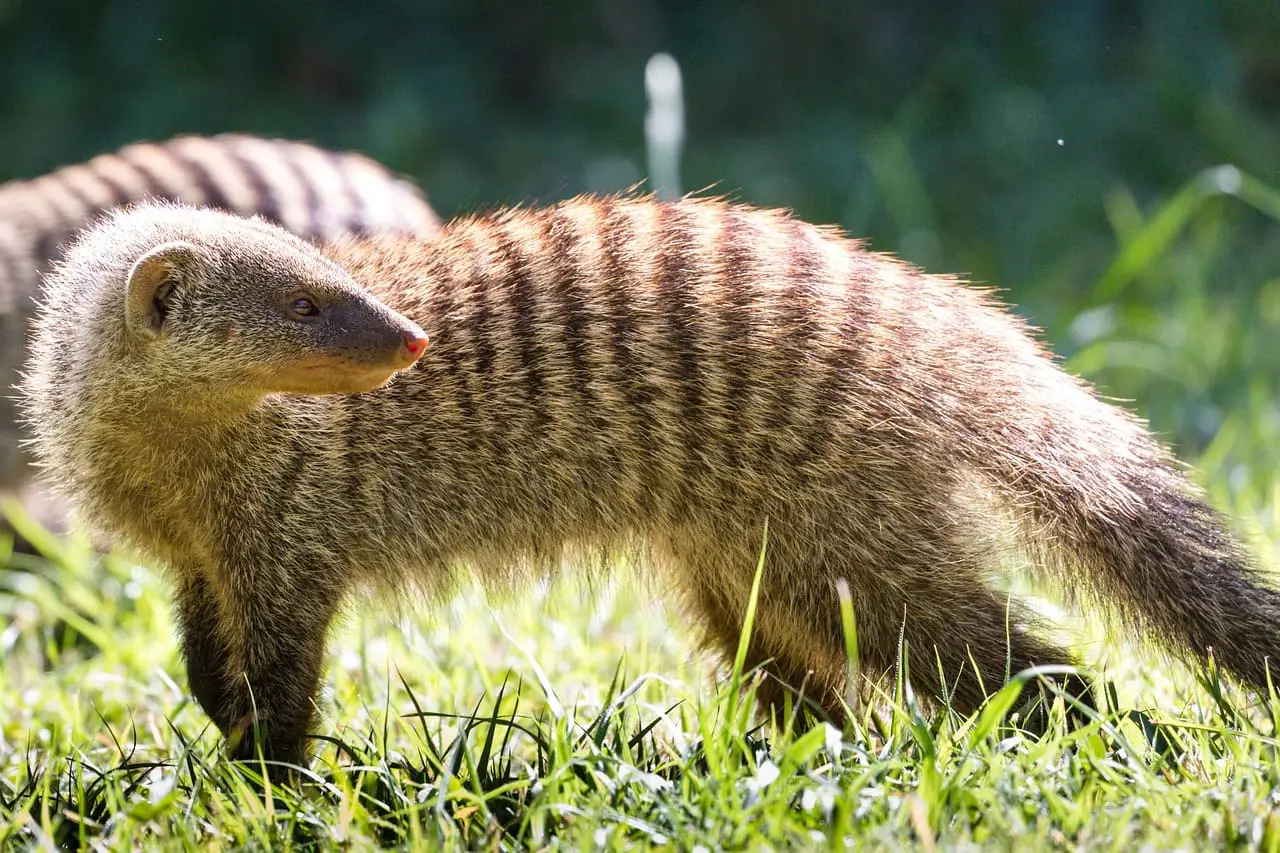
An adult banded mongoose weighs between 1.5 and 2.5 kilograms. It stands about 20 centimeters at the shoulder. The body length reaches roughly 40 centimeters. The tail adds another 25 centimeters. The coat is greyish-brown with 10 to 15 dark horizontal bands across the back—the feature that gives the species its common name.
Pack Structure and Social Life
Banded mongoose packs consist of multiple breeding females, multiple breeding males, and their offspring. Unlike many social carnivores, there is no strict dominance hierarchy of a single breeding pair. Multiple females in one pack breed simultaneously. This synchronized birthing is unusual and reduces competition between females.
Each cub, once weaned, is assigned a dedicated escort — an adult pack member that guides it, protects it, and feeds it throughout the juvenile period. This escort is not necessarily a parent. Any adult in the pack may serve as an escort. The system distributes cub-rearing responsibilities across the entire pack rather than concentrating them in two parents.
Communication in the Pack
Banded mongooses communicate constantly through vocalizations. Moving packs maintain contact with a continuous low twittering call. This sound tracks every individual’s position within the group. When a pack member loses sight of the others, it gives a louder contact call until the group responds.
Alarm calls vary by threat. A ground predator triggers a sharp staccato warning. An aerial predator triggers a different, higher call. Every pack member responds correctly to each call type without needing to identify the threat individually. Young mongooses learn the call library from adults within their first weeks.
How Banded Mongooses Defend Against Predators
When a predator approaches, banded mongooses form a mob. They bunch tightly together, and they stand on their hind legs. They face the threat as a unified mass, advancing toward it while calling loudly. This behavior deters even large predators. Martial eagles, monitor lizards, and jackals regularly back away from a mobbing mongoose pack.
Packs also mob snakes aggressively. They work as a team to distract and attack a snake simultaneously. Individual mongooses dart forward to bite or claw the snake while others draw its attention. The coordinated attack neutralizes the snake’s ability to strike accurately at any single individual.
Foraging and Diet
Banded mongooses eat insects, lizards, small snakes, scorpions, frogs, eggs, wild fruits, and small rodents. They forage by digging with their strong front claws, investigating leaf litter, and probing loose soil. They work through a patch of ground methodically before moving on as a group.
One individual often stations itself as a sentry on an elevated object—a termite mound, a rock, or a fallen log—while others forage below. The sentry scans for aerial and ground predators. It calls immediately on detecting a threat. Then it descends, and the group retreats to cover or mobs the threat collectively.
Where to Watch Banded Mongooses in East Africa
Banded mongooses are widespread across Uganda, Kenya, and Tanzania. They live in savanna, grassland, woodland, and the edges of cultivated land. They are most easily watched in open areas where the pack moves as a visible group.
Uganda’s Queen Elizabeth National Park, particularly the Mweya Peninsula, holds packs that are entirely accustomed to vehicles. Murchison Falls National Park also has accessible packs. In Kenya, the Maasai Mara and Amboseli both support banded mongoose populations. Tanzania’s Serengeti has them in woodland areas and around lodge grounds.
Banded Mongoose Parasites: An Unusual Social System
Banded mongoose packs carry significant parasite loads. Each individual typically hosts multiple species of ectoparasites—ticks, fleas, and biting lice. The pack’s social grooming behavior removes some parasites, but the close contact of group living also facilitates rapid transmission. Research by the Banded Mongoose Research Project in Uganda found that pack members share the same parasite strains with high fidelity. This reflects the close physical contact within groups.
Tuberculosis—specifically the mongoose-specific form—is a documented disease in banded mongoose populations in Uganda. Infected individuals eventually die from the disease, and entire packs can be affected over time. The disease spreads through close social contact and shared latrines. It has caused local population declines at some Queen Elizabeth National Park study sites. Research is ongoing to understand transmission rates and whether vaccination strategies could reduce pack mortality from this disease.
Conservation Status and Human Interaction
The banded mongoose is classified as Least Concern by the IUCN. Populations are stable and widespread across sub-Saharan Africa. They adapt well to disturbed habitats. Packs living near safari lodges, farm settlements, and tourist camps become semi-habituated to humans over generations. These packs are often more visible and bold than wild packs in areas without human activity.
Banded mongooses occasionally raid poultry and eggs near villages. This provokes occasional localized persecution. They are not, however, targeted systematically. Their insect-eating diet makes them broadly beneficial on farmland where they suppress grasshoppers, beetles, and small rodents. Their value as a biological control agent is rarely quantified but is likely significant in areas where they live at high density near cultivation.
Plan Your Safari
Banded mongooses are a genuine highlight of game drives in the right habitat. They are active throughout the day and easy to approach by vehicle. The best watching comes when a pack forages around a termite mound or open clearing—they spread out and work the ground for 15 to 20 minutes, giving sustained viewing time.
Queen Elizabeth National Park in Uganda delivers the most reliable banded mongoose encounters in East Africa. The Mweya Peninsula packs are completely habituated to tourist vehicles. A morning drive there almost always produces a mongoose encounter.
African Wild Trekkers includes Uganda’s savanna parks in all comprehensive East Africa itineraries. Contact us to build a trip that covers Uganda’s remarkable range of small mammal behavior alongside gorillas and big game.