Serval Cat Africa: The Long-Legged Specialist of East Africa’s Wetlands and Grasslands
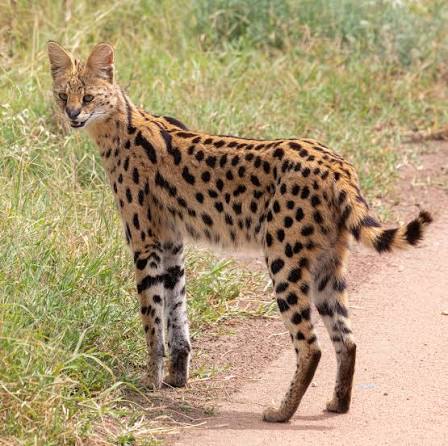
The serval is the most leg-dominated cat in Africa. Its legs are proportionally longer relative to body size than those of any other wild cat on the continent. Standing 60 centimetres at the shoulder with a body that weighs only 9 to 18 kilograms, the serval looks as if it were assembled from the parts of a much larger animal. This body plan is not aesthetic accident it is a highly specific hunting tool built for one of the most consistent and successful ambush strategies in the cat family.
What Is a Serval?
The serval, Leptailurus serval, belongs to the family Felidae. It is the sole member of its genus. An adult male weighs between 9 and 18 kilograms. Females weigh 7 to 12 kilograms. Body length reaches 67 to 100 centimetres. The tail is relatively short 24 to 45 centimetres and the legs take up a disproportionate fraction of the total body height. The coat is tawny-yellow with black spots and stripes. The spots are relatively large on the back and flanks, breaking into smaller spots on the lower flanks and legs.
The ears are enormous relative to skull size. Large, oval, and very mobile, they can rotate independently toward different sound sources simultaneously. The serval’s ears are the largest ear-to-head ratio of any cat. They are the primary sensory organ in hunting the serval locates prey by sound before it uses its eyes to acquire a visual target.
The Hunting Technique: Sound Location and the High Jump
The serval’s hunting technique is unlike any other African cat. It walks slowly through tall grass or wetland vegetation, ears rotating and scanning. When it hears a rodent moving in the grass below the visible surface, it freezes and orients with pinpoint precision toward the sound. It then leaps — straight upward, 1 to 2 metres into the air and drops both forepaws down onto the exact spot where the rodent was heard. The paws land like a double hammer blow on the grass surface.
This high-jump hunting technique penetrates the grass canopy and drives the forepaws through dense vegetation to pin prey at ground level without the need to see it. Success rates for this technique are around 50 percent extraordinarily high for a cat hunt. The serval eats more rodents per unit of time than any other East African carnivore. Research from the Serengeti found that a serval may eat 12 to 15 rodents in a single night’s hunting.
Long Legs: Function Beyond Hunting
The leg length serves multiple purposes beyond the hunting jump. The serval moves through wetland vegetation with its belly above the waterline the long legs keep the body dry while the feet are placed on submerged substrate. This allows hunting in reed beds and papyrus margins where water is shallow. The elevated body also increases the field of view above tall grass, helping the serval detect both prey and approaching predators from further away than a shorter-legged cat could manage.
The leg length also improves the serval’s ability to peer over grass on its hindlegs a surveillance posture used regularly in tall grassland habitat. A serval standing on its hindlegs with its forelegs hanging free scans the savanna at eye height well above the grass, then drops back to all fours when it detects something worth approaching.
Habitat and Range in East Africa
Servals are closely tied to wetland edges and tall grassland near permanent water. They do not venture far from water and are rare in dry, open savanna away from drainage lines. In East Africa, the Maasai Mara’s Mara River margins, the wetlands of Uganda’s Queen Elizabeth National Park, and Tanzania’s Ngorongoro Crater floor are among the most reliable sites. The Crater’s high productivity and moderate predator pressure provides excellent conditions for serval hunting along the swamp margins.
Serval and Cheetah: Similar but Separate
Visitors occasionally confuse servals with young cheetahs. Both are spotted, mid-sized cats. The field separation is straightforward: the serval has disproportionately long legs, a very short tail, and enormous ears. The cheetah has a long tail with a white tip, smaller ears, and the distinctive black teardrop face markings. The serval is a solitary cat that rarely ventures onto open plains. The cheetah is an open-country specialist that rarely enters dense wetland vegetation.
Plan Your Safari
The Ngorongoro Crater is the most reliable serval location in East Africa. The crater floor’s swamp margins, particularly around Gorigor Swamp and Mandusi Hippo Pool, produce regular serval encounters. Uganda’s Queen Elizabeth National Park wetland edges and the Maasai Mara’s Mara River banks are also productive. Early morning drives beginning before 7 am catch servals still active from their overnight hunting, often sitting in grass or moving along drainage lines before the day heat drives them into shade.
African Wild Trekkers designs East Africa safari itineraries that include time in the wetland habitats where servals are most consistently found. Contact us to plan a safari that targets this elegant and distinctive cat.