Striped Hyena Africa: The Secretive Scavenger of East Africa’s Dry Zones
The striped hyena is Africa’s most overlooked large carnivore. It is present across East Africa’s drier zones from Kenya north through Ethiopia and the Horn. nocturnal, shy, and solitary the opposite of the spotted hyena’s loud, social clan life. It scavenges efficiently and supplements its diet with small prey, fruit, and insects. And despite being a genuine hyena, it is so unlike its more famous relative that safari visitors who encounter it frequently mistake it for something else entirely.
What Is a Striped Hyena?
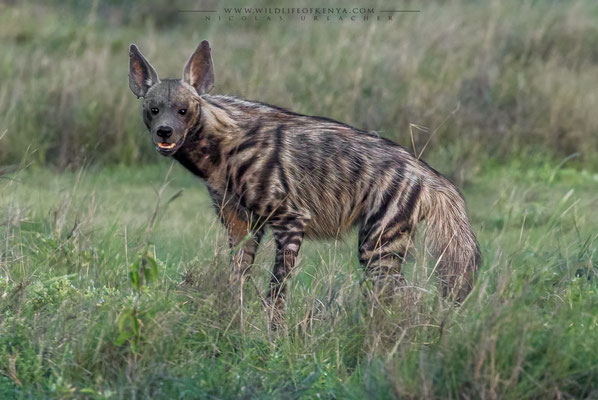
The striped hyena, Hyaena hyaena, is the most geographically widespread hyena species, ranging from North Africa and the Middle East east to India. It is smaller than the spotted hyena an adult weighs between 22 and 55 kilograms. Body length reaches 1 to 1.15 metres. The coat is pale grey-yellow with vertical black stripes on the flanks and neck. The legs carry horizontal black bands. A prominent black-tipped mane of longer hair runs from the back of the head to the mid-back.
The mane is the striped hyena’s most dramatic feature. When the animal is threatened or alarmed, the mane erects fully, doubling the apparent size of the body profile. This threat display serves the same function as the spotted hyena’s intimidation behaviour but is even more exaggerated relative to the animal’s actual size. A fully mane-raised striped hyena facing a threat looks nearly twice its actual body width.
Solitary and Nocturnal
Unlike the spotted hyena’s large clan system, striped hyenas live solitarily or in small family groups of 1 to 4 individuals. They do not maintain defended clan territories. Instead, individual home ranges overlap with those of multiple other individuals without the organised boundary marking and collective territorial defence seen in spotted hyenas. Social interactions between individuals are relatively rare and mostly peaceful avoidance rather than competition.
Striped hyenas are strictly nocturnal. Daytime sightings are unusual and generally indicate an injured or disturbed animal. Night drives in their preferred habitats dry scrub, thorn bush, rocky terrain produce sightings, but the animals flee rapidly from vehicle approach. Finding a striped hyena requires slow driving and a spotlight covering the road margins carefully. The eye-shine is greenish-white and visible from 60 to 80 metres.
Diet and Foraging
The striped hyena is primarily a scavenger. It covers large distances nightly to investigate carcasses detected by smell. In areas with domestic livestock, it preys on weak or dying animals and scavenges livestock carcasses near villages a foraging strategy that brings it into direct conflict with pastoralist communities. It also eats fruit, insects, small vertebrates, and carrion from any available source.
The striped hyena’s jaw musculature and cheek teeth are designed for bone crushing the same dental adaptation that characterises the spotted hyena. Bone provides valuable calcium and marrow fat from carcasses that other scavengers have already stripped of meat. The bone-crushing ability allows the striped hyena to extract nutrition from carcasses long after most other scavengers have finished.
Range in East Africa
Striped hyenas occur in Kenya’s dry north the arid and semi-arid zones of Marsabit, Turkana, Mandera, and the Kerio Valley. They are present but uncommon in Ethiopia’s lowland zones. In Tanzania they occur in the dry central and northern zones. They are absent from the wetter, denser habitats where spotted hyenas dominate. The two species do not coexist comfortably spotted hyenas compete the striped hyena out of most habitats where the two overlap.
Plan Your Safari
Striped hyenas are not a target species for most East Africa safari itineraries. They require dedicated night drive time in the right dry-country habitat and a high tolerance for low success rates. Kenya’s Samburu ecosystem and the Lake Turkana region are the most productive areas. Any dedicated night drive programme in northern Kenya’s arid zones should produce striped hyena encounters over a multi-night stay. Visitors to Ethiopia’s Harar where striped hyenas are famously fed by local tradition each night outside the old city walls can observe them at close range in a unique cultural wildlife context.
African Wild Trekkers builds Ethiopia and northern Kenya itineraries for wildlife visitors interested in East Africa’s more unusual and secretive species. Contact us to plan a safari that targets the region’s overlooked carnivore diversity.