Uganda Kob Facts: The National Symbol of Uganda and Its Open Floodplain Kingdom
The Uganda kob appears on Uganda’s coat of arms. The country chose this medium-sized antelope to represent itself. It is the most numerous large mammal in Uganda’s open floodplains. On the Ishasha and Mweya peninsulas of Queen Elizabeth National Park, kob herds dominate the grassland. Their rutting behaviour — a competitive lek system unique among African antelopes makes them one of the continent’s most interesting ungulates to observe.
What Is the Uganda Kob?
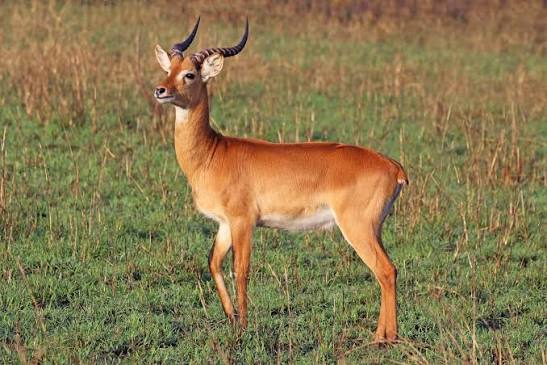
The Uganda kob, Kobus kob thomasi, is a subspecies of the kob a medium-sized antelope in the reedbuck-waterbuck family. Adult males weigh between 94 and 121 kilograms. Females weigh 63 to 77 kilograms. Shoulder height reaches about 90 centimetres. Only males carry horns S-curved, ringed, and reaching 40 to 69 centimetres. Males are tawny-orange; females are paler. The face carries white eye rings, white inner ear linings, and white chin and throat patches. A black line runs down the front of each foreleg.
Kob are closely related to the puku a similar antelope found in Uganda’s Albertine Rift wetlands and in Zambia. Their build is robust and rounded. Compared to the impala, kob lack the black side stripes and black-tipped tail.
The Lek System: One of Africa’s Most Remarkable Breeding Behaviours
The Uganda kob’s mating system is a territorial lek — a concentrated arena of small, closely packed male territories where females come to mate. Each lek covers roughly 200 by 200 metres. Within it, 30 to 40 males hold tiny individual territories of 15 to 20 metres in diameter. Males display constantly, driving off rivals with horn-clashing rushes. Females move through the lek and select mates. The most central territories attract the most female visits.
This lek system parallels the lekking behaviour of certain grouse and birds-of-paradise. Most antelopes defend dispersed territories. The Uganda kob concentrates all competition into one arena, creating a spectacle of sustained male-male interaction visible from a game drive vehicle.
Floodplain Habitat
Uganda kobs graze on short-to-medium open grassland near permanent water. They drink daily. The floodplains of Uganda’s Albertine Rift around Lake Edward, Lake George, and the Kazinga Channel support the highest kob densities. Queen Elizabeth National Park’s Ishasha sector and Mweya peninsula hold the country’s most accessible populations. Murchison Falls floodplains north of the Albert Nile also carry large kob numbers.
Kob do not migrate seasonally like wildebeest. Their association with permanent water keeps them as year-round residents of floodplain ecosystems. Short movements between wet-season and dry-season grazing areas occur within relatively short distances.
Predators and Prey
Lions are the primary kob predator in Uganda’s open ecosystems. Lek concentrations create predictable hunting sites lions learn these locations and hunt them at dawn and dusk. Leopards take individual kobs, particularly at night near water. Spotted hyenas and African wild dogs pursue kobs on open floodplains where sustained chasing is possible. Crocodiles take kobs at water crossings along the Kazinga Channel and Nile tributaries.
Plan Your Safari
Queen Elizabeth National Park offers the best Uganda kob watching in East Africa. Mweya peninsula drives produce kob herds in the hundreds. Active leks on the Ishasha floodplains are visible from the vehicle during morning hours. The Kazinga Channel boat safari passes kob herds drinking at the channel margin — a water-level perspective the vehicle cannot match. Murchison Falls National Park’s northern savanna produces excellent kob sightings alongside Uganda’s other key large mammals.
African Wild Trekkers designs Uganda safari itineraries around Queen Elizabeth and Murchison Falls. Contact us to plan a Uganda safari that explores the full range of savanna and forest wildlife.