Marsh Mongoose Africa: The Amphibious Hunter of East Africa’s Wetland Margins
Most mongoose species live in dry savanna, rocky hillsides, or woodland. The marsh mongoose took the family’s characteristic opportunism and applied it to an entirely different environment. Rivers, streams, lakes, papyrus swamps, and flooded margins are its habitat. It swims readily, dives for prey, and uses flexible, sensitive paws to feel for crabs and frogs under water and in mud. No other East African mongoose has genuinely colonised the wetland edge as its primary habitat. That specialisation makes it one of the most distinct and least studied mongooses on the continent.
What Is a Marsh Mongoose?
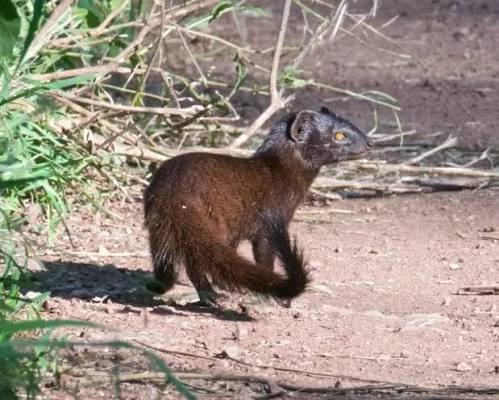
The marsh mongoose, Atilax paludinosus, is a large, robust mongoose. Adults weigh between 2.5 and 4.1 kilograms second only to the white-tailed mongoose among Africa’s mongoose species. Body length reaches 45 to 62 centimetres with a tail of 30 to 50 centimetres. The coat is dark brown almost black in some individuals and coarse in texture. A pointed face and relatively small eyes suit a hunter that relies more on touch and smell than on sight. The paws are unwebbed but highly flexible, with long, independently mobile fingers capable of feeling under rocks and into crevices with precision.
Dark brown camouflage suits the reed, papyrus, and floating vegetation margins of the wetland habitat. The lack of webbing on the paws distinguishes the marsh mongoose from the Cape clawless otter and reflects the difference in hunting style the marsh mongoose wades and swims dog-paddle style, using its paws for prey manipulation rather than propulsion.
Wetland Edge Specialisation
The marsh mongoose is never far from water. It forages along river banks, lake shores, and the margins of swamps and papyrus beds. The foraging technique is distinctive it walks slowly along the water’s edge with its muzzle close to the surface, plunging its head and paws under to feel for prey in the shallows. Crabs and frogs it grabs with both paws and carries to shore to eat. No other African mongoose forages this way.
In areas with abundant crabs the Kazinga Channel, Lake Victoria’s rocky shores, Uganda’s national park rivers the marsh mongoose achieves high catch rates from waterside foraging. Crab cracking mirrors the Cape clawless otter’s technique: carry the crab to a flat rock or firm bank and hammer it against the surface to break the shell.
Nocturnal and Secretive
The marsh mongoose is nocturnal and highly secretive. Its association with dense waterside vegetation — papyrus, reeds, and riparian scrub — means that even in well-visited areas it is rarely seen. Most sightings come from night drives along river banks, boat safaris passing close to swamp edges, and the occasional individual crossing a road near a watercourse at dawn. The loud alarm bark, produced from dense vegetation on a river bank, is more often heard than the animal is seen. Identifying a marsh mongoose by call alone is a common East Africa night experience for anyone spending time near wetland habitats.
Plan Your Safari
Uganda’s Kazinga Channel boat safari and Murchison Falls National Park river drives are the most productive East Africa locations for marsh mongoose sightings. The boat safari, travelling at slow speed along the channel’s papyrus margins at dawn or dusk, produces sightings of marsh mongooses on exposed root tangles and low banks with some regularity. Rwanda’s Akagera National Park’s lake and swamp system also provides suitable marsh mongoose habitat. The right habitat, the right time of day, and patient slow movement produce results that fast game driving never does.
African Wild Trekkers designs Uganda and Rwanda safari itineraries that include quality boat and wetland experiences. Contact us to plan a safari that captures East Africa’s waterside wildlife.