Spotted-necked Otter Facts: The Freshwater Predator of East Africa’s Lakes
The spotted-necked otter is the most aquatic otter species in East Africa. It spends almost all of its active time in water — hunting, socialising, resting on floating vegetation, and playing in lake shallows. The Cape clawless otter, Africa’s other common freshwater otter, uses both riverine banks and open water. The spotted-necked otter orients its entire existence toward the open water of East Africa’s Rift Valley lakes. Spotting one requires looking outward from the lakeshore rather than along the bank — a small dark head moving through ripples, or a group rolling and diving in the morning shallows, is the typical first encounter.
What Is a Spotted-necked Otter?
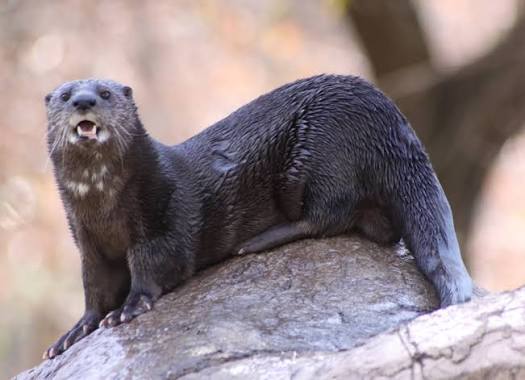
The spotted-necked otter, Hydrictis maculicollis, is a medium-sized freshwater otter. Adults weigh between 3 and 5.7 kilograms. Body length reaches 57 to 76 centimetres with a flattened muscular tail of 30 to 44 centimetres. The coat is dark chocolate brown on the back, paling to reddish-brown on the flanks and underside. The throat and chest carry the defining feature — irregular white or pale yellow spots and blotches on a dark background, varying significantly between individuals. These spots provide individual identification in research populations. The feet carry small webbing between the toes — less extensive than the Cape clawless otter’s fully webbed feet. Small sharp claws on the digits grip slippery fish during capture.
Fish Hunting in Open Water
Spotted-necked otters hunt fish almost exclusively. Cichlids, catfish, and other freshwater fish in East Africa’s Rift Valley lakes constitute the primary prey. A hunting otter dives from the surface, using underwater vision and sensitive whiskers to track fish movement in clear water. The otter’s streamlined body and powerful tail drive rapid underwater acceleration. Fish catches generally involve a short pursuit to within grab range followed by a rapid bite or forepaw grab. The otter surfaces to consume large fish, using the forepaws to hold and tear the fish. Small fish disappear underwater before the otter resurfaces.
Groups hunt cooperatively, driving fish shoals into shallow areas where individual pursuit success improves. This group hunting strategy improves caloric return per individual compared to solitary hunting on dispersed fish in open water.
Social Groups and Lake Territories
Spotted-necked otters live in family groups of two to six individuals — a mated pair and their offspring from successive litters. Groups occupy a lake territory of one to several kilometres of shoreline and associated open water. Territory marking uses spraints — scent-marked droppings deposited on prominent rocks, fallen logs, and reed bases at territory boundaries. Group members vocalise constantly during social interactions — squeaks, chirps, and high-pitched calls maintain contact while members dive independently in open water.
Range in East Africa
Spotted-necked otters occupy the clear-water Rift Valley lakes of Uganda, Rwanda, Tanzania, and Kenya. Lake Victoria’s margins, Lake Edward, Lake George, Lake Kivu, Lake Tanganyika, Lake Malawi, and the smaller Rift Valley crater lakes all hold populations. Clear water with accessible fish populations is the critical habitat requirement. The species avoids turbid, heavily fished lake margins and rivers with poor water quality.
Plan Your Safari
Uganda’s Kazinga Channel boat safari in Queen Elizabeth National Park delivers spotted-necked otter sightings regularly — the channel’s clear water and abundant fish support resident otter groups visible from the water surface. Rwanda’s Lake Kivu shoreline and the smaller crater lakes in western Uganda produce sightings on guided lake walks. Tanzania’s Lake Tanganyika and the lake margins of Gombe Stream and Mahale produce otter encounters on chimpanzee destination add-on days. Dawn boat excursions, when otters are most active before the midday fishing lull, produce the most reliable sightings.
African Wild Trekkers includes Kazinga Channel boat safaris in Uganda itineraries and designs lake margin experiences across the Rift Valley circuit. Contact us to plan a safari capturing East Africa’s freshwater wildlife alongside the savanna species.