Pied Kingfisher Fishing: Master of the Hovering Dive in East Africa
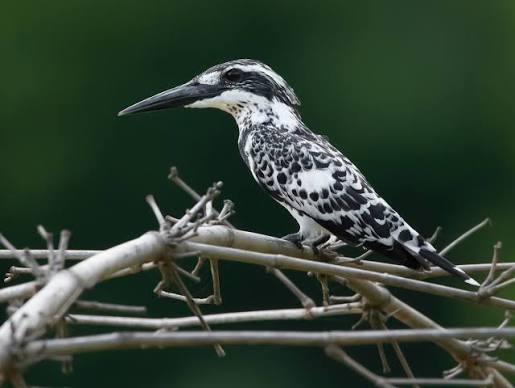
The pied kingfisher is the world’s most commonly observed kingfisher species. It is also the only kingfisher that hunts entirely by hovering over open water rather than diving from a fixed perch. This hovering hunting method allows the pied kingfisher to exploit open water areas far from shore where no perch is available. No other kingfisher species in Africa can feed effectively in the open water environment that pied kingfishers use as a primary hunting zone.
Across East Africa’s lakes, rivers, reservoirs, and coastal lagoons, the sight of a pied kingfisher hovering 5 to 10 metres above the water surface with its bill pointed downward is one of the region’s most familiar waterside wildlife images. The combination of the hovering technique, the black and white plumage, and the rapid, direct flight between hovering positions makes this bird one of East Africa’s most visible and active waterbirds.
The Hovering Technique
A pied kingfisher enters a hover by beating its wings rapidly at approximately 8 to 9 wingbeats per second while holding its body at a downward angle. The head remains virtually stationary relative to the ground as the wings compensate for wind and turbulence. This head stability is essential. It allows the bird to maintain a fixed visual focus on a fish below without the image moving on the retina.
The hover is maintained for 5 to 15 seconds while the bird assesses the prey’s position and depth. When the bird judges the moment correct, it closes its wings and plunges toward the water in a steep dive.
The plunge itself is rapid. The bird enters the water at an angle, submerges briefly, and emerges with the fish held in the bill. It returns directly to a perch or continues hovering to consume the fish at a nearby branch. The hunting success rate is approximately 50 percent per dive, which is high for a pursuit predator.
Colonial Behaviour
Pied kingfishers are unusual among kingfisher species in breeding colonially. Large breeding colonies of 50 to 200 pairs nest in tunnel burrows in sandbanks or earthen cliffs above or near water. Colony sites are used repeatedly across multiple breeding seasons.
The species also roosts communally outside the breeding season. Roost gatherings of hundreds of individuals assemble in reedbeds and waterside trees at dusk. The evening pre-roost gathering, when hundreds of pied kingfishers circle a roost site in fast, chattering flocks before settling for the night, is one of East Africa’s most spectacular small bird aggregations.
Furthermore, the species exhibits cooperative breeding behaviour. Non-breeding males help dominant pairs raise their chicks by delivering food to the nest. These helper males are typically young males from the previous year’s brood who have not yet established their own breeding territory.
Where to Watch Pied Kingfishers in East Africa
Pied kingfishers are abundant throughout East Africa wherever open freshwater exists. Lake Victoria’s shores, the Nile River corridor, Kenya’s Rift Valley lakes, and Tanzania’s coastal lagoons all carry large pied kingfisher populations. The species is one of East Africa’s most reliably encountered waterbirds regardless of the specific destination.
Lake Naivasha in Kenya’s Rift Valley provides particularly productive pied kingfisher watching from boat trips on the lake. The combination of open water for hovering and papyrus-fringed margins for perching creates ideal habitat conditions. Multiple individuals hover simultaneously over different sections of the lake surface, creating a continuous spectacle of hunting activity.
Plan Your Birding Safari
Pied kingfisher watching requires no specialist birding access in East Africa. The species is present at virtually every open freshwater body in the region. Any boat trip on a lake, river, or coastal lagoon produces close-range hovering and diving activity throughout the session.
For the most intense pied kingfisher experience, Lake Naivasha’s boat trips combine dozens of simultaneously hunting individuals with the lake’s other waterbird diversity in a productive 90-minute session.
African Wild Trekkers includes lake and river boat activities in East Africa birding safari itineraries for maximum waterbird encounter density. Contact us to plan a safari that captures the full spectrum of East Africa’s extraordinary kingfisher diversity.